
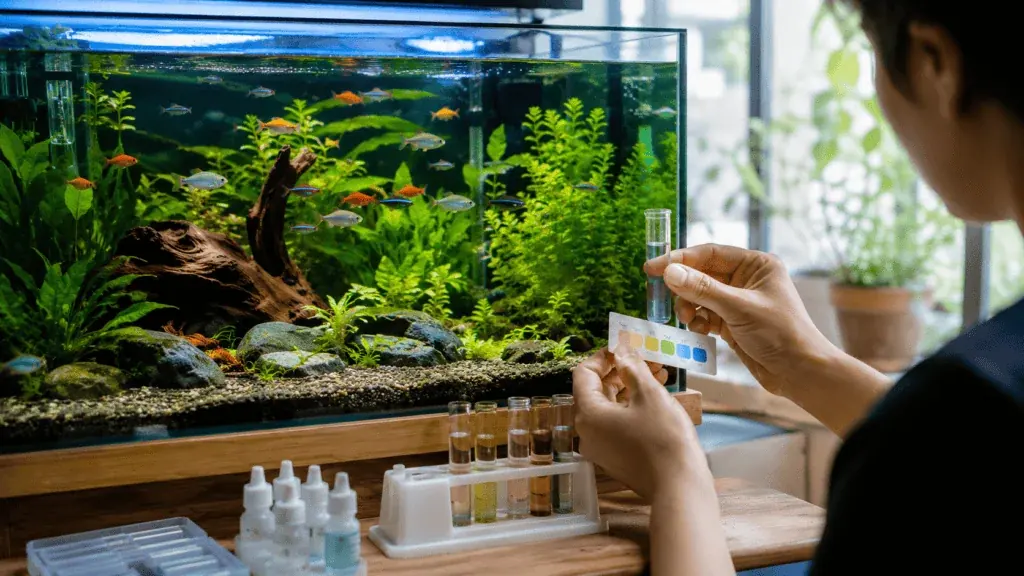
One of the most frequent problems that new aquarium owners have is changing the water chemistry by a pH swing of only 0.3 in one hour, which can cause a shock to sensitive fish. If your test kit is showing a high reading and your fish are gasping and losing color, you’re probably looking for a way to decrease the pH in the aquarium water without causing additional harm or expense.
The good news: There is a way to safely reduce pH without causing any problems, and it is easier than you might think. You will learn the actual causes of pH swings, the safest natural and chemical solutions to lower the pH, dosing tips, species-specific targets for bettas, axolotls and reef tanks, and how to maintain pH stability over the long term rather than trying to correct it weekly.
Understanding Aquarium pH
What Is Aquarium pH and How Is It Measured
PH is a scale between 0 and 14 that indicates acidity/alkalinity, with a neutral pH being 7.0. Testing KH (carbonate hardness) along with pH is most important, and liquid reagent test kits are more accurate than strips, with high KH resisting fluctuations in pH, and low KH allowing pH to wildly fluctuate. Changing the pH of aquarium water without first checking KH is like driving around without brakes.
Ideal pH Ranges by Species
| Tank Type | Ideal pH | Notes |
| Community freshwater | 6.8–7.6 | Tetras, livebearers, corydoras |
| Betta tank | 6.5–7.5 | Tolerates a range if stable |
| Axolotl tank | 7.4–7.6 | Sensitive to swings |
| Planted tank | 6.2–7.0 | CO2 injection lowers pH |
| Goldfish tank | 7.0–8.4 | Prefers harder water |
| Reef/saltwater | 8.1–8.4 | Very sensitive to change |
What Causes pH to Drop in Aquarium Water
Of the “low pH” cases, about half are normal biology (bacteria producing acid to convert ammonia to nitrate), CO2 buildup (due to respiration or injection), tannins from driftwood, and decaying overfeeding waste (low-KH source water).
Symptoms of Low pH in a Fish Tank
Signs of Stress
It’s not the number that kills fish; it’s the rate of change, or secondary effects such as ammonia toxicity. Look for clamped fins, loss of colour, surface gasping, erratic swimming, or hiding. If the sudden drop is below 6.0, this indicates a KH collapse, and should be addressed immediately.
Betta vs. Community Tanks
Bettas are more tolerant of low pH in a betta tank than in a community tank, because they are native to soft, acidic water and will tolerate 6.0-6.5 if the pH is stable. Shrimp and snails require calcium to form shells, and thus have a narrower range of KH in mixed tanks.
Axolotl and Aeration Tanks
Exposed gills are stressed by low pH (below 7.0) in an axolotl tank; axolotl keepers are more likely to need to increase the pH than decrease it. Low pH typically is a result of CO2 accumulation in aeration tank systems as a result of poor gas exchange in high stocking situations, which is corrected in a timely fashion by increasing the surface agitation, rather than any additive.
How to Lower pH in Aquarium Naturally (Without Chemicals)
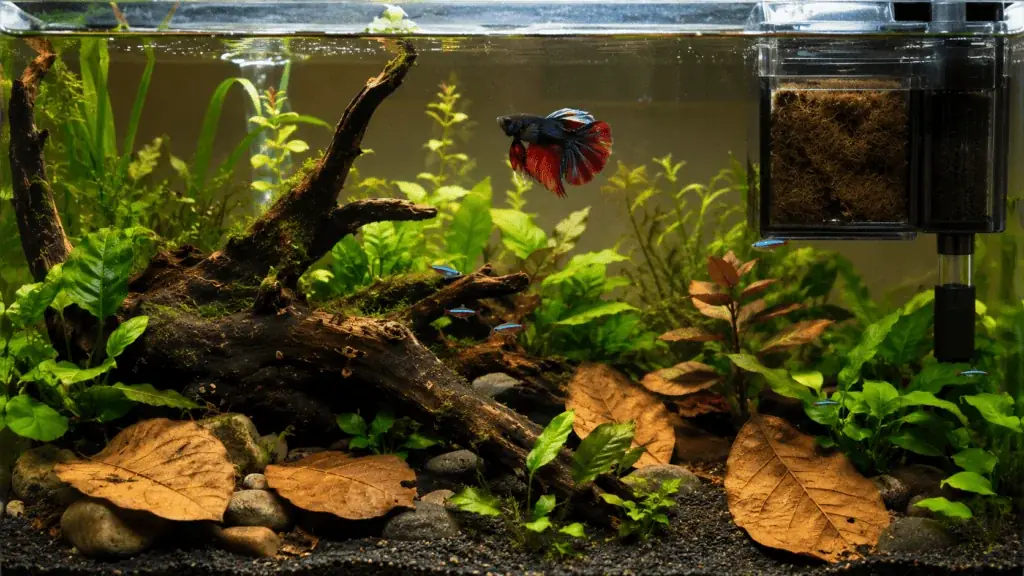
Driftwood, Peat Moss, and Almond Leaves
Untreated driftwood will release tannic acid, which will slowly lower the pH in 1-3 weeks (boil it first to minimize colouring). Peat moss and Indian almond leaves both have the same effect, filtering the water while also providing some mild antibacterial properties; these are used by betta and shrimp owners.
Do Plants Lower pH in Aquarium Water?
Yes, indirectly. Plants absorb CO2 by day and release it at night, so planted tanks often dip 0.5–1.0 lower than bare tanks, with normal day-night fluctuation of about 0.3–0.5 points.
How to Soften Aquarium Water Naturally
Knowing how to naturally soften aquarium water is more important than going after a pH number since KH is what leads to stability. Hardness can be reduced by diluting with RO or distilled water, using driftwood, and avoiding crushed coral, none of which will cause rebound spikes as will chemicals.
How to Lower pH in Aquarium With Chemicals
Commercial pH-Down Products and RO/DI Water
PH Down” products are based on acid buffers and are designed to produce a rapid, controlled decrease, but may rebound if KH is sufficiently high to counteract the pH change. Advanced keepers use RO/DI water dilution because it eliminates the buffering minerals at the source instead of covering them up.
Vinegar to Lower pH in Aquarium Water
Diluted white vinegar will decrease pH, but it’s unbuffered and will dissipate in a day or two, requiring more frequent doses than a consistent, slightly higher reading will, which will cause more stress on the fish. Use it in emergencies only.
Does Baking Soda Lower pH in Aquarium Water?
No, this is a popular misconception. Baking soda raises pH and KH; it works in the opposite direction. If you want to lower the pH, steer clear of it altogether.
How to Lower pH in Aquarium Quickly and Safely
Step-by-Step and Safe Rate of Change
- Check pH, KH and GH before making any changes.
- Determine the cause (source water, decor, stocking, CO2).
- Use only one technique – not a mixture of chemical and natural techniques.
- Make gradual changes and retest after 12-24 hours.
- Monitor for 1 week, and if no problems are found, call it stable.
The recommended safety level is 0.2-0.3 pH points per 24 hours. Fish can adapt over days, not minutes, and a series of small steps will be safer than one big dose.
Comparison Table: Natural vs. Chemical Methods
| Method | Speed | Stability | Rebound Risk | Best For |
| Driftwood | Slow (1–3 wks) | High | Low | Aquascapes |
| Peat moss / almond leaves | Slow-moderate | High | Low | Betta, shrimp tanks |
| RO/DI dilution | Moderate | Very high | Very low | Precise control |
| Commercial pH-Down | Fast | Moderate | High if KH is high | Emergencies |
| Vinegar | Fast, temporary | Low | High | Short-term only |
pH Drop in Aquarium During Cycling
During cycling, the pH will be reduced as the nitrifying bacteria will use up the carbonate buffering as they convert ammonia to nitrate, which will gradually lower the pH. Usually settles in a week after both ammonia and nitrite are at zero; do not change pH chemically during the cycle.
If pH drops below 6.0, reverse course: crushed coral or a buffered pH-up product is required to get KH back up to a point where bacteria can still function – very low pH can stop the cycle altogether.
Saltwater, Reef, and Aeration Tank pH
Ideal pH for a Reef Tank
Coral calcification is dependent on a steady alkalinity and reef tanks require an 8.1–8.4. The pH is not deliberately lowered by reef keepers; it is usually controlled in conjunction with alkalinity (dKH) and calcium levels through reactors or two-part dosing.
How to Increase pH in a Saltwater Aquarium
In most cases, it is necessary to increase the pH value, rather than decrease it. The first steps are usually to improve surface agitation, protein skimming, and to change to a higher alkalinity salt mix.
Goldfish Water Quality Basics
The goldfish actually like harder, more alkaline water (7.0-8.4) — closer to the “raise pH” than the “lower pH.” So, if you’re thinking about how to keep a goldfish in a bowl, the truth is, don’t, because bowls don’t have enough surface area to provide good oxygen exchange or filtration. Goldfish can be kept in filtered, cycled tanks as large as 20 gallons at 65–72°F, and the best water for goldfish is a moderately hard tap water, not soft RO water.
FAQ:
How can I lower the pH in my aquarium quickly?
Apply a commercial pH-down product or dilute the water with half RO water, no more than 0.2-0.3 pH point at a time. “Quickly” should still imply gradual doses over several days, not one big dose.
Does baking soda lower pH in an aquarium?
No. Baking soda will increase the pH and KH; not what you need. If lowering the pH is desired, use driftwood, peat moss, or RO water.
Will vinegar lower pH in a fish tank safely?
Yes, temporarily, but it does not last long and lasts for just a day or two, after which it wears off and needs to be redosed again and again. Most aquarists use it as a last resort, rather than a permanent solution.
Do plants lower pH in an aquarium?
Yes, indirectly, by the uptake and release of CO2 in photosynthesis. Heavy plantings and CO2 injection will typically keep the tank at a lower level and have a normal day/night swing of 0.3 to 0.5 points.
What’s the ideal pH for a betta tank?
Bettas will tolerate 6.5–7.5, and stability is more important than getting it exactly right, as they are native to soft, acid water.
Why does pH drop during aquarium cycling?
Nitrifying bacteria use up the carbonate buffering as they oxidize ammonia to nitrate. This is normal and typically clears up in a week when ammonia and nitrite levels return to zero.
How do I raise pH in an aquarium if it drops too low?
Use crushed coral, a buffered pH-up product, or increase surface aeration to remove excess CO2. If pH drops below 6.0, treat it immediately.
What’s the best pH for a reef or saltwater tank?
Alkalinity and calcium are used to achieve the balanced pH of 8.1-8.4 in reef and saltwater tanks, instead of pH additives.
Conclusion
Learning how to decrease pH in aquarium water comes down to three things: to treat the cause and not the symptom, to use natural remedies such as driftwood, peat moss, or RO water dilution to stabilize your aquarium in the long term, and to never drop the pH more than 0.2–0.3 pH points in 24 hours. Chemical products will be useful during emergencies, but they should be monitored more carefully and are more likely to have a rebound effect than patient, natural changes.
Test your KH and GH before any changes, monitor daily for a week, and adjust your target range to the species you are keeping; a betta, an axolotl, and a reef tank all require a different approach! Run a full water test now, and make gradual changes; don’t try to change to a “perfect” number overnight.
