
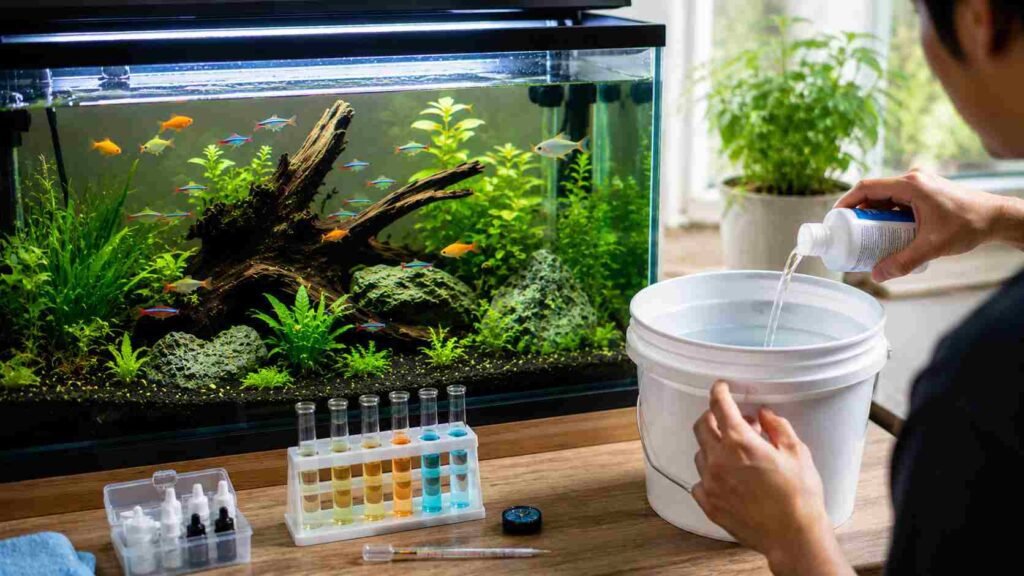
Every year, about 800,000 new fish deaths occur due to one cause: The wrong water. If you’ve ever wondered what kind of water to use for a fish tank, you are ahead of most new fish keepers since untreated tap water is the most common cause of death for first-week fish. The chlorine, chloramine, and heavy metals that are harmless to you can be fatal to your fish and kill the good bacteria your tank needs.
The great thing about picking and making the proper water is that it is not difficult once you know what your fish really require. You’ll discover the actual difference between tap, distilled, purified, spring, and well water, how to use water for your fish tank as a beginner, which water is best for both goldfish and betta fish, which water is best for community tanks, the best water temperature for each species, and how water selection affects the nitrifying bacteria that maintain a healthy fish tank.
1. Why the Water You Use Makes or Breaks Your Fish Tank
Fish don’t only swim in water; they breathe it, soak it up through their skin, and depend upon its precise chemistry to survive. Water problems do not lead to a gradual deterioration, but can lead to the death of a whole tank in hours.
Chlorine and Chloramine Are Silent Killers
Chlorine or chloramine is added to drinking water by the municipal water treatment plant to destroy bacteria. This is good for human safety, but is bad for fish scales because it removes the protective mucous layer, burns the delicate gill tissue, and wipes out the nitrifying bacteria colony that lives in your filter. Chloramine in particular is very dangerous because it is not removed by simply letting water sit out overnight, as chloramine does not evaporate like chlorine.
Chlorine vs. Chloramine: Why the Difference Matters
Many new aquarium owners think that all treated tap water is the same, but that’s not the case with chlorine and chloramine in the aquarium. The chlorine gases off naturally after 24-48 hours if water is left uncovered, so this is why older advice for fishkeeping was to “let water sit.” Most municipal water systems in the United States use a more stable mix of chlorine and ammonia called chloramine, which does not volatilize by itself and, even more problematic, if it does volatilize, it releases free ammonia directly into your tank. This is because the old “let it sit overnight” trick does not work with most tap water these days, and a suitable conditioner is the only reliable method of neutralizing it.
Heavy Metals and Hidden Contaminants
Tap water may contain trace amounts of copper, lead, or zinc, all of which are poisonous to fish at low levels, but harmless to people, depending on the age of your home’s plumbing and your municipality’s water supply. Shrimp and snail farmers are especially at risk with older homes using copper pipes, as the pipes can contain high levels of copper, which can affect invertebrates at much lower concentrations than fish. If you have shrimp, snails, or other invertebrates, a good water conditioner that is capable of removing heavy metals, in addition to chlorine, is worth the extra expense.
pH and Hardness Swings Stress Fish
Fish are tolerant of a narrow range of both pH and general hardness (GH). If you change water supplies (e.g., switch from tap water to bottled spring water) without acclimating your fish, it may suffer osmotic shock, a rapid change in water movement across the fish’s gill membranes as the fish tries to adjust to the new water. Symptoms may occur within minutes, including gasping at the surface, erratic swimming, or clamped fins. This is why knowing what kind of water fish tanks require isn’t merely about eliminating chemicals, but consistency from one water change to the next, not just getting one fill “right.”
Cloudy Water Is Often a Water-Source Problem
If you’ve been looking for the right water to use in a fish tank and you have noticed that there is still a lot of cloudiness, it is possible that the water source is the problem. This is most commonly caused by bacterial blooms due to overfeeding, but it can also be caused by mineral-rich tap water or new substrate not rinsed thoroughly or by topping off with distilled water only (disrupting the mineral balance the bloom was stabilizing on). Regular water changes, if properly treated, are generally the quickest solution.
2. What Type of Water to Use for a Fish Tank: Comparing Your Options
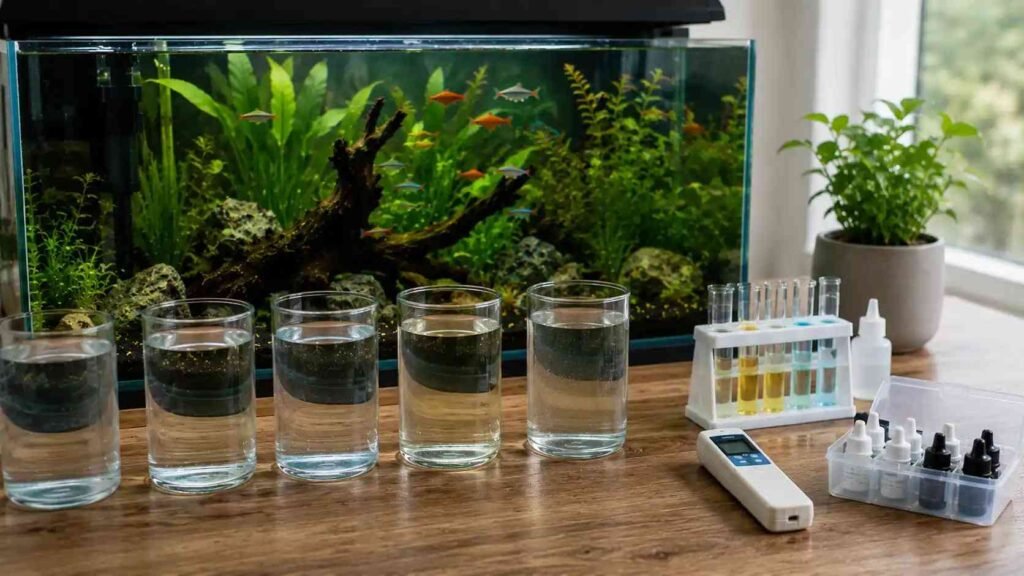
At some point, every hobbyist has to ask themselves what kind of water to use for a fish tank, with all the alternatives available at the store. Let’s take a look at the big picture of the major categories.
Tap Water
The most popular and cheapest option is tap water, and for most freshwater community tanks, it’s safe after treatment. Of course, it has minerals fish require for healthy bone and slime-coat development, a definite plus over purified options with only a few minerals. The problem is, it’ll always need to be dechlorinated using a water conditioner before it comes into contact with your tank.
Distilled Water
Distilled water is water that has been boiled and the steam condensed, thus eliminating virtually all minerals, chlorine, and contaminants. It is chemically “empty”—sounds safe, but is not: distilled water has no buffering capacity, and pH can drop at random. The distilled water used in a fish tank should only be remineralized with a specific mineral supplement; it is not a beginner’s choice of water.
Purified Water (RO and RO/DI)
Purified water for a fish tank is either reverse osmosis (RO) or reverse osmosis/deionization (RO/DI) water from which most minerals are removed, but where minerals can be added to a controlled level. For more advanced aquarists and those who breed sensitive species such as wild-caught tetras or discus, using purified water in fish tanks might be preferable as it allows them to have more exact control over the water chemistry. It’s generally too much for a beginner and an extra cost.
Spring Water
Bottled spring water is a convenient in-between option. It does not contain any chlorine or chloramine, so the “spring or distilled water for fish tank” argument is nearly always in favor of using spring water for casual use, since it still contains natural minerals like tap water. The drawbacks are that it is inconsistent (the content of minerals differs from brand to brand, and even from batch to batch of the same brand), and it is not economical for tanks of more than a few gallons.
Well Water
Many guides do not address well water for use in a fish tank. Well water is not chlorinated, so it may not contain any chemicals. Is well water safe for fish in all situations? Not automatically. Iron, sulfur, agricultural runoff nitrates, or dissolved gases (such as carbon dioxide) can be present in well water in variable amounts. It can cause the pH to drop after filling the tank. Can you use well water in a fish tank? Yes, but only after using a complete testing kit and allowing it to sit in an open container for 24 hours to off-gas before adding a conditioner as an extra precaution.
Should You Use Distilled or Purified Water for Your Fish Tank?
This is a very popular question in the hobby, and the truth is neither, by itself. Distilled and purified water do not contain the minerals the fish require and must be supplemented with a remineralizing product or treated tap water. Of the two, purified (RO/DI) water is the more suitable option as it makes more sense for larger tanks, and distilled water should be used only to replace water that has been lost due to evaporation in smaller tanks.
| Water Type | Contains Minerals? | Needs Treatment? | Best For | Cost |
| Tap Water | Yes | Dechlorinator required | Most freshwater community tanks | Lowest |
| Distilled Water | No | Remineralizer required | Evaporation top-offs, small tanks | Moderate |
| Purified (RO/DI) Water | No | Remineralizer required | Discus, shrimp, breeding, sensitive species | Moderate–High |
| Spring Water | Yes (varies) | Usually none | Small tanks, occasional water changes | Moderate |
| Well Water | Varies widely | Testing + conditioner required | Only after full water testing | Free–Low |
3. How to Prepare Water for a Fish Tank (Step-by-Step for Beginners)
Knowing how to prepare water for a fish tank for beginners comes down to four repeatable steps, whether you’re filling a brand-new tank or doing a weekly water change.
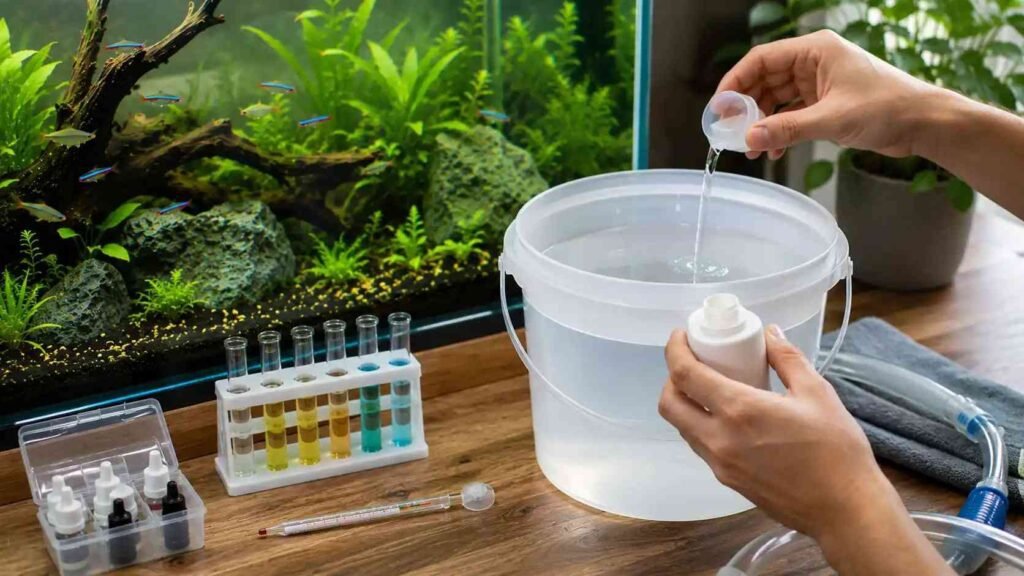
Step 1: Treat Tap Water With a Dechlorinator
The first step in understanding how to treat tap water for a fish tank. When using a liquid water conditioner (e.g., sodium thiosulfate), add it at the recommended dose (usually found on the bottle) to neutralize chlorine immediately and chloramine in about 60 seconds, and to neutralize trace heavy metals. Use the correct dosage for the total amount of water being added and round up, not down, if you do not know the exact number of gallons in your tank. This is the #1 cause of new-tank fish deaths.
Step 2: Match Temperature Before Adding Water
Even if chemistry is perfect, cold water shocks fish and can lead to disease outbreaks. When pouring in new water, try to match the temperature of the water in the tank within 1-2°F, particularly when changing water.
Step 3: Test and Adjust pH and Hardness
Test pH, GH, and KH using a liquid test kit prior to adding fish. Most freshwater species will be stressed by a change in pH of more than 0.3 pH points in one day. If your source water parameters are very different from your target range, add a small amount of source water to the existing tank water, not replacing all the water in the tank.
Step 4: Let Water Rest and Aerate
When using well water or water that has been transported from outdoors, letting new water sit for a few hours with an airstone running to stabilize the temperature and dissolved oxygen is helpful, even after dechlorination.
4. Best Water for Specific Fish Types
All species do not require the same needs. The following is a guide to the types of water suitable for different kinds of fish.
What Water to Use for a Fish Tank for Goldfish
Goldfish are messy, prolific waste producers and prefer slightly harder, alkaline water (pH 7.2-7.6). Most of the time, dechlorinated tap water is best because goldfish thrive on the natural mineral buffering that it provides and do not tolerate the instability of unsupplemented purified water well. Goldfish are particularly sensitive to ammonia, and you should focus on regular weekly water changes rather than “perfect” water quality.
What Water to Use for a Fish Tank for Betta Fish
One of the most common issues with fish tanks is what kind of water to use for the tanks when you own a betta fish. Betta fish are sold in very small cups, and it is not always easy to understand what kind of water you should use for them. Bettas prefer soft to moderately hard, slightly acidic to neutral water (pH 6.5 – 7.5). Most betta keepers use dechlorinated tap water and won’t use straight distilled or purified water for a betta unless it is remineralized because the complete lack of minerals can harm the betta’s sensitive fins and slime coat over time.
Freshwater Community and Planted Tanks
For a general freshwater fish tank, the answer to what water to use for a freshwater fish tank depends on how well your community’s fish tolerate a moderate range of pH and general hardness; most community species (tetras, guppies, corydoras) do well in the range of 6.8-7.8 pH and general hardness. The common practice of experienced planted-tankers is to use dechlorinated tap water, which may be supplemented with a small amount of RO water for soft water species.
Shrimp and Snail Tanks
Invertebrates should be given a special mention as they are not as tolerant as fish. Especially shrimp are susceptible to trace copper found in the tap water and to a sudden change in GH and KH during water changes. A mix of purified water and a shrimp-specific remineralizer is used by many shrimp farmers to achieve a precise and repeatable hardness, instead of using tap water.
5. Water Temperature for Freshwater Fish Tanks
When it comes to water quality and water temperature, they go hand in hand – wrong temperatures stress the immune systems and promote ammonia toxicity even in clean water.
Tropical Fish Aquarium Temperature
Most tropical species (tetras, guppies, angelfish, gouramis) require a relatively stable temperature of 75-80°F, which is controlled by a submersible heater and monitored with a good thermometer every day for the first few weeks of a new setup.
Goldfish and Coldwater Temperature Needs
Goldfish are coldwater fish, and they do best at 65-72°F. Running them warmer with a heater increases their metabolism, waste production, and reduces their lifespan.
Betta Temperature Requirements
Although sold in unheated cups in pet stores, Bettas are true tropical fish and need a constant temperature of 76-82°F. If the temperature drops below 74°F and is maintained for too long, the betta becomes lethargic, refuses food, and is vulnerable to fin rot and other bacterial infections.
6. Fish Tank Bacteria and Cycling Your Aquarium
Water chemistry and bacteria in fish tanks go hand-in-hand; the wrong water can kill the bacteria that keep your fish tank alive.
The Nitrogen Cycle Explained
All aquariums depend on nitrifying bacteria to transform the toxic ammonia (from fish wastes and uneaten food) to nitrite, and then to nitrate, which is much less toxic. Cycling takes 4-6 weeks in an empty tank, and is often the number one cause of fish losses in the first few weeks after the tank is first filled, not water alone.
Nitrifying Bacteria and Chlorine
When you add chlorinated tap water without a dechlorinator, it not only is bad for the fish, it is also bad for the nitrifying bacteria in your filter media, which resets your cycle and could cause a dangerous ammonia spike. One of the most neglected reasons for water preparation is not only at set-up, but also during routine maintenance.
Using a Fish Tank Bacteria Starter
If a fish tank bacteria starter (a bottle of live nitrifying bacteria) is used in combination with dechlorinated water and an ammonia source, then it can help to cycle a fish tank within a few days instead of weeks. This is particularly helpful for new users who would like to introduce fish to their systems sooner, or when using well water that may have more variable bacterial activity than treated tap water. Don’t use a shelf-stable product, as many “instant cycle” products sold at big box pet stores use bacteria species that are not well adapted to freshwater aquarium conditions. Use a product with live bacteria, not a dried or bottled product.
Water Changes During an Active Ammonia Spike
When having to deal with a water ammonia spike, avoid a single large water change, since more than 50% of the water change could cause the remaining bacteria colony to be shocked and extend the problem. Rather, make smaller water changes every day or two (20-25%) using properly conditioned water until ammonia and nitrite are both at zero on a test strip, then resume normal weekly water changes.
FAQ:
What kind of water do fish tanks need?
Fish tanks should be filled with dechlorinated water that has stable and moderate mineral levels and a pH range appropriate to the species to be housed. This is satisfied by straight tap water used in most freshwater tanks and, in sensitive or breeding tanks, by mixing purified water with a remineralizer for tighter control of water chemistry.
What bottled water can I use for a fish tank?
Natural spring water is the safest bottled water, as it does not contain chlorine and still contains minerals. Don’t drink flavored waters, mineral waters, or alkaline “enhanced” water; the additives in these waters may alter the pH. Distilled bottled water is only effective when remineralized before use, and purified drinking water should be labelled to check for added minerals.
What water can I use for a fish tank in an emergency?
Dechlorinated tap water is the quickest and safest emergency choice; if you are not sure of the dosage, overdosing conditioner is less dangerous than underdosing. If a conditioner is not immediately available, bottled spring water is a good alternative.
Can you use well water in a fish tank?
Yes, but after testing for pH, hardness, iron, and nitrates – well water quality is very different depending on where you live. Allow it to sit uncovered for 24 hours to off-gas carbon dioxide that may have dissolved in the water, and condition as a precaution before introducing fish.
Is well water safe for fish?
Yes, it can, but not necessarily. Well water can contain high levels of iron, sulfur compounds, or agricultural runoff that tap water does not. Test well water with a complete liquid test kit before using for the first time and retest periodically, as well; chemistry can change seasonally.
Should I use distilled or purified water for my fish tank?
Neither should be used in isolation — both are lacking in minerals fish require and need a remineralizing supplement. Purified (RO/DI) water is often used by the more advanced keeper and is considered to be more consistent and scalable, while distilled water should be used for evaporation only in smaller tanks.
How do I treat tap water for a fish tank quickly?
Feed liquid dechlorinator at the recommended rate; most modern conditioners will neutralize chlorine immediately and chloramine in about 60 seconds. This means that tap water can be used immediately for emergency top-ups, but it is best to match the temperature first.
How long should tap water sit before adding it to a fish tank?
Sitting time cannot be used as a substitute for a conditioner because chloramine, which is typically found in most municipal water supplies today, is not removed by letting the tap water sit. If it is left, aerate for several hours to help stabilize oxygen and temperature before addition.
Conclusion
While picking the right water is not the most thrilling aspect of fishkeeping, it is the most important decision for the success or failure of your tank. Three tips: dechlorinated tap water is the best option for most beginner fish and species such as goldfish and bettas, distilled and purified water should be remineralized, and temperature and pH are more important than “perfect” purity. Test your source water today, get a good conditioner, and provide your fish with a stable environment where they can not only survive, but thrive.
