
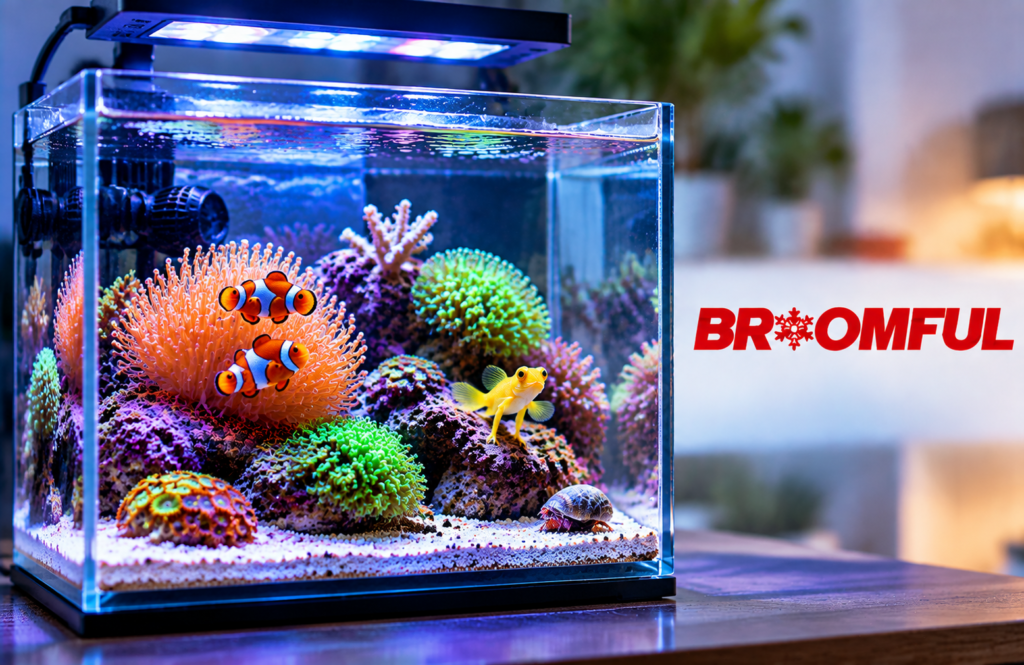
A 5-gallon aquarium holds only about 18.9 liters of water before rock, sand, and equipment displace part of that volume. That tiny water mass can make a marine tank surprisingly demanding: salinity rises quickly when freshwater evaporates, temperature changes faster than it does in a larger aquarium, and one extra feeding can have an outsized effect on water quality. So, can you actually keep saltwater fish for a 5 gallon tank responsibly? In a narrow set of cases, yes—but the list is much shorter than many “nano fish” roundups imply.
The most defensible choices are exceptionally small, low-activity microgobies, and even then a mature, stable tank and disciplined maintenance matter more than the label on the aquarium. Many reputable livestock sellers still list 10 gallons as the minimum for fish that stay around one inch long, which is important context before you buy.
In this guide you’ll learn which species are the strongest candidates, which popular fish should be avoided, how to build a stable 5 gallon saltwater tank setup, how freshwater and saltwater stocking differ, what changes at 10 gallons, how to shop for saltwater fish for sale, and how to decide whether a fish-free pico reef is actually the better display.
Can Any Saltwater Fish Thrive in a 5 Gallon Tank?
The short answer is: only a very small number of marine fish are plausible long-term candidates for an experienced keeper, and “possible” is not the same as “ideal.” A five-gallon system is usually better viewed as a pico reef, coral-and-invertebrate aquarium, or a specialty microgoby tank rather than a miniature version of a normal community aquarium.
Why a 5 Gallon Saltwater Tank Is Harder Than It Looks
Small tanks are attractive because they cost less to fill, fit on a desk, and make dramatic reef displays possible in a tiny footprint. But in marine fishkeeping, smaller water volume means less dilution. Temperature, salinity, pH, oxygen, and dissolved waste can all move faster than they do in a 20-, 40-, or 75-gallon system.
Evaporation is the clearest example. Salt does not evaporate with the water. If a true 5.0 gallons at 35 ppt salinity loses 0.25 gallon to evaporation, the remaining 4.75 gallons contain essentially the same amount of salt. In a simplified calculation, salinity rises to roughly 36.8 ppt—a change of about 5.3%. Rock and sand reduce the actual water volume further, so real-world percentage swings can be even larger. This is why topping off with fresh RO/DI water is a daily stability task, not an occasional chore.
The Merck Veterinary Manual also notes that home saltwater aquariums generally carry fewer fish than freshwater aquariums of the same size because saltwater contains less dissolved oxygen and marine fish can be more sensitive to crowding. Its broad starting guideline of roughly one inch of saltwater fish per five gallons is not a stocking formula, but it illustrates why a five-gallon marine tank has almost no biological margin for error.
Saltwater Fish for a 5 Gallon Tank vs Freshwater Fish
People searching “saltwater fish for a 5 gallon tank freshwater” are often comparing a familiar 5-gallon freshwater setup with a marine one. The comparison is useful because the same glass box behaves very differently depending on what you keep in it.
A freshwater 5-gallon aquarium can support certain solitary fish or small invertebrates because salinity is not part of the stability equation and freshwater species may tolerate different oxygen and waste conditions. Marine systems add salt concentration, higher equipment demands, different biological filtration expectations, and fish that often defend territories larger than their body size would suggest.
That is why “fish for 5 gallon tank” lists cannot simply be copied from freshwater guides. A one-inch marine goby that perches in rockwork is fundamentally different from a one-inch schooling fish that needs a group and horizontal swimming space. Adult length matters, but behavior, feeding style, territory, oxygen demand, and how much of the tank the fish actually uses matter just as much.
“Can Live” vs “Can Thrive”
A fish surviving for a few months does not prove that a tank size is appropriate. A better standard is whether the fish can display normal behavior, maintain body condition, feed reliably, avoid chronic territorial stress, and live without the keeper constantly rescuing water quality.
For a five-gallon saltwater aquarium, use four filters before calling a species suitable: it should remain genuinely tiny as an adult, spend most of its time perching or staying close to a small territory, accept foods you can deliver in tiny portions, and have a care history compatible with compact reef systems. Even then, compare the recommendation with reputable seller or breeder minimums. When those sources say 10 gallons, treat five gallons as an advanced exception—not the default.
Best Saltwater Fish for a 5 Gallon Tank
If you insist on keeping a fish in five gallons, the best candidates are microgobies that stay close to rockwork and typically reach around one inch. The following list is deliberately conservative. It separates “most plausible in a carefully managed pico tank” from species that are merely small enough to tempt you.
1. Trimma Gobies: The Strongest Pico Candidate
Trimma gobies are among the most compelling answers to the question of the best saltwater fish for a 5 gallon tank because many species remain around one inch and spend much of their time perching, hovering close to reef structure, or occupying small caves. Their limited roaming behavior is a better match for a pico footprint than the constant swimming of firefish, wrasses, or damsels.
A representative example is the red-spotted goby (Trimma rubromaculatus), which reaches about one inch. LiveAquaria describes it as peaceful and suitable for nano reef systems, but still lists a 10-gallon minimum. That tension is important: adult size makes Trimma one of the few fish that advanced pico keepers sometimes maintain in five gallons, yet mainstream husbandry guidance remains more conservative.
If you choose a Trimma for a five-gallon tank, keep one fish, not a mixed nano community. Provide porous live rock or mature biological media, shaded crevices, a tight lid, and small meaty foods. Because the fish is tiny, food size matters: finely chopped mysis, enriched baby brine shrimp, copepods, and appropriately sized frozen or prepared foods are more useful than large pellets.
The tank should be established rather than freshly cycled. Microgobies benefit from a mature rock surface that supports microfauna, and a mature system gives the keeper more confidence that ammonia processing is reliable. In a pico aquarium, stability is a husbandry feature.
2. Eviota Gobies: Tiny, Peaceful, but Feeding Matters
Eviota gobies are another group frequently discussed for ultra-small reef aquariums. Species such as the red neon Eviota goby and gold neon Eviota goby stay around one inch. Their size, peaceful temperament, and close association with rockwork make them far more suitable to a pico display than most marine fish.
However, “tiny” should not be translated into “effortless.” LiveAquaria lists 10 gallons as the minimum for both red neon and gold neon Eviota gobies and notes that they should receive small meaty foods, with the red neon Eviota listed as needing feeding twice per day. In five gallons, frequent feeding can conflict with water-quality control. That means the keeper has to balance enough nutrition for the fish with extremely disciplined portion size and export.
A single Eviota in a mature aquarium can make a beautiful specialty display because its scale matches the environment. Build the aquascape around the fish instead of trying to make the fish fit an existing coral garden. Leave small ledges, crevices, and low-flow resting zones, and avoid large or aggressive invertebrates that could prey on a tiny goby.
For beginners, a 10-gallon aquarium remains the safer recommendation. The extra water volume provides more time to notice feeding, salinity, or nutrient problems before they become emergencies.
3. Flaming Prawn Goby: Spectacular but Not Beginner-Friendly
The flaming prawn goby, also called the Griessingeri or spikefin goby (Discordipinna griessingeri), grows to roughly one inch and is one of the most visually striking saltwater fish under 2 inches. Its orange, cream, yellow, and brown markings look almost oversized on such a small body.
Its behavior, however, changes the recommendation. This is a cryptic fish that often stays deep in caves and crevices, and LiveAquaria rates its care as moderate, recommends a sandy or rubble substrate with abundant hiding places, and lists a 10-gallon minimum. It also benefits from high-quality small meaty foods such as brine shrimp, calanus, and rotifers, with twice-daily feeding noted as beneficial.
In other words, this is not a fish to buy just because it is one inch long. In a five-gallon specialty aquarium, an experienced keeper may be able to dedicate the entire system to one specimen, but a 10-gallon mature reef gives more flexibility for aquascaping, feeding, and water-quality control. The fish can also be so secretive that a five-gallon display built around it may still look “empty” for much of the day.
4. Quick Comparison: What Is Actually Suitable?
| Species | Adult Size | Typical Behavior | Mainstream Minimum | 5-Gallon Verdict |
| Trimma goby | ~1 in | Perches/hovers near rock | 10 gal | Most plausible for advanced pico keepers; one fish only |
| Eviota goby | ~1 in | Small-territory reef goby | 10 gal | Plausible only with excellent feeding and stability |
| Flaming prawn goby | ~1 in | Cryptic cave dweller | 10 gal | Advanced specialty option; 10 gal preferred |
| Yellow clown goby | ~1.5 in | Perches on coral/rock | 10 gal | Better in 10 gal; may nip SPS coral |
| Neon goby | ~2 in | Active cleaner goby | 10 gal | Better in 10 gal despite small adult size |
| Greenbanded goby | ~2 in | Hovers around rockwork | 10 gal | Better in 10 gal; more room improves behavior |
| Yasha goby | up to ~2.5 in | Burrow-associated shrimp goby | 10 gal | Not recommended for 5 gal |
| Panamic barnacle blenny | ~2 in | Crevice-dwelling ambush feeder | 10 gal | Better in established 10 gal or larger |
The key lesson is that the best saltwater fish for a 5 gallon tank are not simply the smallest fish in the store. The strongest candidates combine very small adult size with low activity and a compact natural territory. Even then, commonly published minimums often begin at 10 gallons.
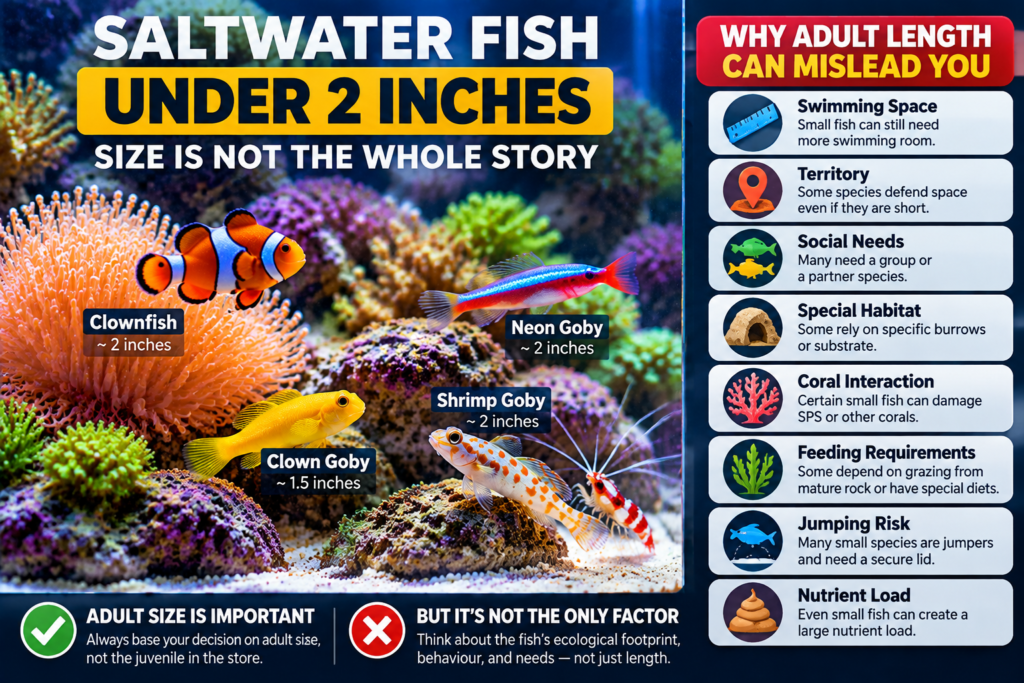
Saltwater Fish Under 2 Inches: Size Is Not the Whole Story
The phrase saltwater fish under 2 inches sounds like the perfect shortcut for stocking a pico aquarium. It is not. A fish can be short and still need more swimming space, a stable feeding environment, a social partner, a specific burrow, or enough territory to avoid chronic stress.
Why Adult Length Can Mislead You
Tank-size decisions should use adult size, not the size of the juvenile in a retailer’s display. But even adult size is only one dimension. A neon goby reaches only about two inches, yet it moves around the rockwork actively and is a cleaner species. A clown goby may stay around 1.5 inches, but it can interact closely with branching corals and may damage SPS tissue. A shrimp goby may spend much of its life near a burrow, but it needs appropriate substrate and can be difficult to feed if it hides constantly.
Think in terms of ecological footprint. How much territory does the fish defend? How far does it travel to feed? Does it need a group? Does it need a partner species? Does it rely on grazing from mature rock? Does it jump? Does it create a large nutrient load relative to its body size? These questions are more useful than “Is it under two inches?”
Species That Look Pico-Sized but Are Better in 10 Gallons
Several attractive fish fall into this category. Yellow, green, and black clown gobies remain small, but LiveAquaria lists 10 gallons as the minimum. The neon goby also tops out around two inches and is commonly marketed for small reefs, yet the same source recommends 10 gallons. Greenbanded gobies are similarly listed for 10 gallons or larger. The Panamic barnacle blenny, another crevice-oriented fish around two inches, is recommended for a well-established 10-gallon or larger aquarium.
These species can still be excellent nano fish. They are simply better answers to what saltwater fish can live in a 10 gallon tank than to what belongs in a five-gallon aquarium.
Why “One Tiny Fish” Beats “Several Tiny Fish”
Five gallons is not a license to stack multiple one-inch fish. Each fish adds oxygen demand, waste production, feeding competition, and territorial pressure. In a tank where the true water volume may be closer to four gallons after aquascaping, adding a second fish can change the entire system’s risk profile.
For a five-gallon fish-focused tank, the conservative stocking ceiling is one appropriate microfish. If the tank feels visually sparse, use structure, macroalgae, small hardy corals, snails, or shrimp to create interest rather than adding another fish. The goal is not to maximize the number of animals; it is to create a stable miniature ecosystem.
Fish to Avoid in a 5 Gallon Saltwater Tank
Search results for small marine aquariums often repeat fish that are colorful, common, or sold as juveniles. Many of those recommendations are too aggressive for a true five-gallon system. This is one area where a responsible guide should be more restrictive than a generic “top 10” list.
Clownfish Are Not 5-Gallon Fish
Clownfish are among the most requested marine aquarium fish, but a five-gallon tank is not a suitable long-term home. Even smaller clownfish species are robust, territorial animals that create more waste than a microgoby and require more room to establish normal behavior. A pair increases both bioload and territorial demands.
Avoid the common argument that clownfish “do not swim much in the wild.” Aquarium suitability is not determined only by swimming distance. Water volume, aggression, oxygen, waste, feeding, and the ability to retreat all matter. If clownfish are your priority, start with a larger aquarium instead of forcing the species into a pico tank.
Also skip host anemones in a new five-gallon setup. Many anemones need strong lighting, mature and stable water, and room to move without contacting pumps or neighboring corals. A wandering anemone can create serious problems in a tiny display.
Firefish, Royal Grammas, Damselfish, and Wrasses Need More Space
Firefish are slender, but they are active hoverers and jumpers that benefit from horizontal space and secure retreat areas. Royal grammas establish cave territories and grow to around three inches. Damselfish may be small but can be extremely territorial. Six-line wrasses are active hunters that patrol rockwork continuously. None of these behavior patterns fit a five-gallon footprint.
The same logic applies to many juvenile fish sold at one or two inches. A tiny tang, basslet, cardinalfish, or larger blenny does not become a nano fish just because it currently fits between two rocks. Buy for adult behavior and adult size.
“Cleaner” or “Algae-Eating” Does Not Mean Small-Tank Appropriate
Lawnmower blennies are sometimes placed on small-tank lists because they graze algae. That is misleading. These fish grow much larger than true microgobies and need an established food supply and more grazing area. The same caution applies to utility fish marketed for pest control. A fish should not be selected as a tool if the aquarium cannot meet its long-term needs.
In a five-gallon tank, solve algae through nutrient control, lighting management, manual removal, snails, and careful feeding. Do not add a fish simply because it has a useful job description.
5 Gallon Saltwater Tank Setup: Step-by-Step
A successful 5 gallon saltwater tank setup should be designed around stability first and appearance second. Because the system has so little water, every piece of equipment should reduce fluctuation or make maintenance easier.
1. Choose the Tank, Lid, Flow, and Heat
Use a purpose-built aquarium with dependable filtration space. An all-in-one pico tank can be convenient because it hides mechanical and biological media while keeping the display uncluttered. A tight-fitting lid is strongly recommended: many gobies can jump, and open tops also increase evaporation.
Install a reliable adjustable heater sized for the aquarium, ideally controlled or at least checked with an independent thermometer. Place flow so there are no stagnant pockets behind rockwork, but avoid blasting a tiny goby with a narrow, high-velocity jet. The goal is gentle, broad circulation and good surface movement for gas exchange.
For fish-only or soft-coral pico reefs, a protein skimmer is usually not mandatory if stocking is extremely light and weekly water changes are consistent. In a five-gallon system, simple equipment that you maintain well often beats complex equipment that consumes valuable space.
An automatic top-off (ATO) is one of the most useful upgrades because it replaces evaporated freshwater before salinity drifts far. If you do not use an ATO, mark the normal water line and top off manually every day with fresh RO/DI water—never saltwater.
2. Build Biological Filtration and Cycle Before Stocking
Marine fish should not be added to a brand-new, uncycled aquarium. Establish nitrifying bacteria using live rock, established biological media, or a reputable bacterial starter and an ammonia source. Test until the system can process ammonia reliably and both ammonia and nitrite read zero after the cycle.
Do not use “the water looks clear” as evidence that the tank is ready. Clear water can still contain toxic ammonia. In a pico tank, use reliable test kits and record results. Patience during cycling is much cheaper than trying to rescue a fish from an unstable system.
A mature tank is especially valuable for microgobies because rockwork develops bacterial films and tiny organisms that add ecological depth. You do not need to wait forever, but a tank that has been stable for weeks after the initial cycle is less risky than one stocked the day ammonia first reaches zero.
3. Aquascape for Territory, Not Just Instagram
A five-gallon aquarium has limited floor area, so avoid filling it with one solid wall of rock. Create small caves, overhangs, and open sand patches while leaving water pathways around the structure. One microgoby needs secure resting areas; a flaming prawn goby needs even more cryptic crevices and rubble-like shelter.
Secure every rock before adding a burrowing species or shrimp. Rock should rest on a stable base rather than on loose sand where digging can undermine it. Keep enough clearance from the glass to clean algae without dismantling the reef.
If you keep soft corals, choose compact species and place fast growers where they can be isolated. Mushroom corals and some zoanthids can work well in tiny systems, but every coral still adds husbandry requirements. Avoid turning the tank into a chemistry project unless you actually want to manage it as one.
4. Target Stable Marine Water Parameters
For a simple mixed pico reef, stability matters more than chasing a perfect number. A practical target range is:
| Parameter | Practical Target |
| Temperature | about 75-78°F |
| Salinity | around 35 ppt / specific gravity ~1.025 |
| pH | roughly 8.0-8.4 |
| Ammonia | 0 ppm |
| Nitrite | 0 ppm |
| Nitrate | low but measurable; avoid rapid accumulation |
| Alkalinity | roughly 8-9.5 dKH for a reef-oriented system |
Bulk Reef Supply commonly publishes reef guidance around 1.025 specific gravity/35 ppt, temperatures in the upper 70s, pH above 8.0, and regular water changes for soft-coral systems. Exact targets vary with livestock, but in a five-gallon aquarium the important word is stable.
Mix new saltwater completely before it enters the tank and match temperature and salinity closely. Use a calibrated refractometer or trustworthy digital salinity meter. A swing caused by inaccurate measuring equipment can be more damaging than being a few tenths away from someone else’s preferred number.
Feeding and Maintenance for a Pico Marine Tank
The best small-tank husbandry is repetitive and boring in a good way: tiny feedings, daily observation, regular top-off, predictable water changes, and quick action when something changes. A five-gallon saltwater aquarium rewards routine.
Feed Micro Fish, Not the Filter
Microgobies have small mouths and small stomachs. Offer finely sized food that the fish can actually capture: chopped mysis, enriched baby brine shrimp, copepods, rotifers for suitable species, and high-quality micro pellets if the individual accepts them. Feed in very small portions and watch the fish eat.
In a five-gallon aquarium, “feed more and let the filter handle it” is a poor strategy. Uneaten food can disappear into rockwork and decompose quickly. Use a pipette or feeding tool to target the fish, then remove obvious leftovers. If a species needs multiple small feedings per day, your export plan has to match that schedule.
Body condition matters. A fish can live in pristine water and still starve. If the belly looks pinched, the fish ignores prepared foods, or a cryptic goby never comes out to eat, the system is not successful just because ammonia is zero.
Water Changes: Small Tank, Small Margin
For an ultra-lightly stocked five-gallon reef, a 10-20% weekly water change is a sensible starting rhythm, adjusted by nitrate, phosphate, feeding, coral demand, and overall cleanliness. In practical terms, that is roughly half a gallon to one gallon per week before displacement is considered.
A small water change can remove dissolved waste and replenish trace elements without requiring complicated dosing. But large emergency changes caused by neglected maintenance can produce sudden temperature, salinity, and alkalinity shifts. Consistency is easier on the animals.
Clean mechanical filter media frequently. In a tiny tank, a dirty sponge or floss pad can become a concentrated nutrient source. Rinse reusable media in removed saltwater when appropriate, replace disposable floss, and keep pump intakes clear.
Evaporation Is a Salinity Problem, Not a Water-Change Problem
Top-off replaces freshwater only. When water evaporates, salt remains behind. Adding mixed saltwater as top-off slowly drives salinity upward. Conversely, performing a proper water change means removing saltwater and replacing it with newly mixed saltwater of matching salinity.
This distinction is one of the most important concepts in a 5 gallon saltwater tank. A quarter-gallon loss is 5% of the nominal system volume. In a larger aquarium, the same absolute loss might be barely noticeable. That is why a lid and ATO can provide a disproportionate benefit in a pico reef.
Check salinity often enough to catch trends, especially during hot or dry weather, after changing a lid, or after installing stronger lighting or a fan. Do not wait for a fish to act stressed before you confirm the number.
Observe First Signs of Trouble
Daily observation should include breathing rate, appetite, posture, skin condition, fin condition, and whether the fish is hiding more than usual. Also check temperature, water level, pump flow, and obvious leaks. Because a tiny aquarium changes quickly, early detection is your best safety system.
Quarantining very small marine fish can be challenging because a separate quarantine tank also needs stable heat, oxygen, and biological control. Still, disease prevention matters. Buy from reputable sources, avoid tanks containing visibly sick fish, and do not assume that a captive-bred label makes quarantine or observation irrelevant. If you run a quarantine system, size and manage it for the species rather than improvising after a disease appears.
Fish for 5 Gallon Tank: Three Safer Stocking Plans
If you want a beautiful five-gallon marine aquarium, fish are only one way to create movement and color. These three stocking concepts range from the most demanding to the most forgiving.
Plan A: One Microgoby Specialty Tank
This is the fish-first option. Choose one Trimma or Eviota goby from a reputable seller, verify its adult size and feeding requirements, and build the aquascape around it. Add only a modest cleanup crew such as a few appropriately sized snails. Avoid additional fish.
Use a lid, heater, mature biological filtration, low-to-moderate flow with sheltered zones, and an ATO if possible. Feed precisely. Keep a log of salinity and maintenance for the first month so you can identify how quickly your specific tank evaporates and accumulates nutrients.
This plan gives you the experience of keeping a marine fish in a true pico aquarium, but it should be attempted only if you are comfortable with daily monitoring and accept that a move to 10 gallons may be necessary if the fish’s behavior or water quality suggests the tank is too restrictive.
Plan B: Shrimp-and-Snail Pico Reef
For many hobbyists, this is the better use of five gallons. A small ornamental shrimp, carefully chosen snails, live rock, and hardy corals can create constant detail without forcing a vertebrate fish into a marginal footprint.
A shrimp-and-snail tank also reduces the temptation to overfeed. You can still practice salinity management, reef lighting, aquascaping, coral placement, and nutrient control—the core skills that make marine aquariums rewarding. The display often looks fuller than a fish-only pico because corals and invertebrates use the space at a smaller visual scale.
Research each invertebrate just as carefully as a fish. Some crabs are opportunistic, some shrimp may steal food from corals, and even snails differ in their preferred surfaces and diets. “Cleanup crew” is not a license to add unlimited animals.
Plan C: Fishless Coral Garden
A fishless five-gallon reef can be the most stable and visually dense option. Focus on a clean aquascape with mushrooms, selected zoanthids, or other beginner-friendly soft corals suited to your light and flow. Without fish, you can run a very low bioload and feed corals sparingly as needed.
This is also an excellent answer for a beginner who loves reef aesthetics but is not ready to manage a fish in such a small volume. You can learn mixing saltwater, maintaining salinity, reading test results, and controlling algae, then move into a 10- or 20-gallon fish system with much stronger fundamentals.
What Saltwater Fish Can Live in a 10 Gallon Tank?
Moving from five gallons to 10 gallons does not merely double your water. It also expands aquascaping options, dilutes waste, slows salinity swings, and gives a fish more usable territory. For many of the species that look tempting in a pico aquarium, 10 gallons is the point where mainstream care recommendations begin.
Better 10-Gallon Choices
When readers ask what saltwater fish can live in a 10 gallon tank, small gobies are still the best place to start. Trimma and Eviota gobies become more comfortable recommendations, while clown gobies, neon gobies, greenbanded gobies, Panamic barnacle blennies, and some small shrimp gobies are more defensible choices when their individual care needs are met.
A Yasha goby can also make more sense in 10 gallons because you have room for a stable sand-and-rubble zone and, if appropriate, a compatible pistol shrimp partnership. A single neon goby has more room to move around rockwork. A clown goby can perch among coral structure without occupying almost the entire display.
Always verify the exact species. Common names can hide major differences. “Blenny,” “goby,” and “clownfish” each cover animals with very different adult sizes and behaviors.
Do Not Treat 10 Gallons as a Community Tank by Default
A 10-gallon aquarium still has limited territory. One or two carefully matched nano fish may be reasonable; a mixed collection of every species labeled “nano” is not. Avoid combining fish with overlapping cave territories or feeding niches unless you have clear compatibility evidence.
If your goal is a clownfish pair, a larger tank provides more comfortable room and more biological margin. If your goal is several fish species, jump to 20 gallons or more. The incremental footprint on a desk or stand can be modest, but the husbandry advantage is substantial.
Why 10 Gallons Is Easier for Beginners
The extra water buys time. A missed top-off, slightly heavy feeding, or heater cycle has a smaller proportional effect. You also have more room for biological media and can create separate caves and open areas. Maintenance is still necessary, but the tank is less likely to punish a small mistake immediately.
For a first marine fish aquarium, 10 gallons should usually be considered the minimum practical starting point, with 15-20 gallons even more forgiving. Five gallons is better treated as a specialist format.
Saltwater Fish for Sale: How to Buy Responsibly
Searches for saltwater fish for sale can lead to local stores, national livestock retailers, breeders, marketplace listings, and social-media sellers. The smallest fish are often the easiest to buy impulsively because they look harmless in a dealer’s tank. Resist that impulse.
Prefer Captive-Bred Fish When Available
Captive-bred marine fish can offer advantages such as known origin, adaptation to aquarium foods, and reduced pressure on wild populations. They are not automatically disease-free, and they still need appropriate tank size, but their feeding history can make acclimation easier.
Ask the seller what the fish is currently eating and request the scientific name. For microgobies, a one-letter difference in a genus or species name can change adult size, availability, and care. If the listing uses only a broad label such as “nano goby,” keep researching before purchasing.
Read the Adult Size and Minimum Tank Size Before the Price
A good saltwater fish for sale listing should state scientific name, adult size, temperament, diet, reef compatibility, and a tank-size recommendation. Compare multiple reputable sources if the fish is uncommon. If a retailer recommends 10 gallons and a blog says five gallons, understand that you are choosing the more aggressive interpretation of the animal’s needs.
Do not buy a juvenile with a plan to “upgrade later” unless the larger aquarium is already available and cycled. Upgrades are delayed all the time. Stock the tank you have, not the tank you might own someday.
Inspect Health and Plan the Trip Home
Choose fish that are alert, breathing normally, holding body weight, and willing to eat. Avoid tanks where multiple fish show white spots, cloudy eyes, ragged fins, labored breathing, or unusual lethargy. Ask the store to feed the fish if possible.
For shipped fish, be ready before delivery. Have temperature-stable saltwater, a planned acclimation procedure, and lights dimmed. Follow the seller’s instructions because bag chemistry changes during shipping and extended drip acclimation is not always appropriate for long-shipped marine animals. The correct process depends on transport time and the seller’s protocol.
Common 5 Gallon Saltwater Tank Mistakes
A pico reef rarely fails because the aquarium is physically incapable of holding saltwater. It fails because small problems become large problems quickly. Avoiding a few repeat mistakes makes the biggest difference.
Mistake 1: Overestimating the True Water Volume
A “5-gallon” tank may contain much less than five gallons of actual water after rock, sand, filter chambers, and the normal water line are accounted for. If the real water volume is four gallons, a one-gallon water change is 25%, not 20%. Medication, additives, and salinity corrections based on the label volume can be inaccurate.
If precise dosing ever becomes necessary, estimate real water volume by measuring how much water the filled system actually takes or by carefully accounting for displacement. For routine pico reef care, the safer principle is simple: dose as little as possible and verify with testing.
Mistake 2: Adding Fish Too Soon
A completed nitrogen cycle does not instantly create a mature reef. New tanks commonly go through algae and microbial transitions. A delicate microgoby introduced into a brand-new system gives the keeper less room to distinguish normal new-tank changes from genuine husbandry problems.
Cycle fully, confirm stability, and stock slowly. A five-gallon tank does not need a “starter fish” to finish cycling.
Mistake 3: Chasing Numbers Instead of Stability
Constantly adjusting pH, alkalinity, nitrate, or other parameters can create more instability than the original reading. Use trustworthy salt mix, regular water changes, controlled feeding, and consistent top-off. Add supplements only when testing shows a real need and you understand the dose for the true water volume.
For a lightly stocked soft-coral pico, frequent small water changes often do more good than a cabinet full of additives.
Mistake 4: Buying by Maximum Length Alone
This is the central error behind many lists of saltwater fish under 2 inches. A two-inch fish can still be active, territorial, social, or demanding. Evaluate behavior and habitat, not just ruler length.
The same warning applies to the awkward search phrase “saltwater fish for a 5 gallon tank freshwater.” Freshwater rules do not transfer directly to marine systems, and even saltwater “inches per gallon” rules are only rough context. Stock according to the species and the biological capacity of the specific aquarium.
Mistake 5: Treating Top-Off as Optional
If you cannot check water level daily or install an ATO, a five-gallon marine tank may not fit your schedule. Salinity is a core environmental parameter. A larger aquarium can be a better choice not because it is more advanced, but because it is more forgiving.
Mistake 6: Trying to Fill Empty Space With More Fish
A well-designed pico reef uses scale. Small rocks, branching structure, macroalgae, coral texture, shrimp, snails, and negative space make the aquarium look intentional. Adding another fish because the tank appears empty is one of the fastest ways to create aggression and nutrient problems.
If you want a visibly busy aquarium, choose a larger tank rather than increasing stocking density.
FAQs
What is the best saltwater fish for a 5 gallon tank?
A single Trimma or Eviota microgoby is among the most plausible choices for an experienced pico keeper because many species stay near one inch and occupy small reef territories. However, major livestock retailers commonly recommend at least 10 gallons even for these fish, so a 10-gallon setup is the safer long-term choice.
Can a clownfish live in a 5 gallon saltwater tank?
A clownfish should not be kept long term in a five-gallon tank. Clownfish are more robust, territorial, and waste-producing than true microgobies, and a pair increases the demand further. If clownfish are your main goal, choose a larger aquarium from the start rather than treating five gallons as a permanent home.
How many saltwater fish can I keep in a 5 gallon tank?
For a true five-gallon marine aquarium, the conservative answer is one carefully selected microfish at most. Multiple fish rapidly increase waste, oxygen demand, feeding competition, and territorial stress. Many hobbyists will achieve a more stable and attractive result by keeping no fish and building a shrimp, snail, and coral pico reef instead.
What saltwater fish under 2 inches are suitable for nano tanks?
Trimma, Eviota, clown gobies, neon gobies, greenbanded gobies, and some barnacle blennies stay around two inches or less, but not all belong in five gallons. Several reputable care listings recommend 10 gallons for these species. Use adult behavior, feeding needs, territory, and published minimums—not size alone—to choose livestock.
What saltwater fish can live in a 10 gallon tank?
A 10-gallon aquarium opens better options, including many Trimma and Eviota gobies, clown gobies, neon gobies, greenbanded gobies, Panamic barnacle blennies, and selected shrimp gobies. Stock lightly and verify each species individually. Ten gallons offers more stable water and territory, but it is still a nano aquarium rather than a full community tank.
Is a 5 gallon saltwater tank good for beginners?
Usually, no. Five gallons is inexpensive and compact, but it is less forgiving because salinity, temperature, and nutrients can change quickly. Beginners often have an easier time learning marine fishkeeping in a 10- to 20-gallon aquarium. A five-gallon tank is better for a carefully monitored pico reef or an experienced specialty setup.
How often should I change water in a 5 gallon saltwater tank?
A 10-20% weekly water change is a practical starting point for a lightly stocked pico reef, then adjust according to nitrate, phosphate, feeding, and livestock response. Match the new water’s temperature and salinity closely. Top off evaporation separately with fresh RO/DI water; do not use saltwater for routine evaporation replacement.
Why does “saltwater fish for a 5 gallon tank freshwater” produce different advice?
Because freshwater and marine aquariums have different oxygen, salinity, territorial, and husbandry constraints. A species that works in a five-gallon freshwater tank does not create a valid stocking rule for saltwater. Marine fish selection should be based on adult behavior, habitat, feeding needs, water stability, and species-specific tank-size guidance.
Conclusion
Choosing saltwater fish for a 5 gallon tank requires restraint more than creativity. The three key takeaways are simple: first, a single Trimma or Eviota microgoby is among the few defensible fish options, but 10 gallons remains the safer recommendation; second, stability especially salinity control, cycling, and careful feeding is the core challenge; and third, a shrimp-and-coral pico reef can be more attractive and easier to manage than an overstocked fish tank.
If you already own a five-gallon aquarium, build the system around the animal rather than buying a fish to fill empty space. If you have not purchased the tank yet, strongly consider 10-20 gallons for your first marine fish setup. Use this guide as your stocking checklist, verify the exact species before buying, and choose long-term welfare over the smallest possible aquarium.
