
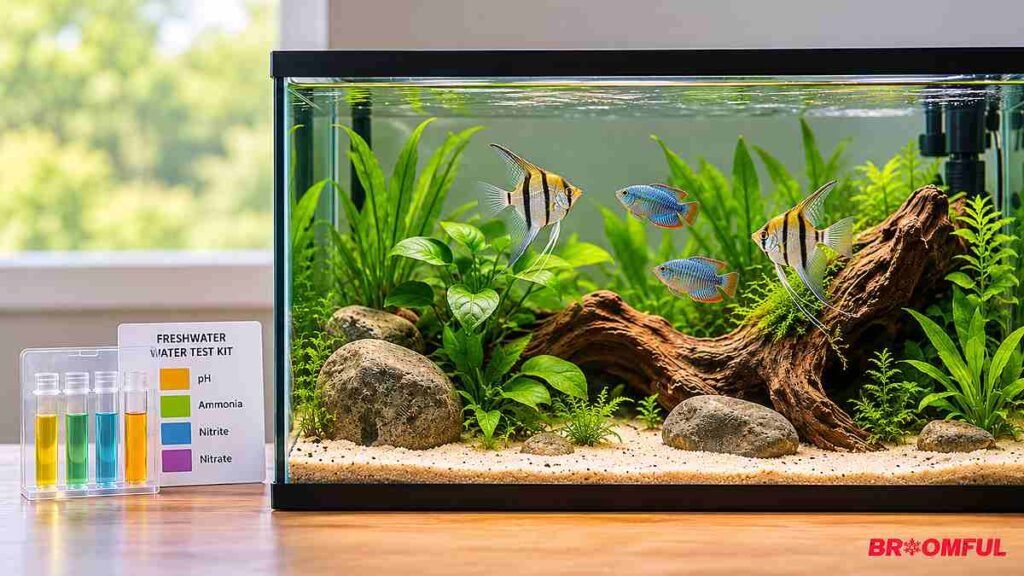
Is well water good for a fish tank, or is it a hidden risk? Plenty of hobbyists are surprised by the answer: well water is often excellent for aquariums, but only after you test it. It has no chlorine or chloramine, which city tap water does. It can, however, carry high nitrates, dissolved iron, hydrogen sulfide, or bacteria, and many beginners don’t find out until their fish are already stressed.
What follows is a practical answer for every type of aquarium, from a simple community tank to a reef system.
In this guide you’ll learn:
- Whether well water is safe for aquarium fish
- Which tests to run before adding a single drop
- How to treat and prepare well water for a fish tank
- How to fix smelly, orange, hard, or softened well water
- What to do about iron bacteria and coliform in your well
- How well water works for planted, shrimp, and saltwater tanks
Is Well Water Good for a Fish Tank?
Yes, well water is good for a fish tank when it tests clean, and its hardness and pH suit your fish. Because it’s untreated groundwater, its quality comes down to local geology, the condition of your well, and what’s happening on nearby land. Two neighbors can get very different results.
Why Well Water Can Be Excellent
- No chlorine or chloramine. Municipal suppliers disinfect with these chemicals, and both burn fish gills and kill beneficial bacteria. Well water normally contains neither.
- Stable minerals. Natural calcium, magnesium, and carbonate hold pH steady, which fish and biofilter bacteria both appreciate.
- Lower cost. There’s no utility bill, so you can change water as often as you like.
Why Well Water Can Be Risky
- Nitrate and ammonia. Farm runoff, septic systems, and fertilizer can push nitrate up. The EPA’s drinking water limit is 10 mg/L nitrate as nitrogen, and even that is too high for sensitive fish and shrimp.
- Dissolved metals. Iron, copper, manganese, and sometimes lead or zinc can harm fish, invertebrates, and plants.
- Bacteria and gases. Hydrogen sulfide (the rotten-egg smell), iron bacteria, and coliform can all turn up.
- Extreme hardness or pH. Hard water suits African cichlids but stresses soft-water species such as tetras and discus.
Is Well Water Better for Fish Tanks Than Tap Water?
It depends. Clean well water beats tap water if you’d rather skip chemical dechlorination. Tap water wins when your well has contamination problems that a public utility would already have dealt with. Neither source is automatically superior, and testing settles it.
What’s in Your Well Water
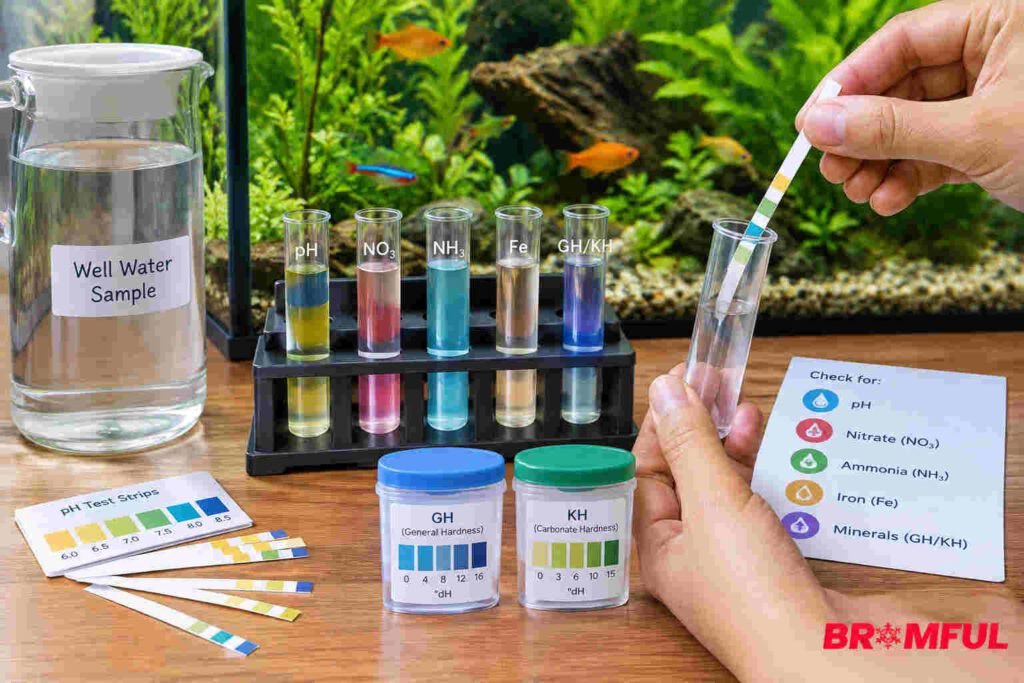
Nothing matters more than testing when you’re deciding whether well water is safe for aquarium fish. A home test kit, at $20 to $40, covers the basics, and well owners should also consider a lab test once a year.
Essential Tests Before Filling Your Tank
| Parameter | Safe Range for Most Freshwater Fish | Why It Matters |
| pH | 6.5–7.8 | Affects fish stress and ammonia toxicity |
| GH (general hardness) | 4–12 dGH (70–210 ppm) | Calcium and magnesium for fish and shrimp |
| KH (carbonate hardness) | 3–8 dKH (50–140 ppm) | Buffers pH swings |
| Ammonia | 0 ppm | Toxic even in tiny amounts |
| Nitrite | 0 ppm | Toxic; blocks oxygen transport |
| Nitrate | Under 20 ppm (under 5 ppm for shrimp and reefs) | Fuels algae and stresses fish at high levels |
| Iron | Under 0.3 ppm | Causes orange staining, algae, and slime |
| Copper | 0 ppm | Lethal to shrimp and snails |
| TDS | Varies by species | Shows overall mineral load |
Hard Well Water for Fish Tanks
Hard well water for a fish tank is fine for hard-water fish such as mollies, guppies, platies, goldfish, and African rift lake cichlids. Soft-water species like neon tetras, rasboras, discus, and most Amazonian fish usually struggle in it.
Too-hard water can be diluted with reverse osmosis (RO) or distilled water, and a 50/50 mix roughly halves the hardness. Chemical pellets and home water softeners are not the way to soften it (see the softened water section below).
Hidden Ammonia, Nitrate and Metals
Test water straight from the tap before it goes anywhere near the tank. Organic contamination can put ammonia in well water, and copper can leach from plumbing, particularly after water has sat in the pipes overnight. Run the tap for 2 to 3 minutes before you collect water for a water change.
How to Prepare Well Water for a Fish Tank
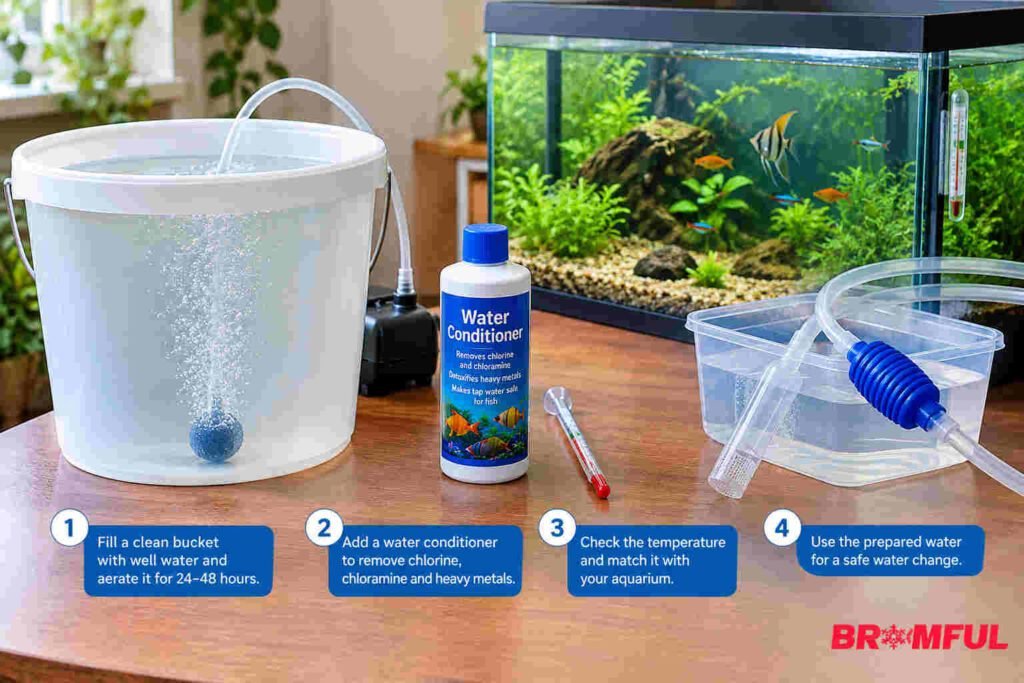
To prepare well water for a fish tank: test it, let it sit and aerate, treat it with a good conditioner, match the temperature, and then add it slowly. That sequence is the core of how to prepare water for a fish tank.
Step-by-Step: How to Treat Well Water for a Fish Tank
- Test the raw water. Check pH, GH, KH, ammonia, nitrite, nitrate, iron, and copper.
- Collect from a cold tap. Flush the line first so standing water doesn’t bring metals along.
- Aerate for 24 hours. Use a bucket and an air stone. Well water is often rich in dissolved carbon dioxide, which lowers pH. Aeration drives the CO₂ off, and the pH may rise by 0.3 to 1.0 units.
- Re-test after aeration. The aerated pH is the one your fish will actually live with.
- Add a water conditioner. The next section covers this.
- Match temperature. Bring the water to within 1 to 2°F (about 1°C) of the tank.
- Add slowly. Pour gently or use a siphon and hose.
Do I Need Conditioner for Well Water in a Fish Tank?
Often yes, though chlorine isn’t the reason. The real reasons to use a conditioner are these:
- It binds heavy metals such as copper, lead, and zinc.
- Many conditioners detoxify ammonia and nitrite for 24 to 48 hours in an emergency.
- Depending on the brand, it adds a protective slime-coat supplement.
- If your well is chlorinated (after a shock treatment, for example), it removes leftover chlorine.
With perfect test results, a conditioner is optional. Metals can come and go, though, so most hobbyists use one routinely as cheap insurance.
What to Add to Well Water for a Fish Tank
| Situation | What to Add |
| Possible metals or trace contaminants | A quality water conditioner |
| Very soft well water (low GH/KH) | Mineral supplement or crushed coral in the filter |
| Hard water for soft-water fish | Dilute with RO/distilled water |
| Low KH, unstable pH | Baking soda in small, measured doses |
| Cloudy water with particulates | A filter sock or sediment pre-filter |
Make every adjustment gradually, no more than 0.2 pH units per day in an established tank.
How to Change Water for Fish Safely
Learning how to change water for fish is half the battle:
- Change 20 to 30% weekly for most freshwater tanks.
- Use a gravel vacuum to pull out debris while you drain.
- Treat the new water and match its temperature before it enters the tank.
- Turn off heaters during large changes so they aren’t exposed to air.
- Keep your source water consistent. Sudden swings stress fish more than a slightly imperfect but stable pH.
Common Well Water Problems
Even good wells develop issues. The most common ones are below, along with a few that other guides skip.
Smelly Well Water for a Fish Tank
A rotten-egg smell is hydrogen sulfide gas, often from sulfur bacteria or natural mineral deposits. The gas is toxic to fish at low levels.
What to do:
- Aerate the water vigorously for 24 to 48 hours. The gas escapes, and the smell fades.
- For a permanent fix, put an aeration system, activated carbon, or oxidizing filter on your well.
- Don’t pour smelly water straight into a tank, and don’t assume a faded smell means it’s safe. Test the aerated water first.
Orange Well Water and Iron Bacteria
Orange or rust-colored water signals dissolved iron. Orange or reddish slime around fixtures points to iron bacteria, which aren’t a direct health threat to people but can foul aquariums. Excess iron fuels algae and leaves stains. Fish-safe iron levels are very low, and planted tanks tolerate only trace amounts.
How to get rid of iron bacteria in well water:
- Shock chlorinate the well with household bleach, following your local health authority’s or well contractor’s guidance.
- Flush the system until the chlorine smell is gone. Test for chlorine before any of this water goes into a tank.
- Install a filter. Oxidizing or manganese greensand iron filters remove iron from water.
- Repeat the treatment if the slime returns, since iron bacteria often recolonize.
For iron algae inside the aquarium itself, cut the iron going in by using filtered water, do more water changes, and scrub the affected surfaces. A phosphate- or iron-absorbing filter media also helps.
Coliform Bacteria in Well Water
A positive coliform test means surface contamination is reaching your well. Coliform usually isn’t a direct threat to aquarium fish, but it suggests other contaminants, nitrate and ammonia among them, may be getting in too. It’s a health concern for you and your family as well.
How to treat a well with coliform bacteria:
- Shock chlorinate the well and plumbing, then retest after flushing.
- Find the source: a cracked casing, a nearby septic system, flooding, or a loose cap.
- Install a UV sterilizer for ongoing protection.
How to remove bacteria from well water naturally is a common question, and the honest answer is that boiling works for drinking water but isn’t practical for aquariums. Sunlight, settling, and activated carbon aren’t reliable disinfectants. Chlorination followed by dechlorination, or UV treatment, are the dependable options. Dechlorinate any treated water with a conditioner before it goes in your tank.
Softened Well Water for a Fish Tank
Softened well water is generally not recommended for a fish tank. Standard softeners swap calcium and magnesium for sodium (or potassium), so fish lose minerals they need, and the water picks up salt.
- Freshwater fish and plants need GH minerals.
- Soft-water fish sometimes tolerate it, but the sodium load can stress many species.
- Shrimp molting depends on calcium.
The fix is a bypass line on the softener that feeds unsoftened water to a dedicated tap, or collecting water before it reaches the softener. Reverse osmosis is another good alternative.
Is Well Water Salt Bad for a Fish Tank?
For most freshwater tanks, yes, whether the salt comes naturally (common in coastal regions) or from a softener. Elevated chloride and sodium stress freshwater fish and kill plants. If your TDS or chloride test comes back high, use RO water instead.
Using Well Water for Different Tank Types
Is well water good for aquarium fish of every kind? The answer changes by tank type.
| Tank Type | Well Water Suitability | Key Considerations |
| Community freshwater | Good | Test pH, hardness, and nitrate; condition water |
| African cichlids | Excellent | Hard, alkaline water is ideal |
| Soft-water tropicals (tetras, discus) | Fair | Often needs dilution with RO |
| Planted tanks | Good to excellent | Watch iron, nitrate, and algae |
| Shrimp tanks | Fair | Zero copper, stable GH/KH required |
| Saltwater/reef | Poor as-is | Use RO/DI water only |
| Breeding tanks | Situational | Match the species’ spawning water |
Is Well Water Good for Aquarium Plants?
Often, yes. The natural minerals and trace nutrients in well water, including small amounts of iron and potassium, can feed aquarium plants, and some hobbyists rely on it for lush growth.
The caveats are real, though. High nitrate and phosphate combined with light can set off algae, and excess iron can cause brown or red algae films. Test your water and dose fertilizer only for what’s missing.
Can I Use Well Water for My Saltwater Fish Tank?
Not directly. Saltwater and reef tanks need near-zero nitrate, phosphate, silicate, copper, and other contaminants, and well water almost always contains at least some of them. Copper alone is lethal to corals and invertebrates.
The standard approach is to run well water through a reverse osmosis/deionization (RO/DI) system, test the output for 0 TDS, and then mix in marine salt. Well water is an acceptable input as long as the filter is maintained.
Shrimp and Breeding Tanks
Shrimp are the canaries of the aquarium world, and even trace copper can wipe out a colony. If your plumbing is copper, always run the tap and test. Breeders should match the water to the species. Many egg layers need softer, slightly acidic water to trigger spawning, which often means blending well water with RO.
Well Water vs Tap Water vs RO Water
| Feature | Well Water | City Tap Water | RO/DI Water |
| Chlorine/chloramine | None | Present | None |
| Minerals (GH/KH) | Natural, variable | Moderate, regulated | Near zero |
| Contaminant risk | Varies, self-monitored | Regulated and tested | Very low |
| Nitrate | Can be high | Usually low | Near zero |
| Cost | Low (pump/electric) | Utility rate | Equipment + wastewater |
| Best for | Hardy freshwater fish | General freshwater | Reef, shrimp, sensitive species |
| Needs conditioner? | Usually, for metals | Always | Remineralize as needed |
Building a Reliable Well Water Routine
- Test the source monthly at first, then quarterly once results are stable.
- Lab test yearly for bacteria, nitrate, and metals.
- Inspect the well after storms or flooding.
- Keep notes on pH, hardness, and nitrate so changes show up early.
- Keep a backup. Have RO or bottled water on hand in case your well fails a test.
When You Should Not Use Well Water
Skip well water, at least temporarily, if:
- Your well has tested positive for coliform and hasn’t been treated
- Nitrate is above 40 ppm
- You smell hydrogen sulfide or notice heavy rust staining
- You’ve had recent flooding or construction near the well
- You keep reef or sensitive shrimp and have no RO filter
Frequently Asked Questions
Is well water safe for aquarium fish?
Yes, if it tests clean. Well water contains no chlorine, and many fish do well in it. Safety hinges on nitrate, ammonia, metals, and bacteria levels, so test first, aerate, and add a conditioner to bind metals before the water goes into your tank.
Is well water bad for a fish tank?
Not inherently. It turns bad when it carries high nitrate, iron, copper, hydrogen sulfide, or contamination. Clean, stable well water is often better than treated tap water, and what decides it is testing, not whether the source is a well or a city supply.
Do I need conditioner for well water in a fish tank?
Usually, yes. Well water doesn’t need chlorine removal, but a conditioner binds heavy metals like copper and lead and detoxifies trace ammonia. It’s inexpensive insurance. If your test results are consistently clean and your plumbing is metal-free, you may be able to skip it.
Can I use softened well water for a fish tank?
It’s best to avoid it. Softeners replace calcium and magnesium with sodium, which strips out essential minerals and adds salt. Use unsoftened tap water or a bypass line. If neither is available, RO water blended with mineral supplements works better.
How do I get rid of iron bacteria in well water?
Shock chlorinate the well, flush it, and install an iron filter. Iron bacteria produce orange slime and staining. Chlorination kills the colony, and an oxidizing filter removes leftover iron. Retreat if slime returns, and dechlorinate any treated water before it goes into an aquarium.
Can I use well water for a saltwater fish tank?
Only after purification. Well water typically contains nitrate, phosphate, silicate, and copper that harm corals and marine fish. Run it through an RO/DI system until it reads 0 TDS, then mix with marine salt. Raw well water never belongs in a saltwater tank.
Why does my well water smell bad in my aquarium?
Most likely hydrogen sulfide. The rotten-egg smell comes from sulfur bacteria or natural mineral deposits. Aerate the water for 24 to 48 hours to release the gas, then retest. For a permanent fix, install an aeration or oxidizing filter on your well.
Conclusion
So, is well water good for a fish tank? Yes, when you test it, prepare it properly, and match it to your fish. It can be one of the best, cheapest, and most natural water sources an aquarist has, and it can also hide problems that only testing will reveal.
Three key takeaways:
- Test first. Check pH, hardness, ammonia, nitrate, iron, and copper before every new source or after any change to your well.
- Prepare and condition. Aerate, adjust gradually, and use a conditioner to handle metals.
- Fix well problems at the source. Smell, orange water, coliform, and softened water all have solutions.
Ready to get started? Grab a good test kit, check your water today, and share your results in the comments. We’ll help you decide whether your well water is ready for your fish tank.
