
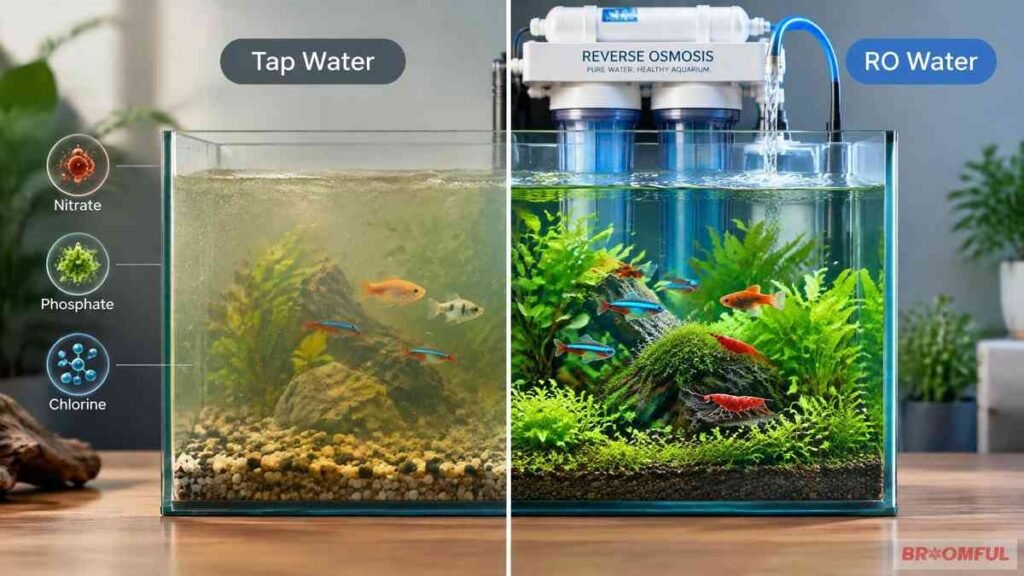
In some regions, tap water arrives with hundreds of parts per million (ppm) of dissolved solids, along with nitrates, phosphates, and chloramine. That raises the question: is reverse osmosis water good for fish tanks, or is it too pure for living animals?
The answer depends on your fish, your tap water, and how you use it. RO water is an excellent starting point for shrimp, discus, wild-type fish, and every reef tank. On its own in a community tank, it can be dangerous: fish and beneficial bacteria both need minerals, and RO strips them out.
In this guide you’ll learn:
- What reverse osmosis water for a fish tank is, and how the membrane works
- Whether fish can survive in reverse osmosis water
- Which is better for fish tanks, tap water or RO water
- How to remineralize RO water for freshwater, shrimp, and reef tanks
- How to choose, run, and maintain an RO or RO/DI system
What Is Reverse Osmosis Water for a Fish Tank?
Reverse osmosis water is tap water pushed under pressure through a semipermeable membrane. Most dissolved solids can’t get through, so what comes out is close to pure H₂O.
How Reverse Osmosis Filters and Membranes Work
Household pressure forces water through the reverse osmosis system membrane, and its pores are small enough to reject most ions, heavy metals, and organic compounds. Two streams leave the unit:
- Product water (permeate): the clean water for your tank
- Waste water (concentrate): rejected minerals and contaminants, sent to drain
Most water membranes of this type remove roughly 90–99% of dissolved solids. Modern units rely on thin-film composite (TFC) membranes, which work well but are delicate.
What Reverse Osmosis Removes From Tap Water
RO removes nitrates, phosphates, silicates, chlorine, and heavy metals such as copper. Each of these matters in an aquarium:
- Nitrates stress fish and feed algae. For scale, tap water in the UK can legally contain up to 50 mg/L.
- Phosphates and silicates fuel nuisance algae.
- Copper is toxic to shrimp, snails, and other invertebrates.
How Does a Fish Tank Filter Work Compared With an RO Filter?
Beginners often confuse the two. An aquarium filter recirculates tank water through mechanical (debris), biological (bacteria that convert ammonia and nitrite), and chemical (carbon, resin) stages. Typical fish filter parts include the intake, impeller motor, media baskets, and outlet.
An RO unit works differently. It treats water before it enters the tank and does nothing to cycle it. Compare the parts of an aquarium filter with an RO unit, and it’s clear why you need both.
Is Reverse Osmosis Water Safe for Fish Tanks?
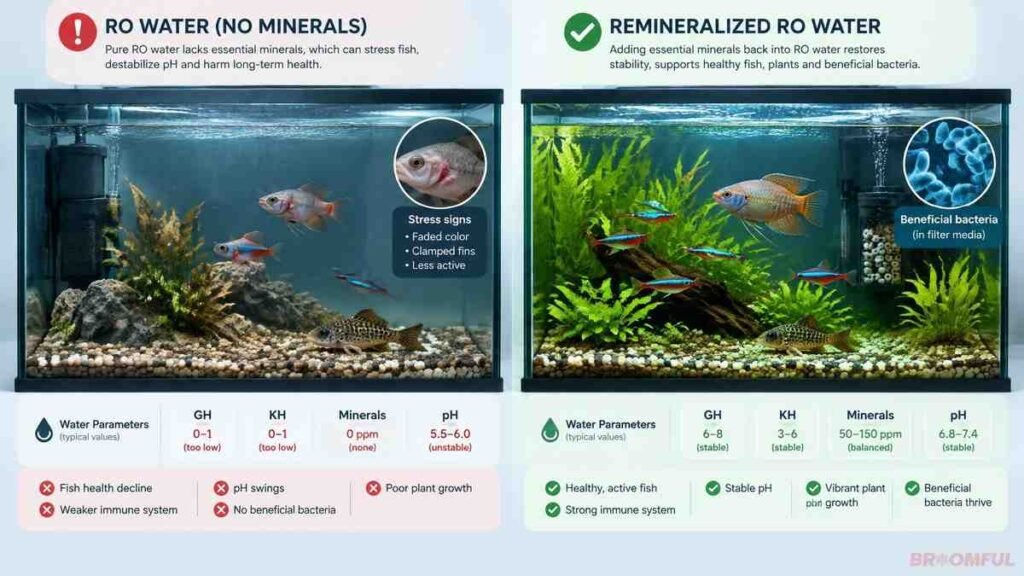
Yes, RO water is safe for fish tanks when used correctly. The unsafe part is running it unmodified in most freshwater setups.
Can Fish Survive in Reverse Osmosis Water?
Not for long in pure RO water. Fish depend on dissolved minerals for osmoregulation, the process that balances salts and water inside their bodies. Pure RO also has essentially zero carbonate hardness (KH), the buffer that holds pH steady. With no KH, pH can swing sharply as waste produces acids, and fish stressed by those swings often show clamped fins, gasping, or lethargy.
Why KH Matters for Your Biofilter
Most guides skip a second problem. Nitrifying bacteria consume carbonates as they process ammonia and nitrite. Pure RO water gives them nothing to draw on, so biological filtration weakens, and pH can collapse. Remineralizing protects your bacteria as well as your fish.
What Is a Major Downside of Reverse Osmosis Water?
The biggest downside is the missing minerals, which leads to unstable pH and stressed fish, plants, and invertebrates. There are two smaller ones:
- Waste water: EPA WaterSense guidance notes that point-of-use units can send roughly five times more water to drain than they deliver, and some send up to ten times more. Efficient models advertise close to 1:1, and WaterSense-labeled units are worth looking for.
- Cost and upkeep: membranes and filters need scheduled replacement.
Is Reverse Osmosis Water OK for a Fish Tank Without Additives?
Rarely. A few soft-water breeding setups use very low mineral levels, but keepers usually add minerals back even there. If you are unsure, remineralize.
Which Is Better for Fish Tanks: Tap Water or RO Water?
Neither wins across the board. Tap water is cheap and mineral-rich, while RO water is clean and adjustable. The deciding factors are your tap quality and your species.
| Factor | Tap Water | RO Water |
| Minerals (GH/KH) | Present, varies by region | Near zero |
| Chlorine/chloramine | Present, needs dechlorinator | Removed if pre-filters work |
| Nitrate, phosphate, silicate | Often present | Mostly removed |
| Heavy metals | Possible | Mostly removed |
| pH stability | Usually buffered | Unbuffered alone |
| Cost | Low | Upfront cost, low per gallon |
| Control over chemistry | Limited | High |
| Best for | Hardy community fish | Shrimp, discus, reef, breeding, poor tap water |
When Tap Water Is the Better Choice
Tap plus a dechlorinator is enough when the water is safe, moderately hard, and suits your fish. Guppies, platies, and many African cichlids do well in mineral-rich water, so RO is overkill for them.
When RO Water Wins
RO wins when your tap has high TDS, nitrate, phosphate, copper, or iron (common in well water). It also wins for soft-water species such as wild blackwater bettas, which come from habitats with very low mineral content. Domestic bettas are far more forgiving, so it depends on the fish.
Alternatives: Distilled Water and Store-Bought RO
You don’t have to own an RO unit. Many local fish stores sell RO water, often in 5-gallon containers, and distilled water works too, typically for under a dollar a gallon at US grocery kiosks. Either one needs remineralizing for most fish.
Pick One Water Source and Stay Consistent
Consistency matters more than a perfect number. Switching back and forth between RO and tap makes parameters swing, and most tropical fish handle a stable range better than a moving one.
Is Reverse Osmosis Water Good for a Freshwater Aquarium?
Yes, provided you remineralize it. Think of RO as an ingredient, not a finished product.
How to Remineralize RO Water
Two methods work:
- Blend with tap water. Simple and cheap. The downside is that you add back some nitrate, phosphate, and silicate, which matters in low-plant tanks.
- Use remineralizing products. Powders and liquids give the most control. Examples include Seachem Equilibrium and Salty Shrimp GH+.
Mix in a separate container, never in the tank. Test GH, KH, and TDS before use.
Target Parameters by Tank Type
These ranges are commonly cited, so check the needs of your specific species.
| Tank Type | GH (dGH) | KH (dKH) | Typical TDS (ppm) |
| Community tropical | 4–10 | 3–8 | 150–250 |
| Planted tank | 4–8 | 3–6 | 150–200 |
| Neocaridina shrimp | 6–8 | 2–4 | 150–250 |
| Caridina shrimp | 4–6 | 0–1 | 100–150 |
| Discus / soft-water fish | 1–4 | 1–3 | 50–120 |
| African cichlids | 10–20 | 8–12 | 250–400 |
Special Cases
- Beginners: start with tap plus a dechlorinator. Move to RO only if tap water causes problems.
- Planted tank owners: RO water strips nutrients, so add carbonate buffer and micro/macro nutrients.
- Blackwater and botanical tanks: botanicals release acids that can drop pH fast in low-KH water, so add a small amount of carbonate hardness.
- Shrimp keepers and breeders: RO is the standard base for stable molting and repeatable spawning.
- Problem-solvers: If you fight persistent algae or unexplained deaths, comparing tap and RO test results is a fast diagnostic.
Top-Offs
Evaporation removes water, not minerals. Topping off with plain RO water stops minerals from concentrating over time.
Reverse Osmosis DI Water for Saltwater and Reef Tanks
The debate is largely settled for marine tanks: reef keepers overwhelmingly use RO/DI.
What Is Reverse Osmosis DI?
A reverse osmosis DI (deionization) setup adds a resin cartridge after the membrane. The resin strips out the remaining ions and polishes the water to 0 TDS. Reefs typically run an RO DI water filtration system because trace phosphate and silicate can drive algae.
Mixing Saltwater and Topping Off
Mix salt into RO/DI water, then aerate and heat it, and check salinity before each change. Evaporation top-offs get pure RO/DI with no additives. For most freshwater tanks, RO alone is sufficient.
Choosing and Maintaining an RO System
Key Components
- Sediment pre-filter: traps particles
- Carbon pre-filter(s): removes chlorine, which damages TFC membranes
- RO membrane: removes dissolved solids
- Flush valve and flow restrictor: protect and pressurize the membrane
- DI resin stage (optional): polishes to 0 TDS
- TDS meter: confirms performance
Requirements and Benchmarks
- Aim for about 40 psi (2.8 bar) of incoming pressure. Below that, use a booster pump.
- Fresh product water should read 10 ppm TDS or less, and 0 GH. If you see KH, something is wrong.
- Once the membrane has been used, never let it dry out. That ruins it.
Maintenance Schedule
| Component | Typical Replacement |
| Sediment filter | Every 6–12 months |
| Carbon block | Every 6–12 months |
| RO membrane | Every 2–3 years |
| DI resin | When TDS rises above 0 |
Harder incoming water shortens these intervals.
Buying Tips
- Choose a 5-stage unit for freshwater and RO/DI for reefs and sensitive shrimp.
- Look for WaterSense labeling to cut wastewater. The waste can be reused for gardens.
- Track your TDS output. A rising number signals a failing stage.
- If you need only a few gallons weekly, store-bought RO may cost less than owning a unit.
FAQ: People Also Ask
1. Is reverse osmosis water good for fish tanks?
Yes, when you remineralize it. RO removes chlorine, metals, nitrate, and phosphate, leaving a clean base. Fish still need minerals, so blend it with tap water or use a remineralizer to reach the GH and KH your species prefers.
2. Can fish survive in reverse osmosis water?
Not in pure RO water for long. It has no minerals for osmoregulation and no buffer, so pH can crash. Add minerals suited to the species and confirm the levels with test kits, and fish can thrive.
3. What is a major downside of reverse osmosis water?
The missing minerals. They cause unstable pH and stress for fish, plants, and invertebrates, and they can weaken your biofilter because bacteria need carbonates. Remineralizing fixes it. Wastewater is a secondary drawback.
4. Which is better for fish tanks, tap water or RO water?
It depends on your tap and your fish. Tap water suits hardy species in moderately hard water. RO is better for shrimp, discus, breeders, reefs, and tap water high in nitrate, phosphate, copper, or iron.
5. Is reverse osmosis water OK for a fish tank?
Yes, if you add minerals first. It’s a useful base, but unmodified RO is unsuitable for most freshwater fish. Mix it with tap water or a remineralizer, then test GH, KH, and TDS before adding it.
6. Is reverse osmosis water safe for fish tanks with plants?
Yes, with extra care. RO removes nutrients plants need, so add a carbonate buffer plus micro and macro nutrients. Match GH and KH to your fish and test regularly so plants and livestock both stay stable.
7. Do I need RO/DI water?
Only for reefs and highly sensitive tanks. RO/DI polishes water to 0 TDS, which keeps out the trace phosphate and silicate that feed algae. Most freshwater tanks do well with standard RO and proper remineralization.
8. How do I know my RO membrane is failing?
Check output TDS. Fresh product water should read 10 ppm or less, and GH should be zero. A steadily rising reading, or any measurable KH, points to a worn membrane, exhausted pre-filters, or low pressure.
Conclusion
So, is reverse osmosis water good for fish tanks? Yes. It’s a clean, controllable base, but minerals have to be added back before it’s safe for most fish.
Three key takeaways:
- Never use pure RO on its own. Fish and biofilter bacteria both need minerals and buffering.
- Match your water to your species. Shrimp, discus, cichlids, and reefs each have different targets.
- Test, don’t guess. A TDS meter plus GH/KH kits keep your tank stable.
Start by testing your tap water today. If it’s high in TDS or nitrate, or you keep soft-water fish, an RO or RO/DI setup is worth it. Otherwise, a good dechlorinator may be all you need.
