
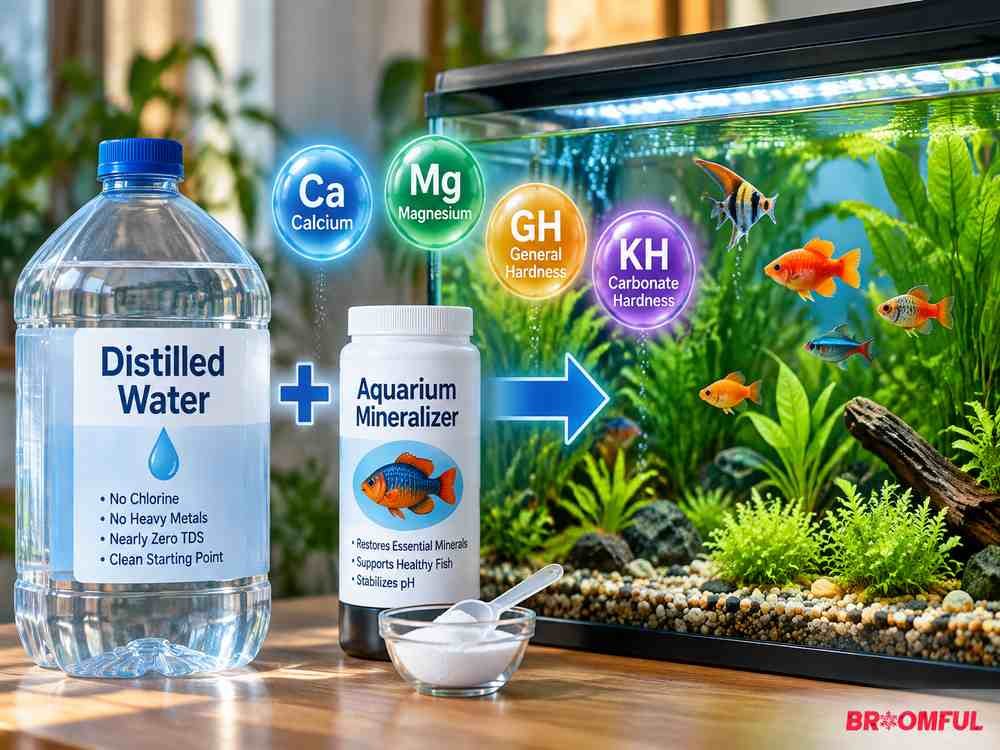
About 95% of an aquarium’s water chemistry is determined before the first fish ever enters the tank, yet many beginners focus only on the fish and ignore the water itself. So is distilled water good for a fish tank? The answer is yes, but only after it has been remineralized. Used directly from the container, distilled water can create serious problems because it removes calcium, magnesium, and the buffering minerals that fish, plants, and beneficial bacteria rely on.
This guide explains when distilled water works, when it does not, how it compares with spring, purified, and tap water, and how to prepare it safely for bettas, goldfish, shrimp, and freshwater community tanks. You’ll also learn a practical maintenance routine to keep your aquarium water stable after setup.
Is Distilled Water Good for a Fish Tank? The Short Answer
Distilled water is technically safe for fish tanks, but only when it is prepared correctly. The mistake many new fish keepers make is adding it directly to an aquarium without restoring the minerals that were removed during distillation. The distillation process removes chlorine, chloramine, heavy metals, and pathogens by boiling water and collecting condensed steam, but it also removes the dissolved minerals naturally found in water.
Fish need more than clean water to survive. They depend on a stable mineral balance to regulate their internal chemistry. Because distilled water contains almost no dissolved minerals, adding it directly to a tank can cause osmotic shock. During this process, fish struggle to balance the difference between the mineral levels inside their bodies and the surrounding water. This is why some sudden fish losses are linked to the use of pure distilled water without remineralization.
What Makes Distilled Water Different From Tap Water
Tap water usually contains chlorine or chloramine for public safety, along with naturally occurring minerals such as calcium, magnesium, potassium, and bicarbonates that enter the water through soil, rocks, and plumbing systems. Distilled water contains none of these minerals after processing.
The distillation process reduces total dissolved solids (TDS) to nearly zero, while typical tap water can range from 100 to 500 parts per million (ppm), depending on the location. These dissolved minerals influence water hardness, and hardness plays a direct role in maintaining stable pH levels inside an aquarium.
Why Fish Need More Than Just H2O
Freshwater fish absorb minerals through their gills and skin to maintain proper blood chemistry through a process called osmoregulation. Calcium contributes to bone and scale development, magnesium supports enzyme activity, and potassium helps with nerve and muscle function.
Beneficial nitrifying bacteria inside aquarium filters also depend on carbonate hardness (KH) to prevent sudden pH changes caused by the nitrogen cycle. When distilled water removes these minerals completely, both fish and the biological filtration system lose an important part of their chemical support.
The Osmotic Shock Mechanism, Explained Simply
A fish’s blood naturally contains a higher concentration of dissolved salts compared with the freshwater around it. Because of osmosis, water constantly moves into the fish’s body, and the fish must regulate that balance through its kidneys and gills.
When a fish enters water with almost no dissolved solids, like distilled water at 0–5 ppm TDS, the sudden difference from its natural environment (50–300 ppm) can cause severe stress. Water can move into the fish’s cells too quickly, causing stress, swelling, organ strain, and, in severe situations, death within hours.
This is why many reports of fish dying overnight are connected to adding pure distilled water directly to a tank without a remineralization step.
Why Distillation Itself Isn’t the Problem
The issue is not the distillation process itself. Distillation is simply a method of boiling water and collecting the condensed steam, and it is highly effective at removing chlorine, chloramine, heavy metals, and pathogens.
The problem comes from treating distilled water as a finished aquarium water source instead of using it as a clean starting point. Once properly remineralized, distilled water can provide a very controlled foundation because unwanted contaminants have already been removed.
Distilled Water vs Spring Water vs Purified Water for Fish Tanks
A common question among fish keepers is whether distilled water or spring water is better for a fish tank. The answer depends on how much control you want over your water chemistry. Distilled water gives you a completely clean starting point, allowing you to add back specific minerals based on your fish’s needs. Spring water already contains minerals, but the amount can vary between brands and even between different batches from the same brand.
Purified water for a fish tank falls somewhere between these options. It is usually produced through methods such as reverse osmosis or deionization, which remove many contaminants. However, the remaining mineral content depends on the exact purification process used by the manufacturer. Since “purified” describes a category rather than one specific method, checking the label or manufacturer details is necessary to understand what is actually in the water.
| Water Type | TDS Level | Minerals Present | Consistency | Best For |
| Distilled Water | Near 0 ppm | None (must be added) | Extremely consistent | Precise remineralization, breeding, shrimp tanks |
| Spring Water | 50–350 ppm (varies) | Natural, but variable | Inconsistent between brands/batches | Casual top-offs, community tanks |
| Purified/RO Water | 0–50 ppm | Minimal, varies by method | Consistent within a brand | Sensitive species, planted tanks |
| Tap Water (treated) | 100–500 ppm | High, source-dependent | Consistent locally | Most freshwater community tanks |
Spring Water for Fish Tank: Pros and Cons
Spring water comes from natural underground sources and usually contains minerals such as calcium, magnesium, and bicarbonates. Because of this, it can sometimes be closer to what fish need than completely untreated distilled water.
The challenge is consistency. Bottled spring water is labeled for human consumption, not aquarium use, so it usually does not provide the GH and KH information fish keepers need. Two bottles from the same company may also have slight differences depending on where the water was collected. This matters most for sensitive species such as shrimp, while hardier community fish are often more forgiving.
Purified Water for Fish Tank: What’s the Difference
Purified water is a broad category that can include reverse osmosis (RO), deionized (DI), or carbon-filtered water. Unlike distillation, which follows a specific heating and condensation process, purification simply means contaminants have been reduced through some type of filtration.
Many aquarium keepers prefer RO water because it provides a clean base that can be adjusted with a remineralizer. This makes it useful for planted tanks and species that require specific GH and KH levels.
Which Is Better for a Fish Tank, Distilled Water or Spring Water?
For beginners, spring water may require less preparation because it already contains some minerals. However, the mineral profile is not always predictable.
Distilled water becomes the better option when precise control matters. Breeding projects, shrimp tanks, or aquariums that need a specific water profile benefit from starting with water that has no existing mineral content, because every mineral added afterward can be measured and controlled.
Cost and Convenience: What It Actually Costs to Maintain Each Option
Distilled water generally costs slightly more per gallon than spring water at many retailers. Both options also cost more over time compared with treating tap water with a conditioner, which usually costs only pennies per gallon.
For a 20-gallon tank with weekly 20% water changes, you would need about 4 gallons of replacement water each week. That amount may be manageable with bottled water, but the cost increases quickly for larger aquariums or multiple tanks.
This is why many hobbyists with tanks above 40–50 gallons or several aquarium setups eventually choose a home RO system instead of continuously purchasing bottled water. After the initial equipment cost, the price per gallon becomes much lower.
Testing Before You Trust It
No matter which bottled water you choose, the label does not always provide everything needed for aquarium use. A TDS (total dissolved solids) meter gives a quick ppm reading and helps compare different water sources or batches.
For a more complete picture, combine a TDS meter with a liquid GH/KH test kit. TDS measures the total amount of dissolved material, while GH and KH specifically show the mineral hardness levels related to calcium, magnesium, and carbonate hardness that affect aquarium stability.
Is Distilled Water Safe for Aquarium Fish? A Species-by-Species Guide
Whether distilled water works for aquarium fish depends largely on the species being kept. Different fish evolved in different water conditions, so their mineral requirements are not identical.
Is distilled water safe for aquarium fish across the board? Generally yes, after proper remineralization. The amount and type of minerals needed will depend on the species.
Is Distilled Water Good for Betta Fish Tanks?
Is distilled water good for betta fish tanks specifically? Bettas come from soft, slightly acidic waters in Southeast Asia, so they can tolerate lower mineral levels compared with many freshwater fish.
However, soft water does not mean mineral-free water. Natural betta environments still contain measurable GH and KH. Straight distilled water without remineralization can still create problems such as unstable pH and osmotic stress.
A safer approach is adjusting distilled water to a GH of 4–8 dGH and a KH of 2–5 dKH before adding a betta. This creates conditions closer to their natural environment than using empty distilled water.
Is Distilled Water Good for Goldfish Tanks?
Goldfish have different requirements from bettas. They are a hardy species that have traditionally lived in mineral-rich ponds and lakes.
Goldfish generally do best in moderately hard water with a GH of 8–12 dGH. Using distilled water without adding minerals can be risky because goldfish produce a large amount of waste, and stable KH is important for preventing pH swings caused by their bioload.
Goldfish keepers should use remineralized distilled or RO water rather than relying on straight spring water, since spring water mineral levels can vary and make it harder to maintain consistent hardness.
Is Distilled Water Good for Freshwater Fish Tanks in General?
For freshwater fish tanks containing species such as tetras, guppies, rasboras, corydoras, and other community fish, remineralized distilled water can work well. It allows keepers to adjust GH and KH closer to the conditions these fish naturally experience.
Many tropical freshwater species do well within the softer range of around 4–10 dGH. This level of control can be especially useful in areas where tap water is naturally very hard.
Shrimp and Invertebrates: The Most Sensitive Group
Freshwater shrimp are among the species most affected by mineral changes. This is why many shrimp keepers prefer distilled or RO water as their starting point instead of untreated tap water.
Neocaridina shrimp, such as cherry shrimp, generally tolerate a wider GH range of around 6–10 dGH. Caridina species, including Crystal Red shrimp, usually require softer, slightly acidic water around 4–6 dGH and often need specialized shrimp remineralizers rather than standard fish mineral products.
The calcium-to-magnesium balance is especially important because shrimp rely on minerals for healthy exoskeleton development.
African Cichlids and Hard-Water Specialists
African rift lake cichlids from Lake Malawi and Lake Tanganyika require much harder, more alkaline water compared with many tropical species. Their preferred conditions are usually around 10–20 dGH, with a pH range of 7.8–8.6.
For these fish, distilled water is not an easy starting point unless significant mineral and buffer supplements are added. Some keepers find it simpler to begin with moderately hard tap water and adjust it upward when necessary.
Planted Tanks: Balancing Fish Needs With Plant Needs
Live aquarium plants also depend on dissolved minerals for healthy growth. Calcium, magnesium, potassium, and trace elements such as iron all contribute to plant development, which means a planted tank using only unremineralized distilled water can leave both fish and plants lacking important resources.
Many planted tank keepers who use RO or distilled water add a dedicated plant fertilizer along with a GH booster. This combination restores the minerals needed for plant growth while maintaining water conditions suitable for fish.
Quick-Reference: Ideal Hardness by Species
Use this table as a starting point when remineralizing distilled or RO water, then adjust based on your test results and the needs of your specific fish.
| Species Group | Ideal GH (dGH) | Ideal KH (dKH) | pH Range |
| Betta fish | 4–8 | 2–5 | 6.5–7.5 |
| Goldfish | 8–12 | 6–10 | 7.0–8.0 |
| Community tropicals (tetras, guppies) | 4–10 | 3–8 | 6.5–7.5 |
| Neocaridina shrimp | 6–10 | 3–6 | 6.5–7.5 |
| Caridina shrimp | 4–6 | 0–2 | 5.5–6.5 |
| African rift lake cichlids | 10–20 | 10–18 | 7.8–8.6 |
Saltwater and Reef Tanks: A Different Story
For saltwater and reef aquariums, distilled or RO/DI water is not optional. It is the standard starting point for preparing marine water. Saltwater is created by mixing a marine salt blend into purified freshwater, so unwanted minerals and contaminants in the base water can interfere with calcium, alkalinity, and magnesium levels that reef corals depend on.
Many reef keepers use RO/DI water because it provides a clean foundation for accurately mixing saltwater and controlling the final chemistry.
How to Prepare Distilled Water for Your Fish Tank
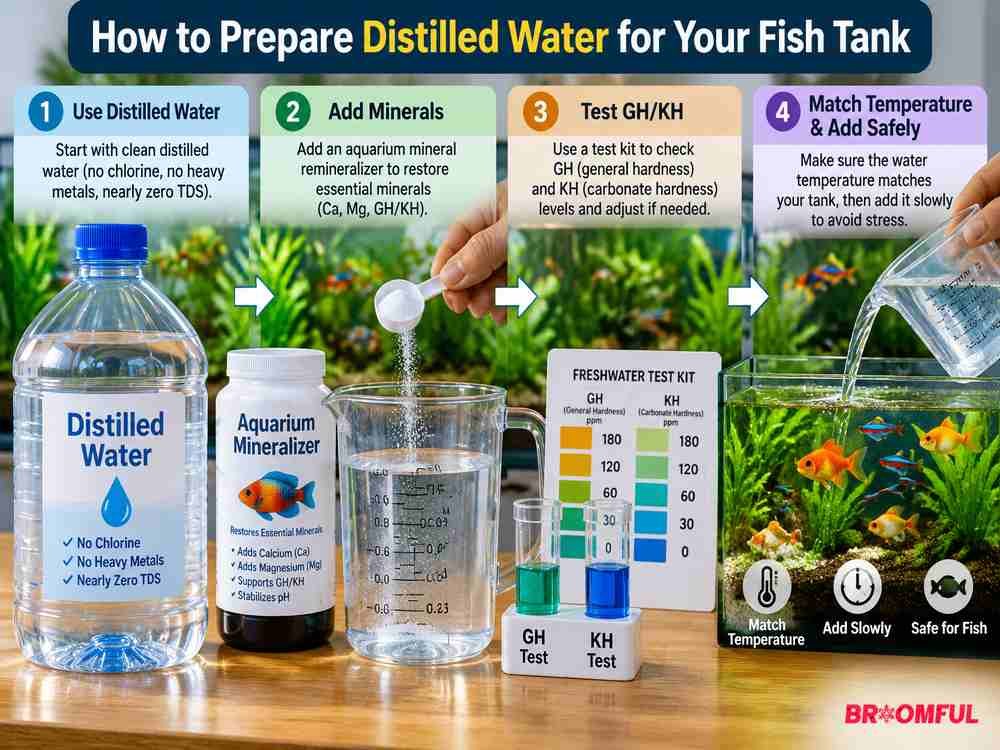
Knowing how to prepare water for a fish tank properly is what separates a stable aquarium from one where fish experience unnecessary stress. Distilled water should never be added directly from the container into a fish tank. It needs to be rebuilt chemically before use.
Remineralizing Distilled Water
Aquarium-specific remineralizer products, often sold as GH boosters, mineral supplements, or “Remineralize” solutions, are designed to restore minerals such as calcium, magnesium, and potassium to distilled water.
Most products include dosing instructions based on gallons and the desired GH level. A liquid or digital GH/KH test kit helps confirm whether the prepared water has reached the correct range before it enters the aquarium.
As a general starting point, many freshwater community fish do well around 4–10 dGH and 3–8 dKH. Goldfish and livebearers usually prefer harder water, while soft-water species such as bettas and wild-caught tetras generally need lower mineral levels.
How to Treat Aquarium Water Before Adding Fish
After remineralization, distilled water still needs preparation before being added to a tank. Temperature and pH should match the existing aquarium water as closely as possible.
If distilled water is mixed with tap water, the tap portion must be treated with a water conditioner to remove chlorine and chloramine. Preparing aquarium water involves two main steps:
- Removing chlorine and chloramine when tap water is involved
- Maintaining stable pH and mineral levels before fish are introduced
After adding minerals, test the pH and allow the prepared water to circulate or sit for at least an hour. This gives the minerals time to dissolve completely and the water chemistry time to stabilize.
A Worked Example: Remineralizing a 10-Gallon Water Change
Imagine preparing water for a 10-gallon community aquarium where the selected GH booster requires approximately 1 teaspoon per 5 gallons to reach a moderate 6–8 dGH.
You would prepare 10 gallons of distilled water, add 2 teaspoons of the GH booster, mix the water thoroughly, and wait 30–60 minutes before checking the results with a liquid GH test kit.
If the hardness level is lower than needed, add a small additional amount and test again instead of adding a large dose immediately. Raising hardness gradually is much easier than trying to correct water that has become too hard.
Acclimating Fish to Remineralized Water
Even properly prepared distilled water may not exactly match the water already inside your aquarium. When moving fish into newly prepared water, drip acclimation over 15–30 minutes can reduce stress compared with placing fish directly into the new environment.
This is especially important when setting up a new aquarium or transferring fish between tanks because sudden changes in water chemistry can still create stress even when GH and KH levels are appropriate.
Common Mistakes When Using Distilled Water
The most common mistake is skipping remineralization because distilled water appears completely clean. Clean-looking water does not mean it contains the minerals fish require.
Another frequent problem is adding too much mineral supplement without testing first. Excessively high GH and KH levels can create another sudden chemistry change that stresses fish.
A third mistake is mixing distilled water with tap water without checking the final result. The correct ratio depends on the starting hardness of your local tap water, so testing the finished mixture is the only reliable way to know whether it is suitable.
Best Water for Fish Tank: Comparing All Your Options
Finding the best water for a fish tank depends on the fish species, the quality of your local tap water, and how much control you want over the aquarium’s chemistry.
Tap Water With Conditioner
For many freshwater community tanks, treated tap water remains the simplest and most affordable option. It already contains minerals that suit many common aquarium species.
The main issue is variation. Some locations have naturally hard water with high mineral content, while others have softer water. Tap water may also contain substances such as heavy metals or phosphates that basic conditioners do not remove.
Testing your tap water once with a GH/KH kit gives a clear picture of whether it already matches your fish’s needs or requires adjustment.
RO (Reverse Osmosis) Water
Reverse osmosis water is created by pushing tap water through a semi-permeable membrane that removes dissolved solids, minerals, and many contaminants. It works similarly to distilled water in that it provides a cleaner starting point, but it does so through filtration rather than boiling.
RO systems are popular among breeders, shrimp keepers, and planted aquarium owners because they provide consistent water quality. Unlike buying individual jugs, a home system can produce large amounts of water for regular maintenance.
Like distilled water, RO water must be remineralized before being used with most freshwater fish.
Rainwater and Well Water
Rainwater is naturally soft and may work for some soft-water species, but it needs careful collection and testing. Contaminants from roofs, air pollution, and other environmental sources can affect its safety.
Well water is often the opposite. It may contain high levels of minerals, iron, or sulfur that require filtration before aquarium use.
Neither rainwater nor well water should be added to a fish tank without testing first. Their quality can vary significantly depending on the source.
Home RO Systems: When Buying Jugs No Longer Makes Sense
A basic 4- or 5-stage home RO unit can be installed under a sink or connected to an outdoor spigot. After the initial equipment cost, it usually produces water at a much lower per-gallon cost compared with repeatedly buying bottled distilled or spring water.
For hobbyists managing multiple tanks, a fish room, or aquariums larger than 55 gallons, a home RO system can become more practical. RO membranes commonly require replacement every 12–24 months depending on usage and local water quality, and regular TDS testing helps confirm that the system continues working properly.
A Quick Decision Framework
For a single small community aquarium, tested and dechlorinated tap water is often the simplest option.
If your tap water is extremely hard, unusually soft, contaminated, or unsuitable for sensitive species such as shrimp, wild bettas, or Discus, remineralized distilled or RO water provides more control.
For multiple aquariums or breeding setups, a home RO system may become a more practical long-term approach.
Fish Tank Maintenance: Keeping Your Water Quality Stable
Getting the water chemistry right at the beginning is only part of keeping a healthy aquarium. Regular freshwater fish tank maintenance is what keeps those conditions stable over time.
How to Treat Fish Tank Water Weekly
Weekly partial water changes, usually 10–25% of the tank volume, are one of the most effective ways to control ammonia, nitrite, and nitrate levels between full maintenance cycles.
No matter whether you use remineralized distilled water, treated tap water, or RO water, the replacement water should match the aquarium’s temperature and pH as closely as possible before being added. Sudden changes in water conditions can stress fish more than a gradual decline in water quality.
How Often to Change Aquarium Filter Pads
How often to change aquarium filter pads depends on the type of filter and the amount of waste produced by the fish. As a general guideline, mechanical filter floss or pads are often changed every 4–6 weeks because they collect debris that can break down and increase ammonia levels.
Biological filter media, such as ceramic rings or bio-balls, should not usually be replaced completely in a healthy aquarium. Instead, rinse them gently in removed tank water to protect the beneficial bacteria colonies living on their surface.
When to Change Fish Tank Filter Completely
Knowing when to change a fish tank filter completely usually depends on the condition of the equipment rather than the age of the filter media.
A complete replacement may be needed if the filter housing is cracked, the impeller is failing, or water flow remains poor even after cleaning. Replacing all filter media at once in an established tank can remove too many beneficial bacteria and trigger a mini-cycle, so gradual media replacement is usually safer.
Freshwater Fish Tank Maintenance Schedule
A consistent freshwater fish tank maintenance routine typically includes:
- Weekly testing for ammonia, nitrite, nitrate, and pH
- Weekly partial water changes
- Monthly rinsing of filter media
- Quarterly deep cleaning of substrate and decorations
Small, regular maintenance tasks are easier on fish than occasional major cleanups. Consistency helps prevent sudden water quality problems that can lead to stress and illness.
Understanding the Nitrogen Cycle’s Role in Water Stability
Every established aquarium depends on the nitrogen cycle, a biological process where beneficial bacteria convert toxic ammonia from fish waste and uneaten food into nitrite, then into nitrate.
Regular water changes remove nitrate, while stable KH helps control the acids produced during this process. This is another reason unremineralized distilled water can create problems in a mature aquarium. With almost no buffering capacity, it may allow pH levels to become unstable even in a fully cycled tank.
Matching Maintenance to Stocking Level
Fish tank upkeep should match the amount of waste produced in the aquarium. A lightly stocked 20-gallon tank with a few small fish may do well with one weekly water change, while a heavily stocked aquarium may need more frequent maintenance or larger water changes.
As a general guideline, keeping nitrate below 20–40 ppm in a freshwater community tank is a common target. Sensitive species and planted aquariums may benefit from maintaining levels closer to 5–10 ppm.
Troubleshooting: Signs Your Water Isn’t Right for Your Fish
Even with a good maintenance routine, water issues can develop over time. Recognizing early warning signs helps prevent small problems from becoming serious.
Signs of Poor Water Quality
Cloudy water, a strong ammonia smell, algae outbreaks, fish gasping near the surface, clamped fins, and unusual inactivity are common signs that aquarium conditions may be out of balance.
When fish die suddenly without visible disease symptoms, water chemistry is often worth investigating. Possible causes include osmotic shock from unremineralized distilled water or a water change that was too large, too fast, or significantly different in temperature and pH.
How to Improve Aquarium Water Quality Fast
If testing shows ammonia or nitrite spikes, an immediate 25–50% water change using prepared, temperature-matched water can quickly reduce toxin levels while you identify the cause.
Common reasons for sudden water problems include overfeeding, too many fish for the tank size, or a filter that is no longer working properly. Adding extra aeration temporarily can also support fish during periods of poor water quality because low oxygen levels often occur alongside unstable conditions.
What’s Actually Causing Recurring Algae Blooms
Algae problems are often blamed only on lighting, but excess nutrients are another major factor. Overfeeding, missed water changes, and mineral-heavy tap water with high phosphate levels can all contribute to repeated algae growth.
Using remineralized distilled or RO water for top-offs, reducing lighting duration, and feeding only the amount fish consume within two to three minutes can help address the nutrient issues behind many algae problems.
Choosing the Right Test Kit for Your Situation
Liquid reagent test kits are generally more accurate than test strips for monitoring ammonia, nitrite, nitrate, and pH over time. Test strips can still be useful for quick checks once an aquarium is stable.
A complete testing setup usually includes a GH/KH liquid kit and a TDS meter as well. Together, these tools show both sides of water chemistry:
- Toxins and waste compounds such as ammonia, nitrite, and nitrate
- Mineral balance through GH, KH, and TDS measurements
Building a Long-Term Water Routine You Can Trust
The easiest way to avoid repeated water problems is to choose one reliable water source and use the same testing and dosing routine every time you perform maintenance.
Whether you use remineralized distilled water, a home RO system, or tested tap water, consistency matters. Fish generally handle stable, predictable water chemistry better than frequent changes between different water sources and mineral levels.
FAQ: People Also Ask
Can you use distilled water in a fish tank?
Yes, but only after remineralizing it. Straight distilled water lacks the calcium, magnesium, and buffering minerals fish need, which can lead to pH instability and osmotic shock. Add an aquarium-specific mineral supplement and test GH/KH before adding fish.
Is distilled water ok for fish tanks long-term?
Yes, as long as you consistently remineralize it during every water change. Many breeders and shrimp keepers use distilled water permanently because it provides precise and repeatable water chemistry compared with tap or spring water.
Is tap water or distilled water better for fish?
It depends on your local tap water quality. If your tap water has suitable GH/KH levels and is properly treated, it may be the easier option. Distilled water provides more control when tap water is extremely hard, contaminated, or contains high levels of heavy metals.
How do you remineralize distilled water for fish?
Add a commercial GH/mineral booster made for aquariums according to the instructions for your target hardness. Test the water afterward with a GH/KH kit and allow it to sit for about an hour so the minerals dissolve completely before adding fish.
Is distilled water good for shrimp tanks?
Yes, and many shrimp keepers prefer it because it allows precise control over GH and KH levels. Different shrimp species require different mineral targets, so the remineralization method should match the species being kept.
Can I mix distilled water with tap water?
Yes, many aquarium owners use this method to reduce hardness or dilute unwanted minerals in tap water. Test the final mixture’s GH, KH, and pH instead of assuming a specific ratio will always create safe conditions.
How often should I test my fish tank water parameters?
Weekly testing for ammonia, nitrite, nitrate, and pH is common for established aquariums. During a new tank’s nitrogen cycle, testing may need to be done daily to monitor changes and detect problems early.
Is bottled spring water safe for fish tanks?
Generally yes, but mineral content varies by brand and source. Check the label for TDS or mineral information and test GH/KH before use, especially when keeping sensitive species such as shrimp or wild-caught fish.
Conclusion
So, is distilled water good for a fish tank? Yes, but only when it is remineralized, tested, and adjusted for the needs of the fish being kept.
The main points are simple: untreated distilled water contains almost no minerals and can cause osmotic stress; different water sources such as spring, purified, RO, and tap water each have different advantages and limitations; and regular maintenance, testing, and stable routines are just as important as the water source itself.
Before your next water change, use a reliable GH/KH test kit and an aquarium mineral supplement so you can prepare distilled water correctly and maintain stable conditions for your fish.
