
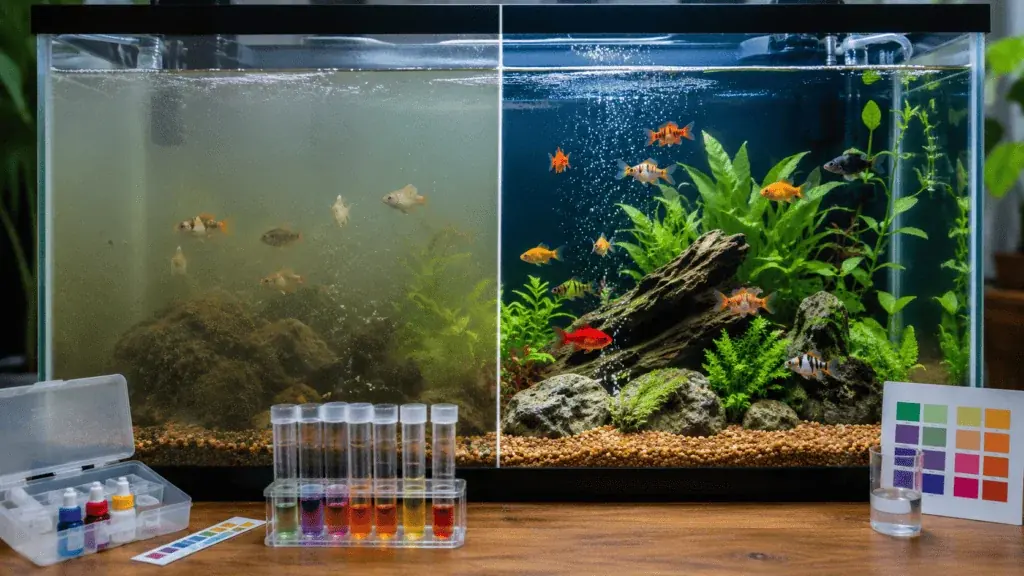
About 60% of new aquarium owners experience cloudy water within the first month and most make it worse by panicking and changing the water. You’re not the only one who has a tank that looks like a snow globe, and the solution is actually quite easy.
Knowing how to keep fish aquarium water clear comes down to three things: what is the real cause, the proper water and filtration system from the start, and not overcorrecting. You will find out why your water is cloudy, the quickest remedy, what type of water to use, how to keep it crystal clear for a long time, and how it can be done without a filter or in a bowl.
1. Why Is Your Fish Tank Water Cloudy?
Cloudy water can have many causes and treating the wrong cause is why so many hobbyists find themselves in an endless cycle of water changes that do not cure the problem.
Bacterial Bloom (New Tank Syndrome)
If you see a white or grey haze in the first weeks of a new setup, it is almost always a bacterial bloom: heterotrophic bacteria that multiply in order to feed on the ammonia and waste before your biofilter has matured (usually takes 2-8 weeks). Blooms tend to get worse if there are big water changes in the tank, as the bacteria attempting to stabilize the tank are removed.
Green Water (Algae Bloom)
A green tint, not white haze, is indicative of free-floating algae, which is caused by excess light, excess nitrates and phosphates. Tanks that are close to windows or lit for 8-10 hours a day are most susceptible.
Suspended Dust and Sediment
Cloudiness immediately after setting up or vacuuming is typically just gravel, sand, or aquasoil dust in the water. It usually resolves itself within 24-48 hours as it settles or is filtered out mechanically.
Overfeeding and Waste Buildup
Uneaten food decomposes to organic debris, which supports the growth of bacteria and algae, the most common preventable source of chronic cloudiness, and the quickest to correct.
2. Fastest Way to Clear Cloudy Aquarium Water
If you need results today, do these steps in order rather than using chemicals first.
Step 1: Stop Feeding for 24 Hours
Stopping the food stops the bacteria and algae from getting a food source straight away, without causing any damage to your tank’s biology.
Step 2: Run a Filter Polish, Not a Water Overhaul
Place a fine filter pad, floss, or wool on the mechanical stage of your filter; this will catch free-floating particles much more efficiently than a water change will dilute the issue. A clarifier can be useful in that it will cause the microscopic particles to clump together, which can be filtered, but it will not cure the problem.
Step 3: Do One Modest Water Change, Not Several
Water changes of 15-20% will eliminate dissolved organics without eliminating beneficial bacteria. Don’t have 50%+ changes (resets progress and can cause a new bloom).
Step 4: Check and Reduce Lighting
If the cloudiness has any green tinge, cut your photoperiod to 6 hours a day for a week and keep the tank out of direct sunlight. This is often enough to clear up algae-related haze, without the use of any product.
Most bacterial blooms resolve within 1-2 weeks once the biofilter is able to catch up; algae cloudiness usually resolves within days of a lighting and nutrient correction.
3. What Water to Use for a Fish Tank
Most beginner guides overlook this important fact: the water you start with determines the maximum clarity of your tank.
Tap Water (Treated)
Most freshwater tanks can be filled with tap water after the chlorine and chloramine are removed with a dechlorinator, as this water is not harmful to the fish or beneficial bacteria. If it is “conditioned” (left outside), it will lose its chlorine but not its chloramine.
Is Distilled Water Good for a Fish Tank?
Distilled water removes virtually all of the minerals and contaminants (good thing, except fish and bacteria need trace minerals). Never use straight, must be remineralised first.
Purified and Bottled Water for a Fish Tank
It is not a long-term solution, as purified or bottled water can be used for small top-offs, but it will be costly and many brands contain enough minerals to cause unpredictable hardness changes.
Reverse Osmosis (RO) Water
RO water removes nitrates, phosphates, silicates, and minerals that cause hardness, leaving you with a clean slate for remineralization. It is the most popular base for planted tanks, shrimp, and reef aquariums.
| Water Type | Contaminant-Free? | Needs Additives? | Best For | Cost |
| Treated Tap Water | No (needs conditioner) | Dechlorinator only | Most community freshwater tanks | Lowest |
| Distilled Water | Yes | Yes — full remineralization | Emergency top-offs only | Moderate |
| Purified/Bottled Water | Partial | Sometimes | Small top-offs, travel | High |
| RO Water | Yes | Yes — tailored remineralization | Planted tanks, shrimp, reef, breeding | Moderate (with RO unit) |
4. How to Keep Fish Aquarium Water Crystal Clear Long-Term
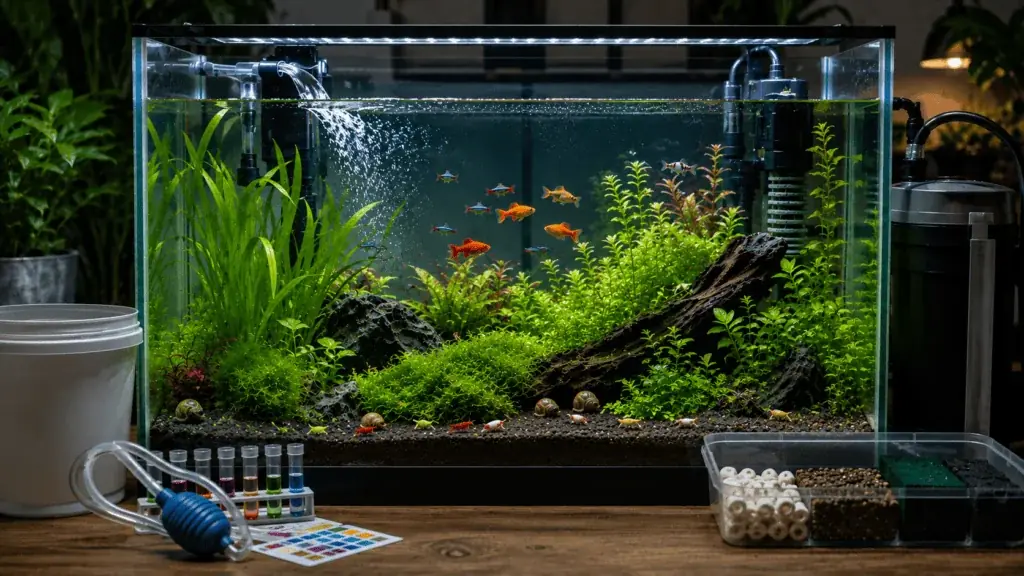
A system, not a single product, is the basis of lasting clarity, and it is comprised of 4 habits.
Match Filtration to Bioload, Not Tank Size Alone
Use biological, mechanical, and chemical media (such as activated carbon) in a filter that turns over 4-6 times the tank volume per hour. The No. 1 cause of chronic haze is a filter that is rated for the size of your tank but is too small for the bioload.
Feed Deliberately
Only feed the amount of food that fish finish in 2-3 minutes once or twice a day. Most existing clarity issues are due to overfeeding, as uneaten feed turns into ammonia and sludge.
Stock Appropriately
The rule of thumb is about 1 inch of fish per gallon, which is reduced for bulkier or territorial fish. The filtration capacity is exceeded long before it becomes apparent.
Add a Cleanup Crew
The snails, shrimp, and bottom feeders eat the uneaten food and detritus which would otherwise feed the bacteria and algae; a low-maintenance method to keep the aquarium clean between cleanings.
5. How to Keep Fish Tank Water Clear Without a Filter (DIY & Natural Methods)
There is no mechanical filtration in bowls, betta cubes, and small nano tanks, so they rely on your routine to keep them clear.
How to Keep Fish Bowl Water Clear
The unfiltered bowls require more frequent and smaller water changes (about 20% every 2-3 days) than a single large water change weekly. Stocking is very light, with a bowl of fish usually holding just one fish.
How to Keep Betta Fish Tank Water Clear
Bettas are frequently housed in small, poorly filtered tanks, and light, regular feeding (2-4 pellets once or twice a day) and twice-weekly partial water changes will have more effect on clarity than any additive. If you have a container that will allow it, a gentle sponge filter will provide stability without a current betta dislikes.
Natural and DIY Clarity Methods
Live floating plants such as water lettuce, hornwort, and duckweed can act as a natural filter by absorbing nitrates and ammonia that stimulate blooms. Even if not used in conjunction with a powered filter, a mesh bag of activated carbon or Purigen can passively adsorb discoloring compounds. Gentle aeration from an airstone also promotes bacteria that digest waste naturally.
Cleaning a Tank Without Changing All the Water
Only remove a third of the substrate in each session and alternate areas weekly to remove the waste without disturbing your entire bacterial colony or requiring a complete drain and refill.
6. How to Keep Aquarium Water Clear After Cleaning
It is common for the water to become cloudy immediately after cleaning, and it is often caused by over-cleaning, not under-cleaning.
Don’t Rinse Filter Media in Tap Water
The good bacteria on your filter media are killed on the spot by chlorine. Rinse sponges and remove tank water, or use dechlorinated water to maintain the colony that maintains clarity.
Avoid Washing the Tank or Decor With Soap
Soap or household cleaner residue can remain in the fish tank or decorations for days and be harmful to fish. Only use hot water and a separate algae scraper or soft brush.
Stagger Your Cleaning Tasks
Do not gravel-vacuum, fully rinse filter media, and do a big water change in one go; each of these will decrease your beneficial bacteria count, and combining the three will cause another bloom, which will undo the entire cleaning. Schedule large tasks a couple of days apart.
Reintroduce Beneficial Bacteria if Needed
In case of cloudiness in the water within 24-48 hours after aggressive cleaning, a bottled nitrifying bacteria supplement can help restore the biofilter more quickly than allowing it to rebuild on its own.
FAQ:
Why does my aquarium water keep getting cloudy no matter what I do?
Almost always, cloudiness is caused by overfeeding, overstocking, or undersized filtration equipment for the bioload. A root cause is not going to be solved by clarifiers if it generates more waste than the clarifier can remove.
How long does it take for cloudy aquarium water to clear naturally?
A new tank with a bacterial bloom should take 1-2 weeks to clear as the filter matures. Algae-induced green water typically clears up in days when the light and excess nutrients are reduced.
Can I use tap water for my aquarium?
Yes, after treating with a dechlorinator to neutralize the chlorine and chloramine. Chlorine will be removed from tap water, but chloramine and minerals will not be removed, so it is necessary to condition the water.
Is distilled water good for a fish tank?
Distilled water does not contain trace minerals that fish and bacteria require on its own. It must be remineralized with an appropriate additive before use.
What’s the fastest way to clear cloudy aquarium water?
Withhold feed for 24 hours, add fine mechanical filter media to capture the particles, and perform a single moderate (15-20%) water change instead of multiple large ones that can upset the bacteria.
How do I keep aquarium water clear without a filter?
Consider small, regular water changes (20% every 2-3 days), low stocking levels, floating live plants, and passive aeration.
Does washing a fish tank with soap help clean it?
No, soap and cleaners leave behind a toxic residue which affects fish and water chemistry. Only use hot water and a special aquarium scraper.
How often should I clean my fish tank to keep the water clear?
Perform light checks daily, a partial gravel vacuum and 15-25% water change every 1-2 weeks, and complete water testing monthly. Too much cleaning is as disruptive as too little.
Conclusion
Three repeatable water and aquarium maintenance habits lead to crystal clear water: proper diagnosis of bacterial blooms, algae, or sediment; beginning with the proper water and filtration for the correct bioload; and maintaining a consistent, moderate cleaning schedule rather than overcorrecting. The same rules apply for a fully filtered system, bowl, or betta cube, and that is light feeding, proper stocking, and waiting for the system to stabilize.
The first step is to determine the type of cloudiness you have today and follow the quickest steps above, and then make the long-term plan a habit in your weekly routine. Your fish and the view of your fish tank will thank you.
