
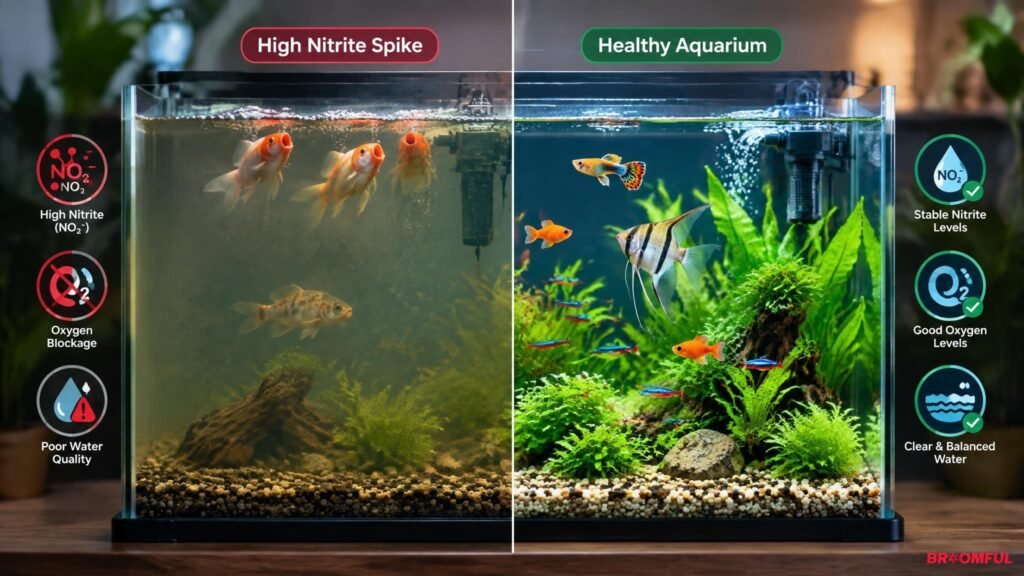
Nitrite at 0.5 ppm is already enough to start suffocating fish from the inside out, and most beginners only find out once their fish are gasping at the surface. Nitrite (NO2⁻) is the invisible middle stage of the nitrogen cycle. When it spikes, it binds to hemoglobin in fish blood and blocks oxygen transport, a condition called “brown blood disease.”
Anyone searching for how to fix nitrite levels in fish tank water is probably dealing with new tank syndrome, an overstocked aquarium, or a crashed filter. The good news: nitrite problems are almost always fixable within days, not weeks.
This guide covers what causes nitrite spikes and how to lower nitrites in your fish tank fast and naturally. It also covers safe nitrite levels for different species, how nitrite relates to ammonia and nitrate, and the exact water-change and dosing schedule that resolves a spike without crashing your cycle a second time.
What Causes High Nitrite Levels in a Fish Tank
Fish waste and uneaten food break down into ammonia. Nitrosomonas bacteria convert that ammonia into nitrite, and a second group, Nitrospira, converts the nitrite into nitrate. Nitrite levels rise whenever that second step lags behind the first.
New Tank Syndrome
This is the most common cause. Ammonia-oxidizing bacteria get established faster than nitrite-oxidizing bacteria in a brand-new aquarium, so nitrite builds up in a bulge that can last one to three weeks during cycling.
Overstocking or Overfeeding
Adding too many fish too fast, or feeding more than the fish can eat in two minutes, overwhelms what the bacterial colony can handle. Uneaten food rots and adds an extra ammonia-to-nitrite load the tank wasn’t sized for.
Filter Media Changes or Cleaning
Rinsing biological filter media in tap water, replacing cartridges too often, or leaving a filter without power for more than a few hours kills off nitrite-consuming bacteria. The result is what’s known as a “mini-cycle.”
Medications and Chemical Disruption
Antibiotics and some parasite treatments aren’t selective. They can wipe out beneficial bacteria along with the target pathogen, which temporarily disables the nitrogen cycle.
Signs of High Nitrites in Your Aquarium
Fish Gasping at the Surface
Nitrite interferes with oxygen transport rather than the water’s oxygen content, so fish gasp at the surface even in well-aerated tanks. That’s the key difference from low dissolved oxygen alone.
Brown or Tan Gills
Nitrite oxidizes hemoglobin into methemoglobin, which can’t carry oxygen. Gill tissue and blood literally turn brownish, and the color shows up first on pale or thin-gilled species.
Lethargy and Loss of Appetite
Oxygen-starved fish conserve energy. A sudden drop in feeding response together with clamped fins is often an early nitrite warning sign, appearing before gill discoloration is visible.
Rapid or Erratic Gill Movement
Fish increase their gill beat frequency to make up for the blood’s reduced oxygen-carrying capacity, even when ammonia and pH are both normal.
Safe Nitrite Levels: What’s Actually Acceptable
The ideal nitrite level in any established aquarium is 0 ppm. Unlike nitrate, nitrite has no “acceptable ongoing” level. Any detectable nitrite means the biological filter isn’t keeping pace with bioload.
| Nitrite Level (ppm) | Risk Level | Typical Cause | Action Needed |
| 0 ppm | Safe | Mature, balanced bio-filter | None — maintain routine |
| 0.25–0.5 ppm | Low risk | Early cycling or minor overfeeding | Water change within 24 hrs |
| 0.5–1.0 ppm | Moderate | Active cycling, mild overstocking | 25–50% water change, reduce feeding |
| 1.0–2.5 ppm | High | New tank spike, filter crash | Daily 50% water changes, add salt buffer |
| 2.5+ ppm | Severe | Major bio-filter failure | Emergency water changes every 12 hrs, consider rehoming fish temporarily |
Freshwater fish are generally more sensitive than brackish or saltwater species, since chloride in saltwater competes with nitrite uptake at the gill. Shrimp and scaleless fish (loaches, certain catfish) are more sensitive still and should be kept as close to 0 ppm as possible at all times.
How to Fix Nitrite Levels Fast: Step-by-Step
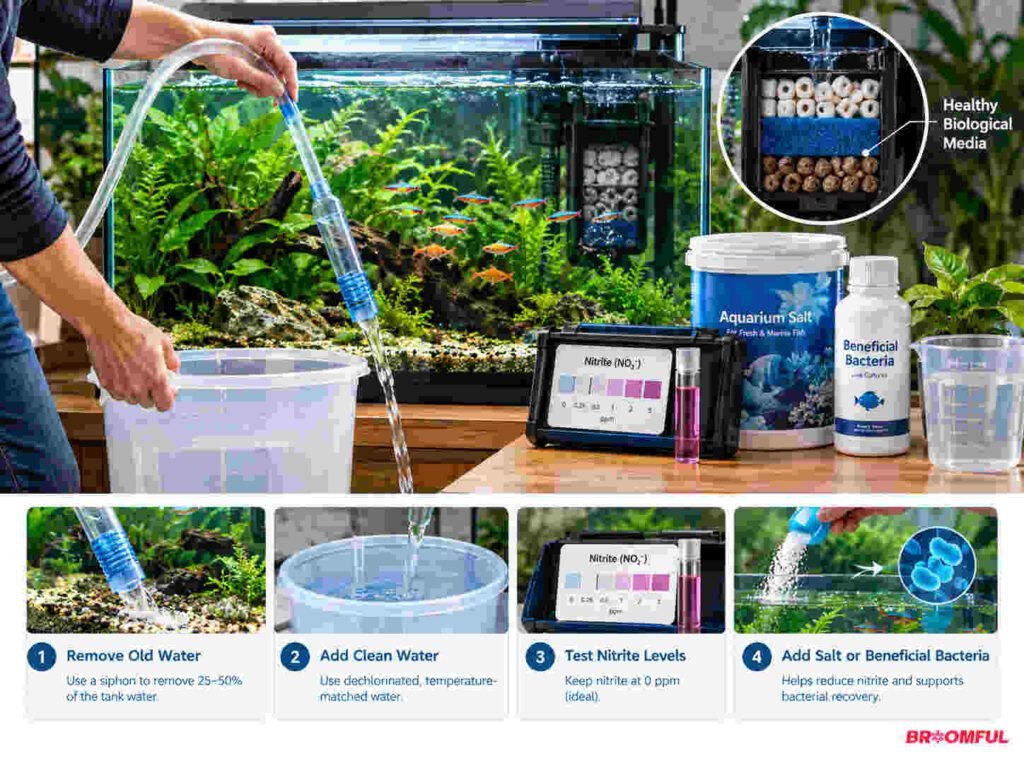
Step 1: Do an Immediate Partial Water Change
A 25–50% water change dilutes nitrite concentration immediately. Match the temperature and dechlorinate the new water. A temperature swing adds stress to gills that are already compromised.
Step 2: Add Aquarium Salt or a Chloride Buffer
Plain, non-iodized aquarium salt (sodium chloride) at roughly 1 tablespoon per 5 gallons introduces chloride ions that competitively block nitrite absorption at the gills. That buys the fish time while bacteria catch up. It’s a supportive measure, not a cure, since it treats the symptom rather than the source.
Step 3: Stop Feeding for 24–48 Hours
Cutting bioload input gives the existing bacteria colony a chance to work through the backlog of ammonia and nitrite without new waste being added.
Step 4: Test Twice Daily and Repeat Water Changes
Test morning and evening during an active spike. Repeat 25–50% water changes whenever nitrite exceeds 0.5 ppm, until readings stay near zero for 48 consecutive hours.
How to Lower Nitrites Naturally (Long-Term Fixes)
Seed the Filter with Established Bacteria
For how to fix nitrite levels in a fish tank naturally, the fastest route is transplanting mature filter media, substrate, or a bottled live-bacteria product (containing Nitrospira, not just Nitrosomonas) from an established, healthy tank.
Add Live Plants
Fast-growing stem plants and floaters like water sprite, pothos, or hornwort absorb ammonia and nitrite directly as a nitrogen source. They compete with the biological cycle for it and take pressure off the bacteria. It’s one of the most reliable ways to lower nitrites in a fish tank naturally, with no chemical intervention.
Increase Surface Agitation and Oxygenation
Extra dissolved oxygen helps the fish, who need it even more during a nitrite spike, and the aerobic bacteria that carry out nitrification, which can’t function without it.
Use Zeolite or Ammonia-Binding Media Temporarily
Zeolite targets ammonia rather than nitrite directly, but less upstream ammonia means slower new nitrite production. The bacterial colony gets breathing room to catch up on the existing backlog.
Fixing Nitrites While Cycling a New Tank
Understand the Cycling Timeline
A fishless cycle typically takes 4–6 weeks. Nitrite usually peaks in weeks two to four, then falls to zero as Nitrospira populations establish. Knowing how to lower nitrites in a fish tank while cycling starts with accepting the spike as a normal, temporary phase rather than a sign of failure.
Fishless Cycling vs. Fish-In Cycling
| Method | Nitrite Spike Handling | Fish Welfare Risk | Speed |
| Fishless cycling | Dose ammonia directly, no livestock present | None | 4–6 weeks |
| Fish-in cycling | Requires daily water changes during spike | High without intervention | 4–8 weeks |
| Seeded cycling | Minimal or no spike, uses mature media | Low | 1–3 weeks |
Dose Ammonia Conservatively
In a fishless cycle, dosing to 2–4 ppm ammonia repeatedly is enough to build bacteria without creating an unnecessarily large nitrite bulge to work through later.
Add a Bacterial Starter Product
Commercial nitrifying bacteria supplements shorten the nitrite phase substantially compared with waiting for bacteria to colonize from ambient sources alone.
Nitrite vs. Ammonia vs. Nitrate: How They’re Connected
The Nitrogen Cycle in Order
Fish waste → ammonia (NH3) → nitrite (NO2⁻) → nitrate (NO3⁻). Fixing nitrite levels in a freshwater fish tank without knowing this chain usually means chasing the wrong test kit reading.
What Causes High Nitrates in a Fish Tank
Nitrate accumulates when nitrite conversion is working, but nitrate isn’t being exported through water changes or plant uptake. Overstocking, infrequent water changes, and heavy feeding drive it most, and they’re the same root causes behind high nitrite.
Ideal Nitrate Level in a Fish Tank
Nitrate, unlike nitrite, is tolerated at low levels. The ideal nitrate level in an aquarium is generally under 20 ppm for freshwater community tanks and under 10 ppm for reef and shrimp tanks. Nitrate (NO3) is far less acutely toxic, but above those thresholds it still causes chronic stress and algae growth.
How to Fix Ammonia and Nitrate Levels in a Fish Tank Together
Ammonia, nitrite, and nitrate share a cause-and-effect relationship, so the fix is the same triage: water changes, reduced feeding, added biological filtration, and live plants. Treating nitrate in isolation, without addressing upstream ammonia and nitrite, just delays the same underlying bioload problem.
Feeding, Bacteria, and Water Quality: Prevention Habits
How Many Times a Day Should You Feed Fish
Most tropical fish do best fed once or twice daily, only what they’ll consume within two minutes. Overfeeding is one of the most common and most preventable contributors to nitrite and nitrate spikes, since excess food decomposes into the same ammonia-nitrite-nitrate chain as fish waste.
Bacteria, E. Coli, and Aquarium Water Safety
Aquarium water can carry opportunistic bacteria, including E. coli, particularly in tanks with poor filtration or overcrowding. Standard aquarium filters with mechanical and biological media aren’t designed to remove E. coli specifically. UV sterilizers are the most effective aquarium-safe method for reducing free-floating bacterial and pathogen loads, since UV light disrupts bacterial DNA on contact.
Do Water Filters Remove E. Coli
Conventional carbon and sponge filtration primarily target ammonia, nitrite, debris, and odor, not bacterial pathogens. Removing E. coli specifically from water generally requires UV treatment, ozone, or fine-pore filtration rated for bacteria, which is why UV sterilizers are increasingly common add-ons in shrimp and breeding tanks.
Routine Testing Schedule
Weekly testing of ammonia, nitrite, and nitrate in established tanks, and daily testing during cycling or after any disruption, catches spikes before fish show symptoms.
FAQ: People Also Ask
How do I fix high nitrite levels in a fish tank fast?
Do an immediate 25–50% water change, add aquarium salt to block nitrite absorption at the gill, and stop feeding for 24–48 hours. Retest twice daily and keep repeating water changes until nitrite drops below 0.5 ppm.
What is a safe nitrite level in an aquarium?
The only truly safe nitrite level is 0 ppm. Even 0.25–0.5 ppm means the biological filter is falling behind the bioload, so do a water change within 24 hours before the reading climbs further.
How do I lower nitrites in a fish tank naturally?
Add fast-growing live plants, seed the filter with mature bacteria-colonized media, and increase surface agitation for oxygen. None of these needs chemicals, and all of them support long-term filter stability.
Why are my nitrites high but ammonia is zero?
Ammonia-oxidizing bacteria are established and working, but nitrite-oxidizing bacteria haven’t caught up yet. It’s a normal mid-cycle stage that typically resolves within one to two weeks.
Is it normal to have high nitrites while cycling a new tank?
Yes. Nitrite spikes are a standard part of the nitrogen cycle, usually peaking between weeks two and four of a fishless cycle before falling to zero as bacteria populations mature.
What causes high nitrite levels in a fish tank?
The leading causes are new tank syndrome, overstocking, overfeeding, and a disrupted biological filter, whether from rinsing media in tap water or from medications that kill beneficial bacteria.
How often should I feed my fish to avoid nitrite spikes?
Once or twice daily, giving only what the fish finish within two minutes. Uneaten food decomposes into the same waste chain, which makes overfeeding a major contributor to ammonia and nitrite spikes.
Can water filters remove E. coli from aquarium water?
Standard mechanical and biological filters don’t remove E. coli specifically. UV sterilizers are the most reliable aquarium-safe method, since UV light disrupts bacterial DNA on contact.
Conclusion
Fixing nitrite levels in a fish tank comes down to three fundamentals: dilute the immediate spike with water changes, support fish with salt while bacteria catch up, and address the root cause, whether that’s a new tank still cycling, overfeeding, or a disrupted filter. Over the long term, live plants and a mature, undisturbed biological filter are the most reliable natural defenses against nitrite ever climbing above zero again.
Key takeaways:
- Zero ppm nitrite is the only truly safe level, so treat any reading above that as an active problem.
- Water changes and reduced feeding are the fastest fix. Live plants and seeded bacteria are the best long-term prevention.
- Nitrite spikes during cycling are normal and temporary, not a sign your tank has failed.
Test your water today. If nitrite reads above 0 ppm, start your first water change now rather than waiting for symptoms to appear in your fish.
