
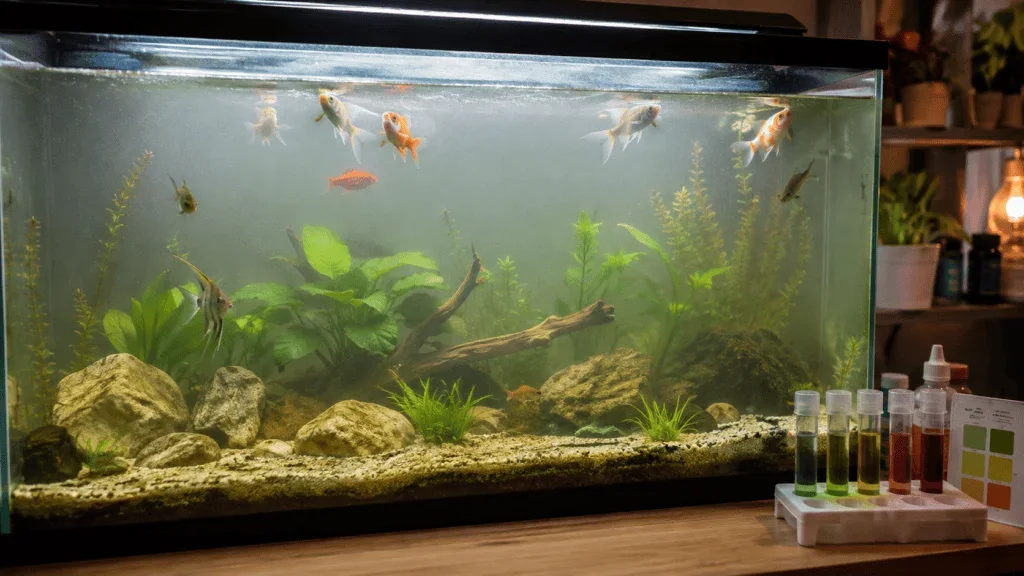
If your test kit suddenly went an alarming greenish or orangeish color, you’re having a very common (and very dangerous) problem in the hobby: high ammonia in a fish tank. Ammonia is invisible and odorless at most home-aquarium concentrations, but at higher levels it can cause severe injury or death in fish within hours. A reading of even 0.25 ppm indicates the tank is not safe to use just yet.
This guide will explain what causes high ammonia levels in an aquarium, how to recognize the symptoms in your fish, how to bring ammonia down fast (with and without a water change), how to prevent it from coming back, and how ammonia relates to the nitrogen cycle that keeps a tank stable long-term. We will also be discussing the toxicity of ammonia to humans and safe use of pure ammonia if you are fishless cycling a new tank.
What Is Ammonia and Why It Builds Up in Aquariums
Ammonia (NH₃) is a continuous nitrogenous waste product that is produced in all aquariums. It is produced by fish respiration and urine, the breakdown of food, dead plants, and decaying organisms. A balanced tank will have beneficial bacteria (mainly Nitrosomonas species) that turn ammonia to nitrite, and another group of bacteria (Nitrobacter and Nitrospira) will convert nitrite to nitrate, which is a much less toxic compound and can be filtered out with water changes or by the plants. It is the most important biological system in a fish tank and is known as the nitrogen cycle or aquarium cycle.
High ammonia occurs when the bacterial colony can’t keep up with the waste production. Unlike nitrate, which accumulates over time and in a predictable way, ammonia can rise in hours and can happen at any time and for no apparent reason, so it can surprise the beginner.
What Causes High Ammonia in a Fish Tank
An Incomplete or New Tank Cycle
The most frequent situation in the hobby is high ammonia in a new fish tank. A new aquarium is sterile and does not have a bacterial population established; therefore, there is no bacteria to break down any ammonia that is added either by fish or a fishless cycle. It is a normal occurrence in the first 2-6 weeks of a tank’s life, but becomes a problem as soon as livestock is introduced before the cycle is complete.
Overstocking and Overfeeding
Each fish adds to the bio-load. If too many fish are added at once or too much feed is given in two or three minutes, the feed will rapidly turn to ammonia. One of the most common reasons for high ammonia levels in aquarium systems that were previously stable
Dead Organisms and Decaying Matter
The death of a fish, snail, or shrimp behind a rock or under substrate can drive ammonia levels up significantly in just one day. The decomposition of plant leaves has the same effect.
Filter Disruption
The beneficial bacteria are primarily filter media bacteria and not free-floating in the water column. If filter sponges are rinsed in tap water (chlorine will kill the bacteria) or all the media are changed at once, or if there is a power failure that brings the filtration system to a standstill for several hours, the colony can become upset, and an ammonia spike can occur in a healthy tank.
Chemical and Medication Interference
Some drugs, even some water conditioners, can inhibit or destroy nitrifying bacteria. Sudden high ammonia in tropical fish tank setups mid-treatment is often caused by copper treatments and antibiotics.
Substrate and Decor Issues
Too deep, not cleaned substrate will result in a slow and steady release of ammonia, which can be hard to detect.
Comparison: Common Ammonia Sources by Tank Age
| Tank Age | Most Likely Ammonia Cause | Typical Severity |
| 0–4 weeks (new/cycling) | Incomplete nitrogen cycle | High, expected |
| 1–6 months | Overstocking, overfeeding | Moderate to high |
| 6+ months | Dead livestock, filter disruption, medication | Sudden spike |
| Any age | Substrate buildup | Slow, chronic |
Signs and Symptoms of High Ammonia in a Fish Tank
Ammonia poisoning is sometimes referred to as “new tank syndrome,” but it can also be a problem in an established tank. Keep an eye out for these symptoms of high ammonia in fish tank water:
Behavioral Symptoms
- Gasping at the water’s surface
- Fins that are tightly clamped to the body.
- Lethargy, or prolonged hiding, for prolonged periods
- Not eating or spitting out food
- Uncoordinated swimming or darting.
Physical Symptoms
- Ammonia burn: Red or purple streaking on the gills, fins or body is a form of chemical tissue damage caused by ammonia.
- Inflamed, ragged-looking gills
- Cloudy eyes
- Loss of slime coat from the skin, making it rough or patchy
Tank-Level Signs
- Cloudy or hazy water (usually with a bacterial bloom that follows an ammonia spike)
- A sudden death of the fish in which there was no previous disease.
Several of these signs together usually tell what high ammonia looks like in a fish tank: do the test and don’t guess!
How to Test Ammonia Levels the Right Way
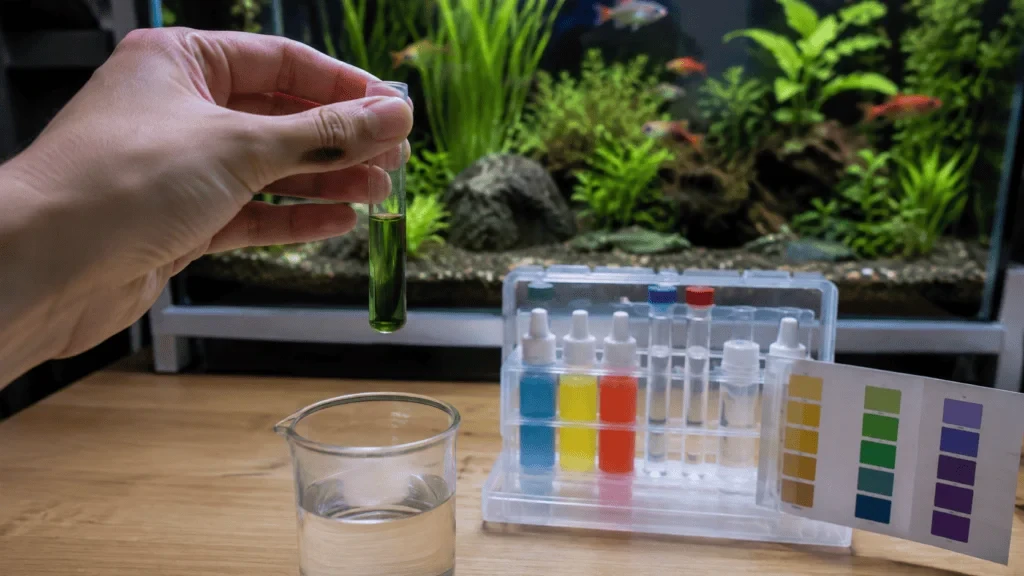
Fish aquarium water testing should be conducted weekly in established aquaria and daily in newly established aquaria. Test strips are much less accurate than liquid reagent test kits (such as the API Freshwater Master Test Kit) for ammonia level test readings.
Understanding the Ammonia Scale
So what is considered high ammonia in fish tank water? Here’s the general threshold most aquarists follow:
| Ammonia Reading (ppm) | Risk Level | Action Needed |
| 0 ppm | Safe | None |
| 0.25 ppm | Elevated — early warning | Monitor closely, test daily |
| 0.5 ppm | Stressful for most fish | Partial water change recommended |
| 1.0 ppm | Toxic | Immediate water change required |
| 2.0+ ppm | Severe, life-threatening | Emergency intervention |
Most aquarists will not consider a reading of 0.25 ammonia in fish tank water lethal on its own, but it should never be ignored; it’s often the first sign of a cycle stalling or a bio-load imbalance. In liquid kits, the ammonia test tube color changes from pale yellow (0 ppm) to green and then deep blue-green with increasing concentrations, so always compare against the manufacturer’s printed chart for accuracy under natural light.
How to Get Rid of High Ammonia in a Fish Tank
Step 1: Perform an Immediate Partial Water Change
The quickest, physical method of reducing ammonia is to change 25–50% of the water. Remix the new water to the same temperature before adding it, and dechlorinate it before adding.
Step 2: Add a Detoxifying Conditioner
Ammonia-binding products like sodium thiosulfate or amine-based detox products (Seachem Prime) will bind ammonia into a less harmful, temporary form, giving the bacterial colony time to catch up for 24-48 hours. This is the primary method for how to remove ammonia from a fish tank without water change in an emergency, but it should be used in conjunction with a water change as soon as possible.
Step 3: Stop Feeding for 24–48 Hours
Minimizing the organic input reduces the amount of raw material that bacteria have to process, and this hastens recovery.
Step 4: Check for and Remove Dead Matter
Check for decaying fish, snails, or uneaten food under decor, in filter intakes, and along the substrate.
Step 5: Boost Beneficial Bacteria
Bacterial supplements are available in bottles and contain live nitrifying bacteria to help get the tank working quickly by adding the bacteria directly to the water, such as Seachem Stability and Fritz Turbo Start.
Step 6: Increase Aeration
Nitrifying bacteria require oxygen to work well. An air stone or surface agitation will aid in the breakdown of ammonia.
Natural, Long-Term Removal
Live plants are the best solution for the long run if you are asking how to remove ammonia from a fish tank naturally. Bacteria compete with fast-growing species such as water sprite, hornwort, and duckweed for ammonia, which is directly absorbed by these species as a nitrogen source. Moderate ammonia loads can be easily handled much more quickly in a heavily planted tank than in an unplanted tank.
High Ammonia After a Water Change: Why It Happens
If you notice high ammonia in a fish tank after a water change, there are a couple of reasons for this:
- Tap water containing chloramine: In some municipal water systems, chloramines are used in place of chlorine. If a conditioner disrupts the chloramine bond, free ammonia will be released into the water, which will be a false reading and will go away within 24-48 hours when bacteria process it.
- Disturbance of bacterial colonies: When gravel is vigorously vacuumed, some of the bacteria in the gravel may be disturbed and removed.
- Incomplete dilution: If ammonia was already rising before the change, a 25% change only reduces it by roughly a quarter, not to zero.
If the reading remains high after 48 hours, consider it a new spike and repeat the above steps for fixing the spike.
Preventing Future Ammonia Spikes
- Stock gradually. Don’t introduce fish in large numbers over a short period of time in a new tank; introduce them one by one over weeks.
- Feed sparingly. Feed only those fish that will eat in 2-3 minutes, once or twice a day.
- Rinse filter media in tank water, not with tap water, to maintain bacteria.
- Regularly vacuum substrate but gently, and not too much in one go.
- Maintain a consistent maintenance schedule; 10-20% water changes per week will help prevent any gradual increases.
- Test before and after introducing any new addition, whether animal, medicine, or decoration.
Using Pure Ammonia for Fishless Cycling
Aquarists who have done fish tank cycling before often use pure ammonia for fish tank cycling to create a colony of bacteria before introducing any fish. This process uses ammonium chloride for fishless cycle dosing and lets the nitrogen cycle start without risking fish. To add ammonia safely, dose to roughly 2-4 ppm, test the water daily, and continue until both ammonia and nitrite reach 0 ppm in 24 hours (usually 4-6 weeks). This is the best method to avoid any high ammonia in a new fish tank altogether.
Is Ammonia in a Fish Tank Dangerous to Humans?
Normal contact with aquarium concentrations of ammonia is not a major health hazard for humans. In a meaningful way, is ammonia in a fish tank dangerous to humans? No, the concentration of ammonia in a household aquarium is too low to be harmful from occasional contact or from being in the vicinity of an open tank. However, sensible precautions apply: Do not drink water from the fish tank, wash hands after water changes, and ensure good room ventilation when dosing concentrated ammonia for a fishless cycle, as the concentrated ammonia itself (before dilution) can be irritating to the eyes, skin, and airways.
FAQ:
What is considered high ammonia in a fish tank?
Readings above 0.25 ppm are considered elevated, and above 0.5 ppm is stressful to most fish. Measurements ≥ 1.0 ppm are toxic and must be acted upon immediately through partial water changes and detoxifying conditioners.
How fast can I lower ammonia in an emergency?
For a spike in toxicity, a 25-50% water change and use of a bacterial conditioner such as Prime can reduce toxicity within minutes, but a 24-48 hour period of reduced feeding and bacterial support is required to eliminate toxicity.
Why is my new tank’s ammonia so high?
The new tanks don’t have a bacterial colony to break down the waste, so the ammonia will have no place to go. This is normal and will pass as the nitrogen cycle develops.
Can too much ammonia kill fish overnight?
Yes. Too much ammonia in fish tank water (typically greater than 2 ppm) can lead to gill and tissue damage and death in hours, particularly in sensitive fish such as bettas, tetras, and shrimp.
Does a water change always lower ammonia?
Typically, but not always, to zero. Only about 25% of the ammonia is removed with a 25% change, and the chloramine in the tap water may cause a temporary increase in the reading immediately after a change.
How long does it take for ammonia to reach zero naturally?
Once bacteria have been established in a maturing tank, ammonia will usually become undetectable within 1-2 weeks if no other overfeeding or overstocking occurs.
Is 0.25 ppm ammonia dangerous?
Not right away, but it is an indicator of a cycle problem. If left unchecked, it can grow rapidly, and regular tests and light feeding are advised at this stage.
What are the first signs of ammonia poisoning?
The first and best signs of high ammonia in a fish tank are gasping at the surface, clamped fins, red streaking on the gills or fins, and lethargy.
Conclusion
High ammonia in a fish tank is one of the most prevalent problems and one of the easiest to rectify if you know what to look for. Here are three things to keep in mind: Test regularly and do not ignore a reading as low as 0.25 ppm; water changes plus a detoxifying conditioner should be used when a spike occurs, and carefully, patiently, and gradually cycle the water, stock, and feed to prevent further spikes. Test your water today — it’s better to find high ammonia levels early than suffer a tragedy.
