
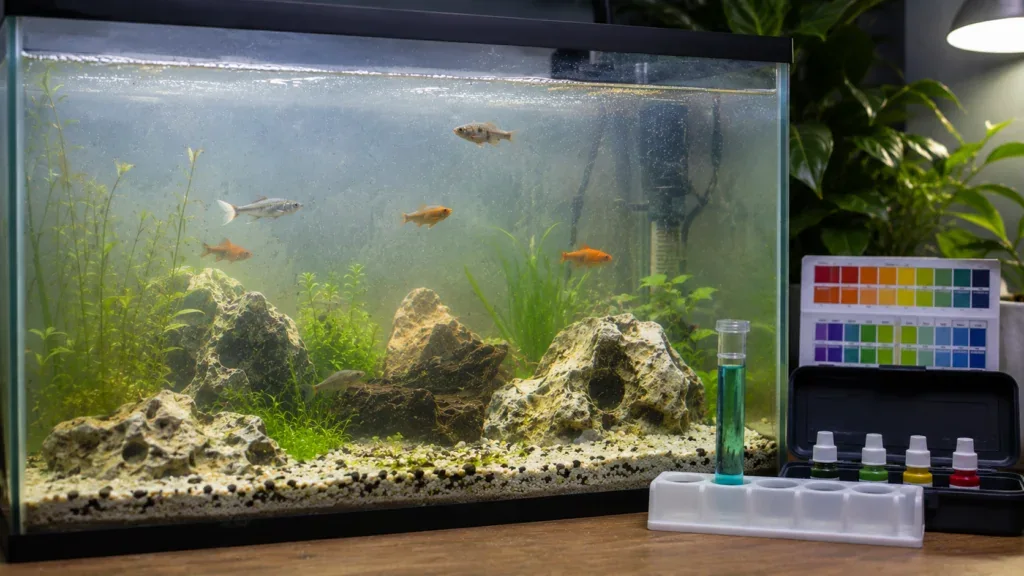
Did you know that more than 60% of the reported “mystery” fish deaths reported by hobbyists in online forums are due to unstable water chemistry, not disease? The most overlooked water parameter in the hobby is high alkalinity in the fish tank, which is generally unnoticed, non-threatening, and silent until your fish begin to gasp at the surface. Alkalinity is not pH, although it is closely related, and that is the reason why many aquarists are treating the wrong problem.
You’ll discover what causes high alkalinity, how it’s different from high pH, the specific signs to look out for (even in a betta tank and a freshwater community tank), and treatment options, both natural and chemical, to return your water chemistry to safe and stable levels. Also included will be a discussion on reef tank alkalinity, which is the opposite, so you don’t do more harm than good when trying to correct a freshwater problem.
1 . What Is Alkalinity — and How Is It Different From pH?
Most beginner guides confuse alkalinity with pH. This is the reason why many fishkeepers “fix” the wrong number.
Alkalinity Is a Buffer, Not a Direct Measurement of Acidity
Alkalinity (also known as KH or carbonate hardness) is the ability of your water to resist pH changes, or neutralize acids. It’s measured in degrees of KH (dKH) or parts per million (ppm) of calcium carbonate. Highly alkaline water has more dissolved carbonates and bicarbonates that provide a chemical buffer.
High pH in Fish Tank Meaning
High pH in a fish tank meaning simply refers to the fact that the water is more alkaline (basic) on the 0-14 pH scale; most of the freshwater community species prefer a pH of 7.6-8.0. pH is the acidity at one moment in time. Alkalinity is the reserve of the pH that helps to prevent it from swinging. High alkalinity and pH in a fish tank tend to move together, but not always identically.
Why the Distinction Matters for Treatment
| Parameter | What It Measures | Ideal Freshwater Range | Ideal Reef Range |
| pH | Acidity/basicity right now | 6.5–7.5 (community); 7.0–7.5 (betta) | 8.1–8.4 |
| KH (Alkalinity) | Buffering capacity/carbonate reserve | 3–8 dKH (54–143 ppm) | 7–11 dKH (125–200 ppm) |
| GH (General Hardness) | Dissolved calcium & magnesium | 4–8 dGH | 8–12 dGH |
If you do not treat the high pH with the high alkalinity and carbonate levels in the fish tank, you are just bailing water out of a leaky fish tank. This is the one thing that most articles will tell you to do: pH down, but they don’t explain why it just “bounces” back in 24 hours.
2. What Causes High Alkalinity in a Fish Tank?
Substrate and Décor Leaching Carbonates
Slowly, crushed coral, aragonite sand, some limestone rocks, and some “aquarium-safe” gravels will release calcium carbonate into the water. Decorative rocks that are labeled as “inert” can leach minerals over months.
Hard Tap Water Source
If your tap water is sourced from limestone aquifers, then it is already high in KH before it reaches your tank. Testing your source water is the number one overlooked cause; it should be the first step, not fifth.
Overuse of Buffering Products
Interestingly, many “pH stabilizer” or “cichlid salt” products that are recommended to help raise and maintain pH are actually responsible for causing high alkalinity in freshwater fish tanks when used in excess, particularly in freshwater tanks that do not require as much buffering (such as softwater species tanks).
Overcrowding and Overfeeding
Over time, excess organic waste decomposes to produce compounds that, in combination with some buffering substrates, increase the carbonate hardness over time, which is a less-discussed competitor.
Insufficient Water Changes
Evaporation, when water is not changed, will cause dissolved minerals (such as carbonates) to build up because pure water evaporates and minerals remain.
3. Symptoms of High Alkalinity and High pH in Fish Tanks
Behavioral Symptoms of High pH in Fish Tank
- Labored gill movements or gasping at the surface of the water, very quick.
- Uncontrolled swimming, darting, or “flashing” of decor.
- Sluggishness and clamped fins.
- Loss of appetite.
Physical Symptoms of High Alkalinity in Betta Fish Tanks
Betta fish are particularly sensitive, as they have developed in soft, slightly acidic rice paddies. Watch for:
- Discolored (faded or blotchy)
- Fin and tail damage, not caused by fin rot.
- More stress stripes (females) or labyrinth organ distress (reoccurring surface gulping)
Symptoms of High pH in Fish Tank After Water Change
If the pH suddenly rises immediately after a water change, the tap water is likely more alkaline than the water in the tank, which can lead to “pH shock.” Within 1-6 hours, symptoms include clamped fins, hiding, rubbing against surfaces (flashing), or gasping at the top. It’s not more chemicals; it’s acclimating fish slowly and testing source water KH before each change.
Long-Term Physiological Damage
Chronically high alkalinity and pH will reduce excretion of ammonia through the fish gills (un-ionized ammonia is more toxic at higher pH), meaning the same ammonia level is far more dangerous in high-pH water
4. How to Test and Measure Alkalinity and pH Accurately
Testing pH Levels in Water
Paper test kits are less reliable than liquid test kits (such as API Freshwater Master Test Kit) because they tend to lose accuracy when they are wet and humid and may read differently from one time to the next. Digital pH meters have the greatest accuracy and should be calibrated using buffer solutions every 1-2 months.
Testing KH (Alkalinity) Specifically
KH test kits are based on a titration method, in which drops are added one by one until the water turns color, and each drop represents about 1 dKH (17.9 ppm). Test tank water and source tap water separately; this will show if the problem is from outside the tank.
How Often to Test
- New Tanks / Cycling: every 2-3 days
- Established tanks: weekly
- Within 24 hours following any water change, substrate addition, or new decor:
5. How to Lower Alkalinity and pH in a Fish Tank Naturally
Driftwood and Tannins
Tannins are organic acids that slowly decrease the pH and KH in 1-3 weeks; they are released by natural driftwood, particularly Malaysian or spider wood. This is the best way to deal with high alkalinity in a fish tank without chemicals, as it does not shock fish and occurs slowly.
Indian Almond Leaves and Peat Moss
Humic and tannic acids are released by steeping catappa (Indian almond) leaves in your filter, or by placing a peat moss pouch in your filter. This has been a method used for decades by betta and blackwater species keepers, and it is slow, safe, and natural.
Reverse Osmosis (RO) Water Blending
The most consistent and long-term solution to a high alkalinity or hard source water is to mix RO water (which has near-zero KH) with your tap water. Test KH with a 50/50 mix and adjust the ratio accordingly.
Rainwater Collection
Rainwater is naturally soft, almost free of alkalinity, and when filtered and removed from urban pollutants, is a natural, free, effective additive; provided it is filtered and free from urban pollutants.
Reducing Buffering Substrate
If crushed coral or aragonite is to blame, then slowly removing and replacing it with inert sand/gravel will remove the continual carbonate source rather than treating symptoms over and over again.
| Natural Method | Speed | Best For | Risk Level |
| Driftwood/Tannins | Slow (1–3 weeks) | Softwater fish, bettas | Very Low |
| Indian Almond Leaves | Slow | Betta, blackwater tanks | Very Low |
| RO Water Blending | Immediate | Persistent hard tap water | Low (test after mixing) |
| Rainwater | Immediate | Budget-conscious hobbyists | Low (filter first) |
| Substrate Replacement | Gradual | Coral/limestone substrate tanks | Low |
6. How to Treat High Alkalinity With Chemical Products
pH Down for Fish Tanks
Commercial pH down products (usually phosphoric or hydrochloric acid-based) will rapidly drop the pH, but will not drop KH; the buffer will fight back, and pH will rise back up often in a day. Hence people complain that their pH “won’t stay down.”
pH Down Aquarium Products vs. KH Reducers
True alkalinity reducers are designed specifically to reduce carbonate hardness and provide a more permanent solution than regular pH drops. Always dose for known KH and never guess; overcorrection will cause pH to plummet rapidly.
The Safest Way to Fix High Alkalinity in a Fish Tank at Home
- Test KH and pH of both tank and tap water.
- Determine the source (substrate, tap water, or additives).
- Select ONE method (natural or chemical, not both at the same time).
- Change no more than 0.3 pH points per 24 hours.
- Retest every day for 1 week to ensure stability.
The best way to lower pH in an aquarium is almost always RO water blending and driftwood — chemical drops should be used as a short-term solution.
7. Reef Tank Alkalinity: When You Need to Raise It Instead
Marine Tank Alkalinity Works in Reverse
Marine tank alkalinity must remain high (7-11 dKH) as corals use carbonate to create their calcium carbonate skeletons.
How to Raise Alkalinity in a Reef Aquarium
The common ways of adding alkalinity to water for coral growth are two-part dosing solutions (calcium + alkalinity buffers) or a calcium reactor, as the natural consumption of coral continuously removes the alkalinity.
Why This Matters Even for Freshwater Keepers
The concept is that “high” is not necessarily a bad thing- it depends on the ecosystem you are working to maintain.
FAQ:
Is high alkalinity bad for fish?
Yes, particularly for soft water fish. High alkalinity is a factor that will maintain high pH, thereby stressing fish gills, increasing ammonia toxicity, and resulting in chronic health problems even if all other parameters are within acceptable limits.
High alkalinity in a freshwater fish tank is it always a problem?
Not always. African cichlids are hard-water fish that prefer high alkalinity. It is only an issue if it is not what the fish species needs in its natural habitat.
How do I lower pH level in my fish tank without hurting my fish?
Apply natural techniques such as driftwood, almond leaves, or RO water blending. It is not recommended to lower pH more than 0.3 pH points in 24 hours, as rapid pH changes are more harmful than the high pH itself.
Can high alkalinity kill fish directly?
It is usually found in combination with other factors, but it enhances the effects of ammonia toxicity and weakens immune systems, making fish highly susceptible to disease and secondary infections.
What’s the fastest way to test alkalinity at home?
A liquid KH titration test kit provides results in less than 5 minutes and will not deteriorate or misread over time like paper test strips.
Does a water change lower alkalinity?
Only if your source water is of lower KH than your tank. Water changes may increase the alkalinity of your water if it is hard. Always check the tap water KH first.
Why did my fish get sick right after a water change?
A pH change in a fish tank that causes sudden symptoms is not a contamination problem, but rather due to using water of a different pH from the source water and the tank.
Is high alkalinity dangerous for betta fish specifically?
Yes, bettas are more sensitive to high alkalinity in betta fish tanks than other community species that can thrive in hard water, like mollies or platies.
Conclusion
High alkalinity in a fish tank is a silent killer that takes patience and eliminates the need to guess. Here are three things to remember: First, alkalinity (KH) and pH are different, and both need to be tested and treated. Second, using natural solutions, such as driftwood, RO water, and decreased buffering substrate, provides a longer-lasting and safer solution than chemical pH-down drops. Third, “high” is not always a bad thing if you’re raising softwater freshwater fish; you may want to keep the water level low, but if you’re raising reef corals, you’ll want to keep the water high to give them the alkalinity they need to grow.
Test your KH and tap water now, determine your root cause, and make changes over time. Your fish’s gills and your peace of mind will thank you.
