
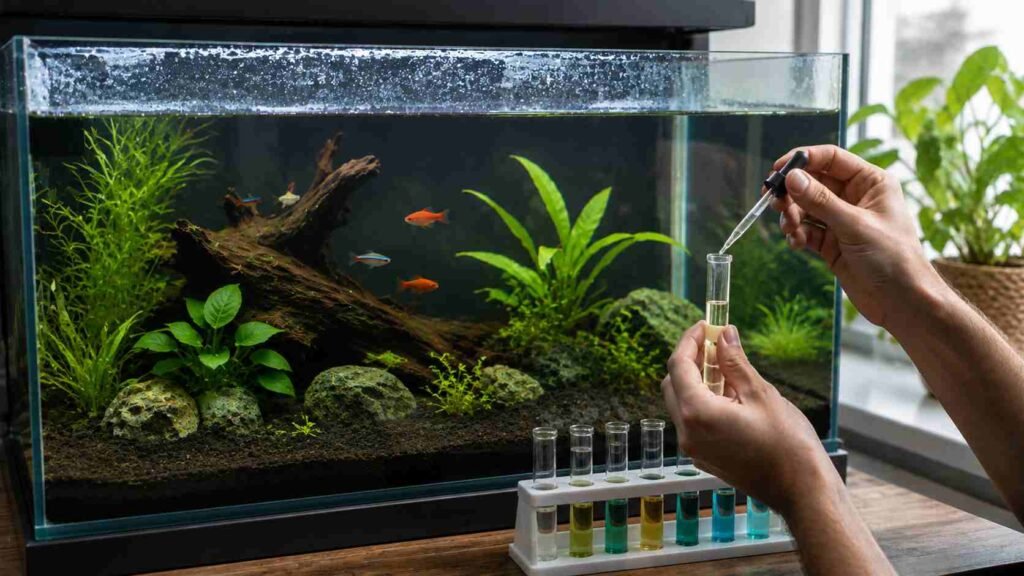
Almost 85% of all U.S. households receive hard tap water directly from the municipal supply, meaning that most new aquarium owners are unaware that they are filling their aquarium with hard tap water each week. Hard water in your fish tank may be the cause of cloudy glass and stressed fish when there is no apparent cause.
Hardness is a measure of the dissolved calcium and magnesium. These minerals are safe in small quantities (some fish require them). However, hard water at high levels can cause pH instability, interfere with plant uptake of nutrients, and stress sensitive fish such as bettas, tetras, and discus.
This guide will help you understand what hard water is, which fish and plants can live in hard water, how to properly test your water, and how to increase or decrease the hardness level safely using reverse osmosis, natural driftwood softening, and more.
What Is Hard Water in a Fish Tank?
Hard water in the fish tank refers to high levels of calcium (Ca²⁺) and magnesium (Mg²⁺). This is measured by aquarists as General Hardness (GH) or dGH or ppm.
GH vs. KH
- GH (General Hardness): total calcium and magnesium; affects fish osmoregulation and plant nutrient uptake.
- KH (Carbonate Hardness): capacity of water to resist pH changes due to carbonates/bicarbonates.
A tank can have high KH and low GH, or the reverse. They don’t move together, so test both separately.
The Hardness Scale
| Classification | dGH Range | ppm Range | Typical Source |
| Soft | 0–4 dGH | 0–70 ppm | Rainwater, RO water |
| Moderately Soft | 4–8 dGH | 70–140 ppm | Filtered tap water |
| Medium Hard | 8–12 dGH | 140–210 ppm | Average municipal tap |
| Hard | 12–18 dGH | 210–320 ppm | Limestone-region tap |
| Very Hard | 18+ dGH | 320+ ppm | Well/borehole water |
The first real diagnostic step is to know where your tap water falls, since most of the community fish will grow best between 4-12 dGH.
What Causes Hard Water in a Fish Tank?
Municipal Tap Water and Regional Geology
When groundwater flows through limestone, chalk, or gypsum, it dissolves calcium and magnesium, which are not a health risk and are rarely removed from the water during treatment. Tap water in the limestone region of the U.S. Midwest, southern England, and the Mediterranean is often more than 200 ppm.
Substrate and Decor Leaching Minerals
This is because crushed coral, aragonite sand, and some “natural” gravels slowly dissolve into the water over months, increasing GH and KH levels even if the source water is soft, a common but overlooked cause.
Evaporation and Mineral Concentration
Minerals do not evaporate with the water; they are concentrated in the remaining water. If plain tap water is used to top off, it will add to hardness over time.
Well Water
The highest readings, often more than 25 dGH, are commonly found in well and borehole water, where prolonged exposure to mineral-rich rock can cause this.
Is Hard Water Bad for Fish, Betta Fish, and Plants?
Is Hard Water Bad for Fish in General?
Osmoregulation is the process by which fish maintain the salt/mineral balance within their body. High mineral levels can reduce immunity and growth rates for soft-water natives (discus, cardinal tetras, rasboras). Hard-water natives (African rift lake cichlids, mollies, platies, goldfish) will tolerate or require high GH/KH.
Is Hard Water Bad for Betta Fish?
Bettas evolved in soft, slightly acidic rice paddies, and are particularly sensitive. Hardness stress manifests in the form of clamped fins, lethargy, loss of color, and increased fin rot. The ideal range for Bettas is 3-8 dGH.
Is Hard Water Bad for Aquarium Plants?
Hard water is not a problem for hardy plants (Anubias, Java fern, Vallisneria), and calcium is often beneficial for them. In very hard water, calcium can be deposited on the leaves of delicate stem and carpeting plants, which interferes with light absorption and slows growth, a mechanical issue that is not correctable with fertilizer.
Does Hard Water Cause Algae?
Not directly; algae is stimulated by too much light and nutrients, such as nitrate and phosphate. However, sometimes the tap water has naturally high nutrients, which also contribute to the blooms.
How to Test Water Hardness
Paper strips are not as accurate as liquid drop-count kits, such as API GH/KH, which are sensitive to humidity. Test GH and KH separately, and record weekly for the first month. This will give you a picture of how you are doing now, and if it is rising, it is because of evaporation or leaching decor.
How to Fix Hard Water in a Fish Tank
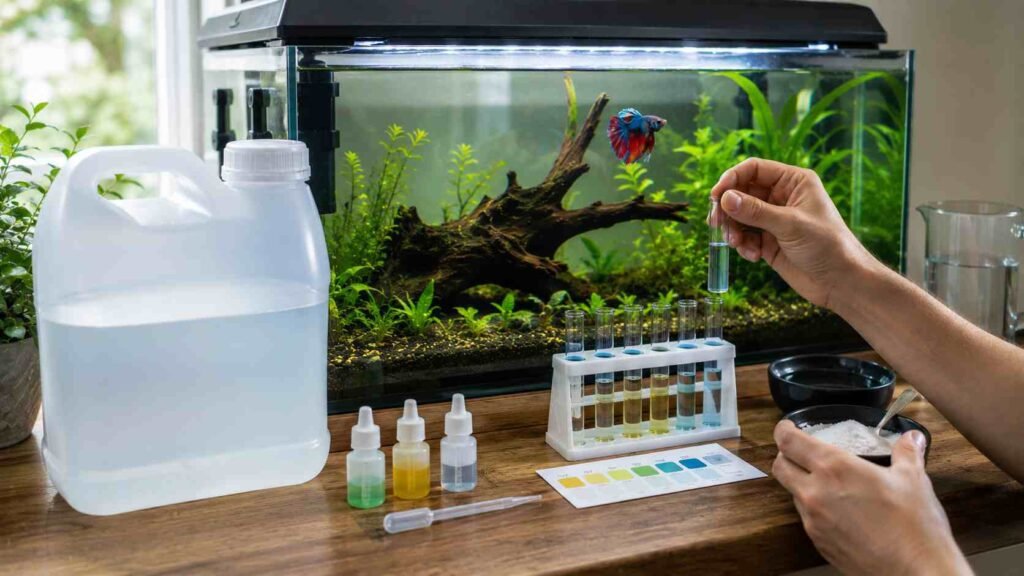
Reverse Osmosis (RO) Water for Fish Tanks
RO systems push tap water through a membrane, removing 95-99% of the dissolved minerals, leaving you with a blank slate to remineralize to your desired species’ requirements. Can you use RO water in aquariums? Yes, after remineralized, straight RO water has little buffer capacity and can destroy the pH if it is introduced directly.
Deionized and Demineralized Water
RODI (Ion-Exchange Resin Deionized Water) is used in fish tanks to remove charged mineral particles, and is sometimes combined with RO for even purer water. The same applies to demineralized water, which must be remineralized before use.
Is Distilled Water Good for Fish Tanks?
The water is distilled, meaning it is boiled and condensed, with minerals removed; this is similar to RO, but more expensive due to the number of times the water has to be boiled. Safe for small tanks and top-offs, but it should first be remineralized as it is not an electrolyte-rich water.
Do Water Conditioners Lower Hardness?
No a common misconception. Regular conditioners (Seachem Prime, API Tap Water Conditioner) remove chlorine, chloramine, and heavy metals, but do not affect calcium or magnesium. It does not affect the hardness unless the label states “GH reducer”.
Comparison: Methods to Lower Hard Water
| Method | Effectiveness | Cost | Best For |
| RO/RODI unit | Very High | $-$$ | Large tanks, breeders, discus/betta keepers |
| Distilled water | High | $$ ongoing | Small tanks, occasional top-offs |
| GH reducer resin | Moderate–High | $$ | Precise, medium tanks |
| Peat moss | Moderate | $ | Natural softening |
| Driftwood | Low–Moderate | $ | Gradual, cosmetic softening |
| Rainwater | High | $ (labor) | Budget DIY |
| Standard conditioner | None (chlorine only) | $ | Dechlorination, not hardness |
How to Soften Hard Water Naturally
Driftwood and Tannins
Tannins are produced by decaying driftwood that will provide some softening and reduce the pH of hard water in a few weeks, not enough to cure it entirely.
Peat Moss Filtration
Humic and tannic acids are excreted by peat moss in a filter bag, which will complex calcium and magnesium and turn the water tea colored. Rinse well initially and monitor pH during week one.
Rainwater Collection
Rainwater is naturally soft, as it does not pass through the soil and rock that can cause mineralization. Collected properly and tested before use, it can be used to soften the water in a freshwater aquarium without the added expense of using hard water filters.
Boiling (Limited Effectiveness)
Boiling only removes temporary hardness (carbonate) and is not effective in removing permanent hardness (sulfates and chlorides) — not effective for most tap water.
How to Increase Water Hardness in a Freshwater Aquarium
Some other fish species, such as African cichlids, livebearers (guppies, mollies, platies), and goldfish require more hard water than is provided by standard tap water.
Crushed Coral and Aragonite
These slowly and gradually increase GH and KH levels, which is ideal for cichlid and livebearer tanks that require a long-term increase and not a quick spike.
Commercial Remineralizers
Seachem Equilibrium or Salty Shrimp GH+ are products that are the most controllable methods to raise the hardness of the water, particularly when using RO or distilled water as a base.
Limestone and Mineral-Rich Rock
Limestone or dolomite rock passively releases calcium carbonate, providing low-maintenance hardness increases for African cichlid biotopes.
Hard Water Stains: Prevention and Removal
Hard water stains in a tropical fish tank are chalky white films at the level of the water, caused by minerals being left behind as the water evaporates, similar to limescale in a kettle.
Safe Removal
A 1:1 solution of white vinegar and water will remove deposits, which can be done with a soft cloth or aquarium-safe scraper; this solution will not scratch glass or acrylic. Avoid using household glass cleaners; ammonia residue is poisonous to fish.
Prevention
Clean the waterline with a magnetic scraper every week before deposits get hard and use treated or lower-hardness water for top-offs to slow down deposits.
FAQ:
Can you use hard water in a fish tank?
Yes, goldfish, mollies, platies, and African cichlids will live in moderately hard water. Do not assume all fish need soft water; test your GH/KH to match fish species’ needs.
What causes hard water in a fish tank?
Primarily from dissolved calcium and magnesium in tap water, mineral-leaching substrate (e.g., crushed coral), and evaporation. The highest readings will generally be found in well water sources.
Does hard water cause algae in a fish tank?
Not directly. Algae is stimulated by light and nutrients such as nitrate and phosphate. Tap water with high mineral content can also contain high nutrients, which indirectly help to cause blooms.
Is RO water good for aquariums?
Yes, once remineralized. RO water removes almost all minerals, providing a clean base, but adding unremineralized minerals can lead to potentially harmful pH instability.
Does water conditioner lower hardness in a fish tank?
No, standard conditioners will only neutralize chlorine, chloramine, and heavy metals. RO water, GH-reducing resin, or natural softening such as peat moss or driftwood are required to reduce hardness.
Is distilled water good for fish tanks?
Yes, for small tanks or top-offs, but it must be remineralized first. Zero-hardness water will not have the electrolytes that fish require, and the shock of adding it directly can be a problem.
What is the ideal nitrate level in a fish tank?
The nitrate level should not exceed 20 ppm in most freshwater community tanks. It is not a hardness measurement but should be taken in conjunction with hardness in routine testing.
How often should I test GH and KH?
Test weekly for the first month after setup and then monthly thereafter, unless changes in substrate, decor, or water source occur; then test sooner.
Conclusion
Hard water in a fish tank is not always bad; it becomes problematic when it is not measured and not properly matched with the requirements of your fish and plants. Here are three things to keep in mind: test GH and KH separately before selecting a fix; remember that soft-water fish like bettas and hard-water fish like goldfish have opposite needs; and standard conditioners will not affect mineral content, so use RO water, GH-reducing resin, or natural softening.
Check the GH and KH of your tank today, and use this guide to compare the hardness scale to your tank and make confident adjustments; your fish and plants will thank you within days.
