
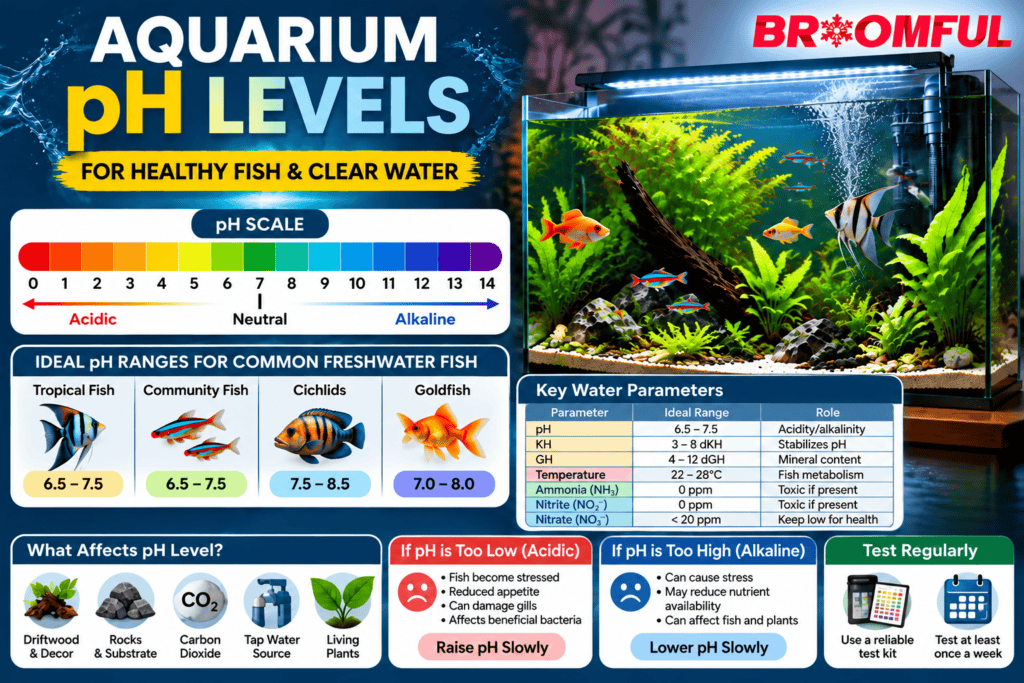
A one-point change on the pH scale is not a small adjustment: because pH is logarithmic, a move from pH 7 to pH 6 represents about ten times the hydrogen-ion activity. That is why aquarium water can look perfectly clear while the chemistry is moving in a direction that stresses fish, plants, shrimp, snails, or the biological filter. For aquarium water quality, aquarium pH levels in freshwater should never be viewed as a single “magic number.” The safer goal is a stable range that matches the livestock and is supported by appropriate carbonate hardness (KH), general hardness (GH), temperature, and nitrogen-cycle control.
In this guide you’ll learn how to read a freshwater aquarium pH level correctly, how KH stabilizes pH, what causes a fish tank pH level too high or a fish tank pH level too low, and how to correct problems without creating dangerous swings. You will also get an aquarium water quality aquarium pH levels in freshwater chart, a tropical fish pH level chart, a complete freshwater aquarium water parameters chart, practical testing schedules, troubleshooting examples, and a printable layout you can export as a freshwater aquarium water parameters chart PDF.
Aquarium Water Quality: What Freshwater pH Really Means
pH describes how acidic or alkaline water is on a scale commonly shown from 0 to 14. A pH of 7 is neutral, values below 7 are acidic, and values above 7 are alkaline. In home aquariums, however, pH is useful only when interpreted together with the fish species, KH, GH, temperature, dissolved carbon dioxide, and the nitrogen cycle. A stable pH of 7.6 can be excellent for one community and inappropriate for another. Likewise, a pH of 6.4 can be ideal in a deliberately soft-water setup but risky in a neglected tank with almost no buffering capacity.
Why pH Stability Matters More Than Chasing 7.0
Many beginners assume that “neutral” automatically means “best.” It does not. Aquarium Co-Op notes that many freshwater fish can live in roughly the 6.5–8.0 range, while Aqueon gives about 6.8–7.8 as a general range for many tropical freshwater fish. These are broad community-tank guidelines, not universal prescriptions. Wild-type soft-water fish, African Rift Lake cichlids, livebearers, and specialist shrimp can require very different chemistry.
The more important principle is consistency. Fish regulate salts and water across their gills and body tissues. Sudden chemistry changes force them to adjust rapidly, and a dramatic pH swing often arrives with changes in hardness, conductivity, or dissolved gases as well. For that reason, a stable but slightly imperfect freshwater aquarium pH level is frequently safer than repeatedly dosing products to force a textbook value.
The pH Scale Is Logarithmic, Not Linear
A change of one full pH unit represents a tenfold change in hydrogen-ion activity. In simple hobby terms, pH 6 is about ten times more acidic than pH 7, and pH 5 is about one hundred times more acidic than pH 7. This does not mean a fish experiences “ten times more stress,” but it explains why small-looking numerical shifts can represent meaningful chemical changes.
This is also why rapid correction can be more dangerous than the original reading. If a tank has been stable at 7.8 and healthy fish are adapted to it, pushing the water to 6.8 in a single session is usually a poor strategy. First determine whether the number is actually outside the acceptable range for the species, then find the cause, then make gradual changes.
pH Changes the Meaning of Other Water Tests
pH is not isolated from toxicity. UF/IFAS explains that total ammonia exists mainly as ionized ammonium (NH4+) and un-ionized ammonia (NH3), and that the proportion of the more toxic NH3 increases as pH and temperature rise. UF/IFAS also notes that un-ionized ammonia is roughly 100 times more toxic to fish than the ionized form. That means an ammonia reading is more urgent in warm, alkaline water than the same total-ammonia reading in cooler, more acidic water.
pH also interacts with carbon dioxide. In planted aquariums, dissolved CO2 forms carbonic acid and can lower pH. During the photoperiod, plants consume CO2 and pH may rise; overnight, respiration increases CO2 and pH may fall. A predictable daily swing driven by CO2 is different from a true loss of buffering capacity, so always test KH before assuming the tank is “crashing.”
Freshwater Aquarium Water Parameters Chart
A good freshwater aquarium water parameters chart is a dashboard, not a rigid rulebook. The targets below are practical starting points for a typical, established tropical community aquarium in the United States. Species-specific requirements always take priority. If you keep discus, African cichlids, Caridina shrimp, wild-caught fish, coldwater species, or a high-tech planted tank, use a narrower species or system target.
| Parameter | General Starting Target | Why It Matters | Practical Note |
| pH | About 6.5–7.8 for many community fish | Species match + stability | A stable 7.6 can be safer than repeatedly forcing 7.0. |
| Ammonia (total) | 0 ppm | Directly toxic; more NH3 at high pH/temp | Any detectable reading deserves attention in an established tank. |
| Nitrite | 0 ppm | Interferes with oxygen transport | Often appears after ammonia during cycling. |
| Nitrate | Preferably <20–40 ppm for many home tanks | Chronic stress/algae at higher levels | Aqueon describes >50 ppm as undesirable in freshwater aquaria. |
| KH | Often 3–8 dKH for general community use | Buffers pH | Low KH can allow faster pH drops; specialist soft-water tanks may run lower. |
| GH | Often 4–12 dGH, species dependent | Calcium/magnesium and osmoregulation | Livebearers usually prefer harder water than many tetras. |
| Temperature | Often 74–80°F for tropical communities | Metabolism, oxygen, ammonia toxicity | Match the fish; goldfish and some species prefer cooler water. |
| Chlorine/Chloramine | 0 detectable after conditioning | Toxic to fish and biofilter organisms | Always condition municipal tap water appropriately. |
This freshwater aquarium water parameters chart deliberately separates “general starting target” from “species requirement.” That distinction matters. A breeder working with soft-water dwarf cichlids may intentionally maintain very low KH and lower pH. A guppy keeper in hard municipal water may do best by leaving the water moderately alkaline rather than fighting the tap every week.
Ammonia, Nitrite, and Nitrate: The Nitrogen-Cycle Core
Fish release nitrogenous waste, uneaten food decomposes, and organic debris breaks down. In a cycled aquarium, beneficial microorganisms convert ammonia to nitrite and then to nitrate. Ammonia and nitrite should be kept at zero in an established tank. Nitrate is less acutely toxic, but long-term accumulation is still a water-quality problem and often indicates that water changes, stocking, feeding, plant uptake, or filtration need review.
If ammonia or nitrite is detectable, do not focus only on pH. Protect the fish first: verify the test, reduce feeding, check filter function, remove obvious decaying material, perform an appropriate conditioned water change, and retest. Do not replace or sterilize all biological filter media at the same time, because doing so can remove the organisms that process the waste.
GH, KH, and TDS Are Related but Not Interchangeable
GH (general hardness) primarily reflects dissolved calcium and magnesium. KH (carbonate hardness) is used by aquarists as a practical measure of carbonate/bicarbonate buffering. TDS (total dissolved solids) estimates the overall concentration of dissolved substances but does not tell you what those substances are. Two aquariums can have the same TDS and very different GH, KH, sodium, nitrate, or other ion composition.
For quick conversion, 1 degree of hardness (1 dGH or 1 dKH in common hobby usage) is approximately 17.9 mg/L expressed as calcium carbonate equivalent. Use the units printed on your test kit rather than mixing ppm and degrees without converting.
Freshwater Aquarium Water Parameters Chart PDF: How to Use This as a Checklist
If you want a freshwater aquarium water parameters chart PDF, this document is designed to convert cleanly: open it in Google Docs or Microsoft Word, choose Print or Download, and export as PDF. Keep one copy near your test kit and record your own target range beside each parameter. A generic freshwater aquarium water parameters chart PDF becomes much more useful when it includes your tank’s normal readings, water-change day, source-water chemistry, and species-specific limits.
Freshwater Aquarium pH Level: Ideal Ranges by Tank and Fish
There is no single ideal freshwater aquarium pH level. The correct target depends on the species, whether the animals are captive-bred or wild-caught, the hardness of the water in which they were raised, and whether you are keeping them for display, breeding, or long-term specialty husbandry. Use the ranges below as practical starting points and confirm the needs of the exact species or strain you own.
Tropical Fish pH Level Chart
| Fish / Group | Practical pH Range | Typical Hardness Direction | Important Note |
| Betta | 6.5–7.5 | Soft to moderate | Stable, warm water is more important than chasing an exact number. |
| Neon/Cardinal-type tetras | About 6.0–7.2 | Soft to moderate | Many captive-bred fish adapt wider; breeding may require softer water. |
| Corydoras | About 6.2–7.6 | Soft to moderate | Species vary; prioritize clean substrate and low nitrogen waste. |
| Angelfish | About 6.5–7.5 | Soft to moderate | Often adaptable when captive-bred; avoid abrupt shifts. |
| Discus | About 5.5–7.0 | Soft | Warm, clean, stable water; breeding setups may be more specialized. |
| Guppies/Platies/Swordtails | About 7.0–8.2 | Moderate to hard | Usually prefer mineral-rich, alkaline water. |
| Mollies | About 7.5–8.5 | Hard | Often perform poorly in very soft acidic water. |
| African Rift Lake cichlids | About 7.8–8.6 | Hard, well-buffered | High KH and mineral content help reproduce alkaline lake conditions. |
| Goldfish | About 7.0–8.0 | Moderate to hard | High waste production makes ammonia/nitrite control especially important. |
| Neocaridina shrimp | About 6.5–7.8 | Moderate | Stable GH/KH supports molting; exact targets vary by line. |
A tropical fish pH level chart is most useful for compatibility planning. If one species thrives in soft acidic water and another needs hard alkaline water, forcing both into a compromise can produce chronic stress even when neither fish dies immediately. Build communities around overlapping pH, GH, KH, and temperature requirements instead of selecting fish only by appearance.
Community Tanks: Choose the Overlap, Not the Average
Suppose one fish is listed at pH 6.0–7.4 and another at 7.0–8.2. The meaningful shared zone is approximately 7.0–7.4, not the numerical average of all endpoints. The same logic applies to temperature and hardness. A compatibility spreadsheet that checks overlap is more valuable than memorizing one “ideal” number for each species.
Also consider the water you can reproduce consistently. If your tap water is pH 7.6 with moderate KH and GH, a community of captive-bred fish comfortable in that chemistry may be easier and safer than continuously blending or chemically altering water for fish that require extreme soft-water conditions.
When a “Non-Ideal” pH Is Still Acceptable
If fish are active, feeding normally, growing, showing normal respiration, and the pH is stable within a tolerable species range, you may not need to change anything. This is especially true for many captive-bred community fish that have lived for generations in commercial water rather than in wild habitat chemistry. The source of the fish matters. Ask a reputable breeder or retailer what water they use and acclimate gradually.
The exception is when the pH is far outside the species’ tolerated range, when breeding goals require a narrower chemistry, or when the reading signals a larger instability problem such as extremely low KH. In those cases, adjust the system methodically instead of treating only the pH number.
KH Levels in Freshwater Aquarium: The Key to pH Stability
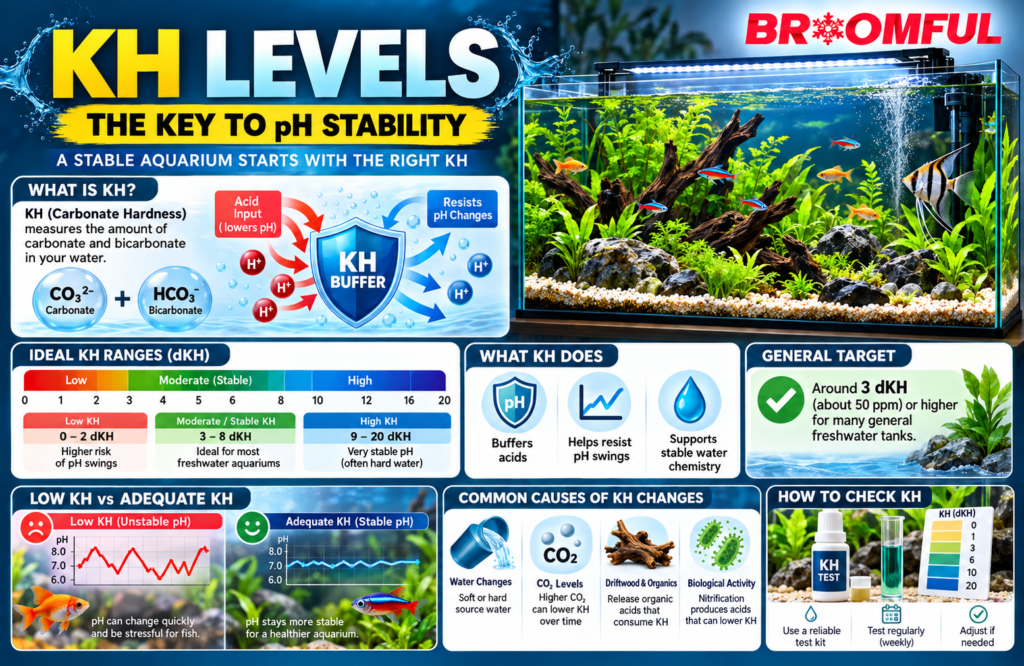
KH levels in freshwater aquarium systems often explain why one tank holds a steady pH while another swings after feeding, water changes, CO2 injection, or a week of biological activity. KH is the aquarium hobby’s shorthand for carbonate hardness or buffering capacity. Carbonates and bicarbonates can neutralize acids, helping resist sudden pH drops.
What KH Actually Does
Think of KH as a chemical shock absorber. Fish respiration, bacterial nitrification, decaying organics, wood, botanical materials, and injected CO2 can all contribute acids or alter the acid-base balance. When KH is adequate for the system, those forces cause smaller pH changes. When KH is very low, the same acid input can move pH much more quickly.
Aquarium Co-Op recommends around 3 dKH (about 50 ppm) or higher for many general freshwater aquariums to reduce the risk of rapid pH swings, while specialty soft-water systems may intentionally run lower. The correct KH therefore depends on the livestock and the keeper’s ability to monitor and control the tank.
KH Levels in Freshwater Aquarium: Practical Interpretation
| KH | Buffering Capacity | Likely pH Behavior | Use Case |
| 0–2 dKH | Very low buffer | pH can move easily | Appropriate only for some specialist systems with close monitoring. |
| 3–5 dKH | Low to moderate | Generally stable for many community tanks | A practical zone for many mixed tropical aquariums. |
| 6–8 dKH | Moderate to strong | Resists pH change | Often works well for livebearers and harder-water communities. |
| 9–12+ dKH | High buffer | pH is difficult to lower | Common in hard-water regions and some African cichlid setups. |
Do not interpret KH as a direct pH target. High KH often supports a higher, stable pH, but pH also depends on dissolved CO2 and the broader water chemistry. Likewise, low KH does not automatically mean low pH at every moment; it means the water has less resistance to acid-driven change.
How to Raise or Lower KH Safely
To raise KH gradually, aquarists commonly use crushed coral, aragonite, limestone-based media, or a measured commercial buffer. Crushed coral is self-limiting compared with aggressive one-time dosing because it dissolves more readily as water becomes acidic, but the result still depends on flow, surface area, source-water chemistry, and tank demand. Always test after changes.
To lower KH, the most controllable method is usually dilution with low-mineral reverse-osmosis (RO) or deionized water, followed by remineralization to the desired GH/KH. Do not switch an established hard-water aquarium to very low KH in one large water change. Lowering KH removes part of the system’s pH buffer, so the tank may become easier to acidify and easier to destabilize.
KH vs. GH: The Common Beginner Mistake
KH and GH answer different questions. KH tells you about buffering. GH tells you mainly about calcium and magnesium hardness. A tank can have low KH but high GH, or high KH with only moderate GH. This matters for shrimp, snails, livebearers, and plants because a pH problem cannot always be solved by “adding minerals” unless you know which minerals the water actually lacks.
When troubleshooting, record pH, KH, and GH together. That three-number pattern is far more diagnostic than pH alone. It can reveal whether you are dealing with soft unbuffered water, hard alkaline source water, a carbonate-rich substrate, or a planted system in which CO2 is driving predictable daily pH movement.
Fish Tank pH Level Too High: Causes, Risks, and Safe Fixes
A fish tank pH level too high is not defined by one universal number. A pH of 8.2 may be excellent for Rift Lake cichlids and unsuitable for a soft-water breeding tank. Diagnose “too high” relative to the species and the tank’s normal chemistry. If the fish are healthy and the pH is stable, do not lower it simply because another website says 7.0 is ideal.
Common Causes of High Freshwater Aquarium pH
- High-pH, high-KH tap or well water. This is the most common reason a tank resists attempts to become more acidic.
- Crushed coral, aragonite, limestone, shells, or other carbonate-rich decor dissolving into the water.
- Low dissolved CO2 or strong gas exchange, especially when comparing a freshly drawn tap-water sample with an aerated tank.
- Heavy photosynthesis in planted tanks, which removes CO2 during the light period and can raise pH by the end of the day.
- Large changes in source water chemistry after municipal treatment adjustments or a move to a different water supply.
- Overuse of alkalinity buffers or “pH up” products.
When the fish tank pH level too high problem appears suddenly, test both the aquarium and the source water. Let a cup of tap water sit with aeration for 12–24 hours and retest; dissolved gases can make fresh tap-water pH different from its stabilized value. Then test KH. If KH is high, repeated doses of acidifying products may temporarily push pH down only for it to rebound as the buffer neutralizes the added acid.
Safe Ways to Lower High pH
- Remove the cause first. If limestone, coral sand, or shells are unintentionally raising KH and pH, replace them with inert materials gradually.
- Use RO water strategically. Blend RO with conditioned tap water to reduce KH and GH in a repeatable ratio, then remineralize if necessary.
- Use botanicals, peat, or aquarium-safe driftwood when appropriate. These can release tannins and organic acids, but their effect is limited in high-KH water.
- Adjust CO2 only if you already run a planted CO2 system. Do not use CO2 as a general-purpose pH drug; manage it for plant needs and fish safety.
- Use commercial acid/buffer products cautiously and according to the label. They are most predictable when the underlying KH is understood.
Chewy’s current aquarium guidance similarly emphasizes testing both pH and KH before lowering pH and notes that carbonate-rich substrates, source-water hardness, and CO2 can all contribute to elevated readings. The shared lesson is diagnostic: changing the number without changing the cause produces unstable water.
What Not to Do When pH Is High
Do not add large, repeated doses of acid to highly buffered water. Do not perform a massive water change with dramatically softer or more acidic water unless there is a separate emergency requiring it. Do not remove all substrate and filter media at once. And do not assume that fish lethargy proves a pH problem; ammonia, nitrite, oxygen, temperature, disease, and toxins can cause similar signs.
Most importantly, never lower pH while ignoring ammonia. At higher pH and temperature, a larger proportion of total ammonia is present as toxic un-ionized NH3. If both pH and ammonia are high, prioritize waste control, safe conditioned water changes, filtration, and reduced feeding while making chemistry corrections gradually.
Fish Tank pH Level Too Low: Causes, Risks, and Safe Fixes
A fish tank pH level too low usually means one of two things: the aquarium is intentionally or naturally soft and acidic, or the buffering system is being exhausted. Those situations require different responses. A blackwater tank at pH 6.0 with controlled low KH may be healthy. A neglected community tank that fell from 7.2 to 5.8 while KH dropped near zero may be experiencing a genuine pH crash.
Common Causes of Low pH or a pH Crash
- Low-KH source water with little buffering reserve.
- Accumulation of organic acids from heavy feeding, detritus, decaying leaves, dead livestock, or infrequent maintenance.
- Nitrification, which consumes alkalinity and contributes acidity over time in closed systems.
- CO2 accumulation from livestock respiration, especially overnight or in poorly ventilated systems.
- Active aquasoils designed to reduce KH and pH for planted or shrimp aquariums.
- Peat, botanicals, or large amounts of tannin-releasing wood in low-buffer water.
- Using large amounts of RO or distilled water without appropriate remineralization.
If the fish tank pH level too low reading is unexpected, immediately test KH, ammonia, and nitrite. A low pH can slow nitrification, while a collapsing biological filter can simultaneously create an ammonia problem. The pH number alone does not tell you which process failed first.
Safe Ways to Raise Low pH
- Perform a moderate water change with conditioned replacement water that is close to the tank’s temperature and chemistry. This removes accumulated acids and replenishes buffering if the source water has higher KH.
- Increase KH gradually using crushed coral, aragonite media, or a measured buffer appropriate for freshwater use.
- Review maintenance. Vacuum decomposing debris, remove dead plant material, clean mechanical filter media in old tank water, and correct overfeeding.
- Improve gas exchange if excess CO2 is suspected. Surface agitation can help equilibrate CO2 with room air, though planted CO2 systems need a controlled balance.
- Remineralize RO water rather than using nearly mineral-free water as a permanent replacement source unless the setup is specifically designed for it.
Avoid trying to jump the tank from very low pH to a high target in one dose. A safer plan is to restore KH and water quality progressively, then let pH stabilize. If fish show severe distress, treat the situation as a water-quality emergency and verify ammonia, nitrite, temperature, oxygenation, and possible contamination instead of assuming pH is the only cause.
Low pH Can Hide Ammonia Risk
An acidic tank can contain measurable total ammonia while a smaller fraction is present as the highly toxic NH3 form. That can create a dangerous trap: if you rapidly raise the pH without first reducing total ammonia, the proportion of toxic NH3 can rise. This is one reason emergency pH correction should be paired with ammonia testing and waste reduction rather than handled as an isolated number.
The UF/IFAS ammonia guidance is especially useful here: pH and temperature strongly influence the ammonia/ammonium balance. In practical aquarium care, fix the waste problem first, then stabilize the buffer and pH.
Testing, Maintenance, and a Stable pH Routine
Good aquarium water quality comes from trend tracking, not random testing. A single pH value can tell you whether the water is acidic or alkaline at that moment. A log showing pH, KH, GH, ammonia, nitrite, nitrate, temperature, water-change volume, and any recent changes tells you why the tank behaves the way it does.
How Often Should You Test?
| Situation | Testing Frequency | Why |
| New/cycling aquarium | Daily or every 1–2 days for ammonia/nitrite; pH regularly | Cycling can change quickly; establish a trend. |
| Established stable aquarium | Weekly to biweekly for core parameters, then adjust by experience | Test more often after stocking, filter changes, illness, or unusual behavior. |
| Low-KH or CO2-injected planted tank | pH/KH more frequently until daily pattern is understood | Compare readings at the same times of day. |
| After a major change | Test before, shortly after, and again over the next few days | Major changes include new substrate, RO blending, buffer dosing, or large livestock additions. |
| When fish look stressed | Immediately test temperature, ammonia, nitrite, pH, and oxygen-related conditions | Symptoms alone are not specific enough to diagnose pH. |
For routine pH comparison, test at roughly the same time each day. In planted tanks, a morning reading and an end-of-light-period reading can reveal the daily CO2-driven swing. If you test at random times, you may mistake a normal daily pattern for instability.
Liquid Kits, Test Strips, and Digital pH Meters
Test strips are fast and useful for trend checks, especially when they include pH, GH, KH, nitrite, and nitrate. Liquid reagent kits are slower but often provide finer resolution for common aquarium parameters. Digital pH meters can be excellent when calibrated and stored correctly, but an uncalibrated meter can create false confidence. The best tool is the one you can use consistently and verify.
If a result is surprising, repeat it. Rinse test tubes with tank water before sampling, follow timing instructions exactly, check reagent expiration dates, and compare with a second method when possible. For a suspected high or low pH problem, also test your source water after it has equilibrated with air.
The Weekly Water-Quality Routine
- Observe fish before touching the tank: breathing rate, appetite, swimming, fins, color, and social behavior.
- Test the parameters most relevant to your system and record the numbers, not just “good” or “bad.”
- Perform an appropriate partial water change using dechlorinated, temperature-matched water.
- Remove detritus and dead plant material without sterilizing the whole tank.
- Rinse mechanical filter media as needed; preserve biological media and avoid replacing everything at once.
- Check filter flow, heater function, surface agitation, and CO2 equipment if used.
- Compare this week’s pH, KH, nitrate, and maintenance notes with prior weeks to spot trends early.
UF/IFAS notes that chlorine and chloramine used in municipal water are toxic to fish, so U.S. aquarium keepers using treated tap water should use an appropriate conditioner and follow the product directions. If your water utility uses chloramine, simple aging or aeration is not a reliable substitute for treatment.
Build Your Own Aquarium Water Quality Baseline
During four stable weeks, record the same set of readings at the same point in your maintenance cycle. That gives you a personal baseline. If your aquarium normally runs pH 7.4–7.6, KH 4–5 dKH, GH 7–8 dGH, ammonia 0, nitrite 0, and nitrate 10–20 ppm, a future shift to pH 6.6 and KH 1 dKH is meaningful even if a generic chart still labels pH 6.6 “safe.” Trends often reveal trouble earlier than universal ranges.
Troubleshooting Real-World pH Problems
The fastest way to solve aquarium pH problems is to diagnose patterns instead of treating symptoms. The examples below show how pH, KH, source water, and maintenance interact in real tanks.
Scenario 1: pH Keeps Rebounding After You Lower It
You test pH 8.2, add a pH-lowering product, reach 7.4, and two days later the tank is back at 8.1. The likely explanation is high KH. The added acid temporarily consumes part of the buffering capacity, but the water chemistry resists the change. The solution is not endless acid dosing. Test KH and source water, remove accidental carbonate materials, and if the livestock genuinely requires softer water, create a repeatable RO/tap blend.
This is a classic case where the freshwater aquarium pH level is a symptom of source-water chemistry. Once KH is adjusted into the desired range, pH becomes easier to manage. The target should still be gradual and species-driven.
Scenario 2: pH Falls Every Week Before Water-Change Day
Suppose the tank is pH 7.2 after a water change and pH 6.5 seven days later. KH tests at only 1 dKH, nitrate is rising, and the substrate contains accumulated debris. This pattern suggests insufficient buffering plus acid production from biological activity and organics. Correct feeding and cleaning, use regular partial water changes, and raise KH gradually if compatible with the livestock.
Do not simply dose “pH up” every Sunday. That creates a repeating chemical roller coaster. Fix the cause so the pH stops falling sharply in the first place.
Scenario 3: Morning pH Is Lower Than Evening pH
In a planted tank, pH 6.7 before lights-on and 7.1 late in the photoperiod can be a normal CO2 pattern. Overnight, plants and animals respire and CO2 accumulates; during the day, photosynthesis consumes CO2 and pH rises. Measure KH and watch the size and repeatability of the swing. A predictable daily cycle with healthy livestock is different from a progressive multi-day crash.
If you inject CO2, use the pH pattern as one data point, not the sole control method. Fish behavior, gas exchange, drop-checker or CO2 estimation methods, and consistent injection timing all matter.
Scenario 4: New Fish Are Fine at the Store but Struggle at Home
The problem may be the chemistry gap between store water and home water rather than the absolute pH alone. Compare pH, temperature, GH, and if possible conductivity/TDS. A fish moved from moderately hard pH 7.6 water into very soft pH 6.2 water experiences multiple simultaneous changes. Choose species compatible with your source water when possible and acclimate appropriately.
This is where the tropical fish pH level chart should be treated as a compatibility filter rather than a promise. The same species can be raised under different conditions by different breeders, so ask what water the fish are actually coming from.
Quick Diagnostic Matrix: High vs. Low pH
| Pattern | Likely Cause | Best First Action |
| pH high + KH high | Hard/alkaline source water or carbonate materials | Test tap/well water; inspect rock/substrate; consider RO blending if species require softer water. |
| pH high + KH moderate + planted tank | Low CO2 / daytime photosynthesis effect | Compare morning vs. evening; review CO2 and aeration rather than dosing acid. |
| pH low + KH very low | Buffer depletion / pH-crash risk | Water change, remove excess organics, restore KH gradually if species allow. |
| pH low + ammonia present | Cycle/filter problem plus acidic chemistry | Reduce waste, water change, support biofilter; avoid rapid pH increase until ammonia is controlled. |
| pH swings after every water change | Replacement water differs from tank | Age/aerate source sample, compare KH/GH, create a consistent mixing routine. |
A strong aquarium water quality aquarium pH levels in freshwater chart should help you diagnose relationships, not merely label colors as “safe” or “unsafe.” If you know the direction of pH, KH, and nitrogen waste together, you can usually identify the category of problem before buying another chemical.
FAQs
What is the best freshwater aquarium pH level?
For many community freshwater fish, a stable pH roughly in the 6.5–8.0 range can work, but there is no universal best number. Match pH to the species and its hardness needs. Stability, zero ammonia and nitrite, and consistent maintenance are usually more important than forcing every tank to pH 7.0.
What happens if the fish tank pH level is too high?
If the pH is too high for your species, fish can become stressed and ammonia becomes more dangerous because a greater fraction exists as toxic un-ionized NH3. First test KH and source water. Correct the cause gradually rather than repeatedly dosing acid into highly buffered water.
What happens if the fish tank pH level is too low?
Low pH can be normal in a controlled soft-water aquarium, but an unexpected drop may signal exhausted KH, accumulating organic acids, or a maintenance problem. Test KH, ammonia, and nitrite immediately. Restore water quality and buffering gradually instead of making a large one-time pH correction.
What are good KH levels in freshwater aquarium setups?
For many general community aquariums, around 3–8 dKH provides useful buffering, while specialist soft-water tanks may intentionally run lower and African cichlid systems may run higher. KH should match the livestock and maintenance method. Very low KH requires closer pH monitoring because the water resists acid changes less strongly.
Does driftwood lower aquarium pH?
Driftwood can lower pH by releasing tannins and organic acids, especially in water with low KH. In hard, strongly buffered water, the effect may be small. Use aquarium-safe wood, expect possible amber coloration, and test pH and KH over time rather than assuming a predictable numerical drop.
How often should I test aquarium pH?
Test more frequently in new tanks, after major changes, or when KH is low. In a stable established aquarium, weekly or biweekly pH checks may be enough, depending on the system. For planted tanks, compare readings at consistent times because CO2 can cause a normal morning-to-evening pH cycle.
Can I use baking soda to raise aquarium pH?
Baking soda raises alkalinity/KH and can raise or stabilize pH, but it is easy to change chemistry too quickly if dosed casually. A measured aquarium buffer or gradual carbonate media is often easier to control. Always test KH and pH before and after any addition and match the change to the species.
Where can I get a freshwater aquarium water parameters chart PDF?
You can export this guide as a freshwater aquarium water parameters chart PDF from Google Docs or Word. The most useful version is customized with your tank’s normal pH, KH, GH, ammonia, nitrite, nitrate, temperature, and water-change schedule, so you can spot deviations from your own stable baseline quickly.
Conclusion
Managing aquarium water quality and aquarium pH levels in freshwater is less about finding one perfect number and more about building a stable chemical system. Three takeaways matter most: first, choose a pH range that fits your livestock; second, test KH because buffering explains many pH swings and rebounds; third, never troubleshoot pH without also checking ammonia, nitrite, nitrate, temperature, and source water. Use the freshwater aquarium water parameters chart and tropical fish pH level chart in this guide as starting points, then create a baseline for your own aquarium. If a fish tank pH level too high or too low appears, correct the underlying cause gradually rather than chasing the reading with repeated chemicals. Consistent testing and species-matched water beat “perfect pH” shortcuts. Bookmark or print this guide, record your aquarium’s baseline today, and retest before making your next pH adjustment.
