
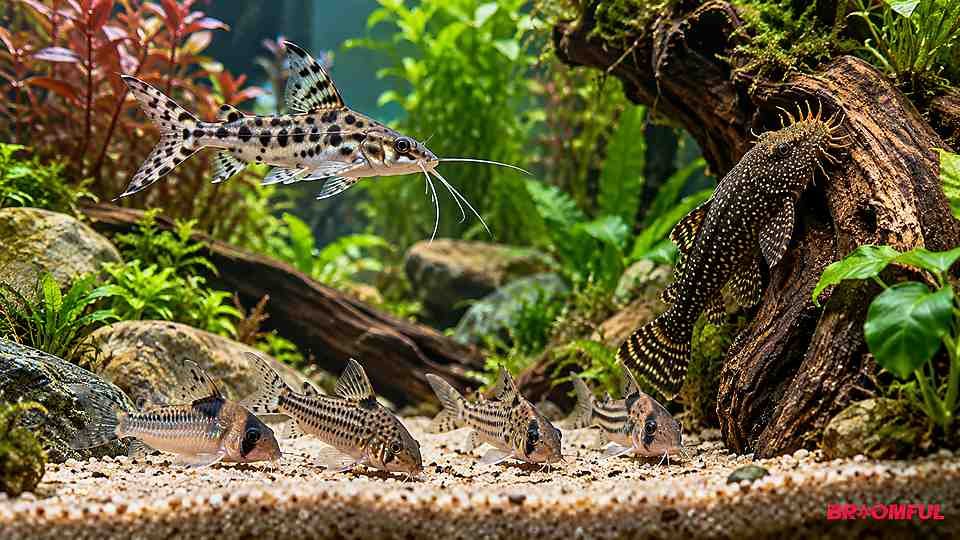
A catfish that is only two inches long at the store can eventually become a fish measured in feet, not inches. That single fact explains why choosing the right freshwater catfish for aquarium setups matters so much. “Catfish” is an enormous group, and the fish sold under that label range from tiny, social Corydoras to active Pictus catfish, armored plecos, transparent midwater schoolers, and giant predators that are unsuitable for ordinary home tanks.
The good news is that there are excellent freshwater catfish for nearly every properly planned aquarium. Some stay under two inches, some are ideal for planted community tanks, and others become striking centerpieces in 55-gallon-and-larger systems. The key is to choose by adult size, social needs, diet, activity level, and tank footprint, not by how small the juvenile looks at the store.
In this guide you’ll learn which species fit small, medium, and large aquariums; how to care for Pictus catfish; how to compare tank sizes and temperaments; what catfish really eat; which “cleanup crew” myths to ignore; and how to identify popular species from pictures before you buy.
What Makes Freshwater Catfish Good Aquarium Fish?
Catfish Fill More Than One Niche
Freshwater catfish are often described as bottom dwellers, but that is only partly true. Corydoras patrol the substrate and sift for food. Bristlenose and clown plecos spend much of their time on wood, rock, and glass. Otocinclus graze biofilm on plant leaves and hard surfaces. Glass catfish are unusual because they spend much of their time schooling in the middle of the water column. Pictus catfish are fast, active swimmers that use both the bottom and open water.
That behavioral variety is one reason catfish work so well in community aquariums. They can add activity to areas of the tank that might otherwise look empty, and many species have body shapes, markings, or behaviors that contrast strongly with tetras, rasboras, barbs, gouramis, and livebearers.
However, adding a catfish does not automatically make a tank cleaner. Catfish still eat, produce waste, and require targeted nutrition. A healthy aquarium depends on filtration, water changes, sensible stocking, and feeding control. A catfish may consume some algae or leftover food, but it cannot replace maintenance.
Adult Size Matters More Than Store Size
One of the most important rules in catfish keeping is simple: buy for adult size. Many catfish are sold as juveniles because small fish are easier to ship and display. That can create a misleading impression.
A bristlenose pleco that is 1.5 inches in a sales tank may mature around 4 to 6 inches depending on the species and line. A “common pleco” can become dramatically larger and heavier-bodied. A redtail catfish may look manageable as a juvenile but can exceed three feet and has no place in a typical home aquarium.
Tank length and floor area are especially important because many catfish spend much of their time close to the substrate. A long 30-gallon aquarium can offer more useful bottom space than a tall aquarium with similar volume. For active species such as Pictus catfish, horizontal swimming room is even more important.
Social Behavior Is Species-Specific
Do not assume all catfish want to live alone. Corydoras are social and generally behave best in groups, ideally with several of the same species. Otocinclus also benefit from groups. Glass catfish are schooling fish and can become shy or withdrawn when kept in insufficient numbers. Upside-down catfish are also commonly maintained in social groups.
Plecos are different. Some can coexist in large, structured tanks, but males of certain species may become territorial around caves and feeding areas. Giant predatory catfish may need enormous individual territories. Social requirements should therefore be checked at the species level instead of applying one rule to the entire catfish category.
Scientific Names Prevent Expensive Mistakes
Common names can be dangerously vague. “Pleco,” “bumblebee catfish,” “shovelnose,” and even “glass catfish” may be applied to more than one species in the aquarium trade. Two fish with similar names can have very different adult sizes and care requirements.
Before buying, ask for the scientific name and compare it with a reputable species profile. A label such as Ancistrus sp. points you toward a bristlenose-type pleco, while an unidentified “common pleco” deserves extra caution because the trade name may cover multiple large-growing loricariids. This habit is one of the easiest ways to prevent a future tank-size problem.
Aquarium Catfish Species List: Quick Comparison
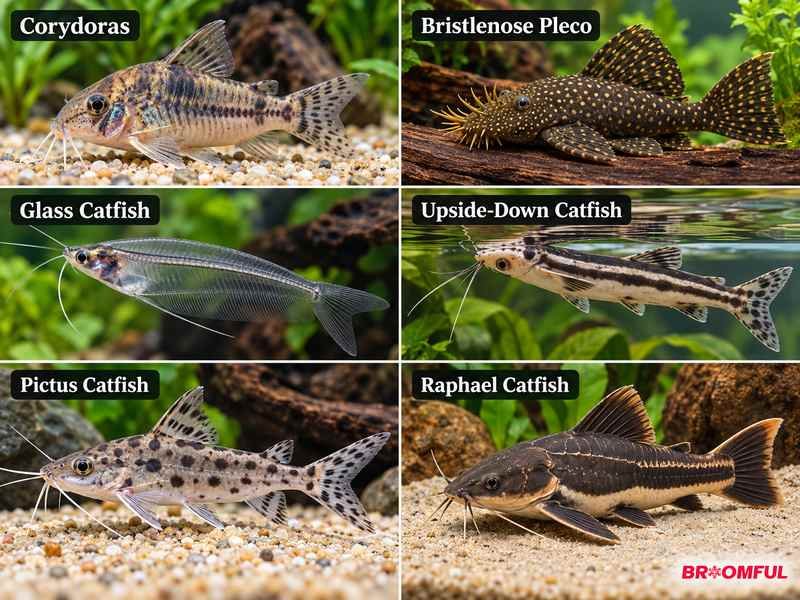
The following aquarium catfish species list is designed for fast comparison. Tank-size recommendations are intentionally conservative and assume healthy adult fish, appropriate group sizes, good filtration, and normal community stocking. Exact requirements can vary by species, group size, tank footprint, and aquascape.
| Catfish | Typical Adult Size | Practical Minimum Tank | Social Need | Temperament | Best For |
| Pygmy Corydoras | 1-1.3 in | 15-20 gal | 8+ | Peaceful | Small planted communities |
| Panda Corydoras | 2-2.5 in | 20 gal long | 6+ | Peaceful | Cool-to-moderate community tanks |
| Bronze Corydoras | 2.5-3 in | 20 gal long | 6+ | Peaceful | Beginners and mixed communities |
| Otocinclus | 1.5-2 in | 20 gal mature tank | 6+ | Very peaceful | Established planted aquariums |
| Asian Stone Catfish | 1-1.5 in | 10-15 gal | Small group | Peaceful | Quiet nano-style setups |
| Clown Pleco | 3-4 in | 20-30 gal | Usually single | Peaceful/territorial with own kind | Driftwood aquascapes |
| Bristlenose Pleco | 4-6 in | 30 gal | Usually single | Generally peaceful | Community tanks with wood and caves |
| Upside-Down Catfish | 3-4 in | 30 gal | 5+ | Peaceful | Planted African-style communities |
| Glass Catfish | 3-4 in | 30 gal | 6+ | Shy, peaceful | Calm planted communities |
| Synodontis petricola | 4-5 in | 30-40 gal | 5+ preferred | Peaceful to mildly assertive | Tanganyika-style or robust communities |
| Pictus Catfish | 4.5-6 in | 55+ gal | Single or group with more space | Peaceful predator | Active medium-large communities |
| Striped Raphael Catfish | 7-9+ in | 55-75+ gal | Usually single | Peaceful but predatory toward tiny fish | Larger community tanks |
| Common Pleco-type Fish | 12-20+ in | 125+ gal, species dependent | Usually single | Variable | Very large aquariums only |
| Redtail Catfish | 3-4+ ft | Public-aquarium/pond scale | Single | Predatory | Not a normal home aquarium fish |
| Tiger Shovelnose-type Catfish | 2-3+ ft | Custom monster system | Single | Predatory | Expert, very large systems only |
This aquarium catfish species list shows why the word “catfish” is not enough to guide a purchase. A 20-gallon community may support a proper Corydoras group, while a Pictus catfish needs a much larger footprint and a redtail catfish is a completely different level of commitment.
Use the table as a shortlist, not as a substitute for a species-specific care check. If your store label and a reliable profile disagree about adult size, assume the larger requirement until you can verify the exact fish.
How to Read the Tank-Size Column
A minimum tank size is not a target to squeeze under. It is a planning baseline. Long-bodied fish, active swimmers, groups, heavy waste producers, and territorial species often benefit from more space than the minimum.
For bottom-oriented fish, consider floor dimensions. A 40-gallon breeder, for example, can provide useful horizontal area for many medium community fish because it is wider than a standard tall tank. For Pictus catfish and larger Synodontis, long tanks are especially valuable because swimming distance matters.
Size Categories Are Practical, Not Taxonomic
In this guide, “small,” “medium,” and “large” describe aquarium planning categories, not scientific groups. A small catfish is roughly under four inches, a medium fish is roughly four to eight inches, and a large catfish is anything that becomes substantially bigger or requires a large footprint because of activity, body mass, or predatory behavior.
That framework helps shoppers avoid a common mistake: assuming a five-inch fish belongs in the same setup as a five-inch, highly active predator. Size matters, but behavior and body shape matter too.
Small Catfish Aquarium: Best Species Under 4 Inches
A well-planned small catfish aquarium can be one of the most interesting freshwater setups because small species allow you to keep natural social groups without requiring a huge tank. The most successful choices are fish that remain genuinely small as adults, not juveniles of large species.
Corydoras: The Classic Small Community Catfish
Corydoras are among the most dependable choices for peaceful community aquariums. Bronze, panda, peppered, pygmy, habrosus, and many other forms are available in the U.S. hobby. They have armored plates rather than ordinary scales, short barbels around the mouth, and an endearing habit of searching the substrate together.
The biggest care point is social structure. A single cory may survive, but a group is far more likely to show confident, natural behavior. Six of the same species is a useful starting point for many standard Corydoras, while tiny pygmy species often look and behave even better in larger groups when the aquarium can support them.
Use sand or smooth, rounded substrate and keep the bottom clean. Corys constantly investigate the substrate with their barbels. They are not “garbage disposals,” so feed sinking pellets, wafers, frozen foods, or other appropriately sized foods after making sure faster midwater fish do not eat everything first.
A 20-gallon-long aquarium is a versatile starting point for many standard Corydoras groups. Pygmy species may fit smaller systems, but stable water quality and enough group space remain more important than chasing the smallest possible tank.
Otocinclus: Tiny Algae Grazers for Mature Tanks
Otocinclus are small, peaceful armored catfish famous for grazing soft algae and biofilm from leaves, glass, and hardscape. They can be outstanding inhabitants of planted tanks, but they are often recommended too casually.
The main challenge is food security. Newly set-up tanks usually do not have the mature biofilm, microalgae, and ecological stability that Otocinclus use throughout the day. A brand-new aquarium that looks “clean” may actually be a poor environment for them. Add otos after the tank is established, and supplement with appropriate algae wafers, vegetable-based foods, and other foods they accept.
Keep them in a group rather than as one isolated “algae eater.” Watch body condition closely. A healthy oto should not look pinched behind the head or hollow-bellied. If the tank is spotless and the fish are losing weight, algae control has become starvation.
For a small catfish aquarium, Otocinclus are best when the setup is planted, mature, peaceful, and maintained for stability rather than constant deep-cleaning.
Asian Stone Catfish: Tiny, Cryptic, and Unusual
Asian stone catfish are among the smallest catfish commonly seen in the hobby. Their mottled bodies and broad fins make them resemble dead leaves, pebbles, or bark. They spend much of their time resting and are easy to miss in a heavily decorated aquarium.
They suit calm tanks better than chaotic community systems. Avoid aggressive feeders that will prevent them from getting food. Because they are small and often subdued, targeted feeding is important. Fine frozen or prepared sinking foods work better than assuming scraps will reach them.
Their tiny size makes them attractive to nano-tank keepers, but the same caution applies as with all small fish: a small body does not mean a fish tolerates unstable water. A fully cycled, mature setup with gentle flow and plenty of hiding structure is safer than an ultra-small container with fluctuating parameters.
Clown Pleco: A Compact Wood-Grazing Pleco
The clown pleco is a strong option for aquarists who want the armored pleco look without the enormous adult size associated with many common plecos. It usually remains around three to four inches and spends much of its time close to driftwood and shaded cover.
Driftwood is important because clown plecos are strongly associated with wood-grazing behavior. They also need supplemental food; the visible algae in an aquarium is not a complete diet. Offer sinking foods and plant-based items appropriate to the species, and make sure food reaches the fish after lights dim.
One clown pleco can work well in a 20- to 30-gallon aquarium with adequate structure. If keeping more than one loricariid, provide multiple caves and feeding zones because space disputes can occur even among generally peaceful fish.
Medium Size Catfish for Aquarium: Best 4-8 Inch Choices
Choosing a medium size Catfish for aquarium setups requires more attention to floor space, filtration, and tank-mate size than choosing a tiny cory. Fish in this range can still be realistic for home aquariums, but they may be active, territorial, predatory toward small tank mates, or heavy waste producers.
Bristlenose Pleco: A Manageable Pleco for Community Tanks
Bristlenose plecos are among the most practical plecos for normal home aquariums. Mature fish generally remain far smaller than common pleco-type fish, and their facial tentacles make adults easy to recognize. They spend much of their time grazing hard surfaces and resting in caves or under wood.
A 30-gallon aquarium is a comfortable baseline for one adult in many community setups. Provide driftwood, a cave, and strong enough filtration to handle the waste. These fish can eat algae, but an aquarium should not rely on naturally occurring algae as the only food source. Use quality sinking wafers and vegetables or other foods appropriate to your specific Ancistrus.
Males may defend caves, particularly during breeding. If you keep multiple adults, increase floor space and provide several shelters with broken lines of sight.
When aquarists search for a medium size Catfish for an aquarium, a bristlenose is often a more realistic long-term choice than an unidentified “common pleco.”
Glass Catfish: A Midwater Schooling Catfish
Glass catfish are visually unlike almost every other freshwater catfish. Their bodies are transparent, and healthy fish school in the midwater rather than spending all day on the substrate.
They are peaceful but can be shy. Keep a proper group—six or more is a sensible starting point—and use subdued lighting, plants, and darker areas so they feel secure. A 30-gallon or larger aquarium gives the school enough swimming space and helps maintain stable water quality.
Tank mates should be calm enough that the glass catfish are not constantly intimidated at feeding time. Small peaceful tetras, rasboras, and similar community fish are usually better companions than aggressive barbs or territorial cichlids.
Because glass catfish are relatively sensitive to instability, they are better in established tanks than freshly cycled systems that are still fluctuating.
Upside-Down Catfish: An African Oddball
The upside-down catfish, Synodontis nigriventris, is famous for swimming belly-up under wood, leaves, and overhangs. This is normal behavior, not a sign that the fish is sick.
Adults remain manageable compared with many other Synodontis. They are social, nocturnal to crepuscular, and appreciate caves, wood, and broad surfaces they can investigate from below. Keeping several together often produces more natural behavior than maintaining one by itself.
A 30-gallon tank can work for a small group if the footprint is adequate, but larger is better when combined with other bottom-oriented fish. Feed sinking omnivore foods and meaty items in a way that ensures the catfish receive food after lights dim.
Synodontis Petricola and Similar Small Synodontis
Small Synodontis species can add bold spotting, active behavior, and a different body shape to African or mixed community tanks. Synodontis petricola stays much smaller than some of its relatives and is often kept in groups.
The word “Synodontis” alone is not enough for purchasing, because other species in the genus can grow much larger. Confirm the scientific name. Provide rocky caves, high oxygen, and a tank layout that allows each fish to retreat from view.
A 30- to 40-gallon aquarium may work for a group of small Synodontis depending on the species and overall stocking, while larger relatives may require 75 gallons or more.
Large Catfish for Aquarium: What Actually Fits?
Searching for large catfish for aquarium setups can lead aquarists toward spectacular fish that are poorly suited to ordinary homes. “Large” should be divided into two groups: fish that are large but still realistic in a carefully planned aquarium, and true giants that belong in custom systems, indoor ponds, or public-aquarium-scale facilities.
Striped Raphael Catfish: Large but Still Realistic
Striped Raphael catfish are heavily armored, nocturnal fish with bold cream-and-dark striping. They often hide during the day and become more active after lights dim. Mature size can vary, but aquarists should plan for a robust fish around the upper single-digit-inch range and potentially larger.
A 55- to 75-gallon aquarium is a more sensible long-term starting point than a small community tank. Provide caves large enough for the adult fish, smooth decor, and strong filtration. They are not usually aggressive, but very small fish can be viewed as food.
Raphael catfish also have strong fin spines and can become entangled in nets. When moving one, use a rigid container rather than forcing the fish through fine mesh.
For many hobbyists who want a large catfish for aquarium displays, a Raphael is far more realistic than a monster species.
Common Pleco-Type Fish: Know What “Common” Means
The phrase “common pleco” is one of the most confusing labels in aquarium stores. Multiple large loricariids can be sold under that name. Some exceed a foot, and some approach or surpass 18 inches depending on the actual species and conditions.
These fish require more than length. Their bodies become thick, their waste output is substantial, and adults need broad turning space. A 125-gallon tank may be only a starting point for some individuals and species. If your goal is simply to keep an algae-grazing pleco in a community tank, a bristlenose or another verified smaller species is usually easier to plan around.
Never buy a “common pleco” for a 20- or 30-gallon tank because the juvenile fits today. Ask for a scientific name and plan for the full adult animal.
Redtail Catfish: Not a Standard Home-Aquarium Fish
Redtail catfish are beautiful, powerful predators from South America. Their black-and-white body pattern and vivid orange-red tail make juveniles irresistible in stores. The problem is adult size.
FishBase lists a maximum length of about 135 cm, roughly 53 inches, for Phractocephalus hemioliopterus. An animal of that size needs a system measured in hundreds to thousands of gallons with industrial-level filtration and enormous floor space.
A juvenile redtail catfish should therefore not be viewed as a “future upgrade” for a normal household aquarium. Rehoming giant fish is difficult, public aquariums have limited capacity, and releasing any aquarium fish into local waterways is irresponsible and may be illegal.
Tiger Shovelnose and Other Monster Catfish
Tiger shovelnose-type catfish and related large pimelodids are active predators with long bodies and huge adult space requirements. Some grow to several feet and need exceptional filtration, swimming room, and carefully selected tank mates.
They are fascinating fish for specialized keepers with custom indoor ponds or massive systems, but they should not appear on a normal beginner shopping list. If you want the long-whiskered look in a practical aquarium, Pictus catfish provide a much more manageable option.
The best rule for any unusually large catfish is to verify the species before purchase, check documented adult size, and design the final adult enclosure first. If the adult enclosure does not already exist or is not financially realistic, choose a smaller species.
Pictus Catfish Care Guide
Pictus catfish (Pimelodus pictus) are among the most recognizable medium-sized aquarium catfish. Their silver bodies, black spots, forked tails, and extremely long barbels give them a classic river-catfish appearance. They are active, fast, and much more predatory than a cory or Otocinclus.
FishBase reports Pimelodus pictus from the Amazon and Orinoco basins, with a listed maximum around 11 cm total length for the referenced record and tropical water in the low-to-mid 70s Fahrenheit. Aquarium sources often report adults closer to 5 to 6 inches, so conservative tank planning should allow for the larger practical aquarium size and high activity level.
Tank Size, Flow, and Layout
A 55-gallon aquarium is a reasonable minimum starting point for a single Pictus catfish because activity matters as much as body length. A group needs substantially more swimming room. Depending on the number of fish, tank footprint, and tank mates, 75 to 125 gallons or more can be more appropriate.
Use a long tank with open swimming lanes, but also provide caves, driftwood, and shaded retreats. Pictus catfish are often most active in dim light and after dark. They appreciate clean, well-oxygenated water and noticeable circulation.
Avoid cluttering the entire floor with sharp rockwork. Their barbels are long and constantly sweep the surroundings. Leave clear routes through the aquascape.
Pictus Catfish Tank Mates
Pictus catfish are often called peaceful, but “peaceful” does not mean safe with tiny fish. They are opportunistic predators. A neon tetra, juvenile guppy, small rasbora, or shrimp that fits into the catfish’s mouth can become food, especially at night.
Choose tank mates that are too large to swallow, fast enough to avoid accidental harassment, and compatible with similar water conditions. Medium barbs, robust rainbowfish, larger tetras, peaceful cichlids of suitable size, and similarly sized community fish may work depending on the exact setup.
Avoid very slow fish with long fins if the Pictus is constantly racing around them. Also avoid overcrowding the bottom zone with multiple territorial species.
Feeding Pictus Catfish
Pictus catfish are omnivorous predators with a strong preference for protein-rich foods. Use sinking carnivore or omnivore pellets as a staple and rotate in frozen foods such as brine shrimp, mysis, or appropriately sized worms. A varied diet is better than relying on feeder fish.
Feed in a way that gets food to the catfish. If all food is floating, fast surface feeders may take too much before it sinks. Evening feeding can help because Pictus catfish often become more active as lights dim.
Watch body condition and waste production. Overfeeding meaty foods can quickly degrade water quality, especially in a heavily stocked aquarium.
Handling and Safety
Pictus catfish have sharp fin spines. Like several other catfish, they can snag badly in a standard net. Use a smooth container or fish bag when moving them rather than chasing them into fine mesh.
Their long barbels are sensory organs, not decorative whiskers. Good water quality, smooth routes through the aquascape, and gentle handling help prevent damage.
When transporting a Pictus catfish, use a container large enough that the fish does not have to bend tightly and double-bag if using fish bags because spines can puncture thin plastic.
How to Set Up a Freshwater Catfish Aquarium
A successful freshwater catfish aquarium setup begins with the adult fish and works backward. Decide on the species, final group size, and tank mates first. Then choose the tank, filtration, substrate, hardscape, and feeding strategy.
Choose Tank Footprint Before Gallons
Gallons measure volume, but they do not tell you how useful the space is. Many catfish benefit from a tank that is longer and wider rather than tall and narrow.
For Corydoras, floor space allows the group to forage together. For plecos, extra bottom area allows caves and feeding territories. For Pictus catfish, tank length provides room for fast swimming. For a large Raphael, width matters because the adult fish needs to turn comfortably.
When comparing two tanks of similar volume, check the length and front-to-back width. A larger footprint often creates a more functional catfish habitat.
Use Smooth Substrate and Safe Hardscape
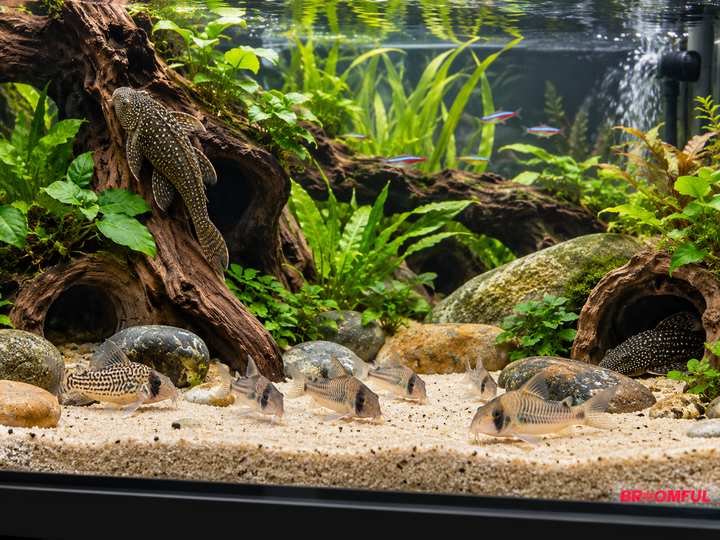
Fine sand is popular because Corydoras can sift through it naturally, and it does not have sharp edges. Smooth rounded gravel can also work for many species if it is kept clean.
Avoid jagged rock, sharp plastic ornaments, and narrow holes that an armored catfish can enter but not exit. Plecos and Raphael catfish have rigid body armor and fin spines that can make backing out difficult.
Driftwood is particularly useful. It creates shaded territories, supports biofilm, and is important in the natural feeding ecology of some loricariids. Caves can be made from rock, ceramic, wood, or purpose-built pleco tubes as long as edges are smooth.
Cycle the Aquarium Completely
Catfish are not starter fish for an uncycled aquarium. Before adding them, establish the biological filter so ammonia and nitrite remain at zero under normal conditions.
Cycle the aquarium before stocking, then add fish gradually instead of filling the tank with the entire final population at once. This gives the biofilter time to adjust to increased waste production.
Otocinclus deserve extra patience. Even after the nitrogen cycle is complete, waiting for visible biofilm and a more mature planted ecosystem can improve their food security.
Test water regularly. Stable parameters are generally more important than chasing a perfect number from one care sheet, provided the species is kept within an appropriate range.
Filtration, Oxygen, and Water Movement
Catfish vary in current preference, but clean, oxygen-rich water benefits nearly all aquarium species. Choose a filter rated for the actual bioload rather than the tank’s empty volume. Large plecos, Synodontis, and predatory catfish can create significant waste.
A hang-on-back, canister, or large sponge-filter system can work depending on tank size. Many aquarists combine a primary filter with an air stone or sponge filter to improve gas exchange and provide redundancy.
Aim the outlet so there are both flowing and calmer areas. Pictus catfish tend to appreciate current, while shy species need places to rest without being blasted constantly.
Temperature and Water Chemistry
There is no single “catfish temperature.” Bronze Corydoras, Pictus, Otocinclus, Synodontis, and plecos come from different habitats.
For a mixed tropical aquarium, the mid-70s Fahrenheit often overlaps with many popular species, but always check the exact fish. Pictus catfish are commonly maintained in the low-to-upper 70s, while some Corydoras species tolerate cooler conditions and others prefer warmer water.
The same principle applies to pH and hardness. Stable, conditioned water inside the species’ acceptable range is more useful than rapid chemical manipulation. If your tap water is naturally hard and alkaline, choose species compatible with it or adjust slowly using a planned method rather than repeatedly adding “pH up” or “pH down” products.
Feeding, Behavior, and Tank-Mate Compatibility
Catfish Are Not Living Vacuum Cleaners
One of the most persistent aquarium myths is that catfish live on waste. They do not. Fish feces are not a complete food, and leftover flakes are not a balanced diet.
Corydoras need sinking foods with appropriate protein and plant content. Otocinclus need algae, biofilm, and supplemental vegetable-based foods. Plecos vary widely; some are heavy wood grazers, some are more omnivorous, and some need higher-protein diets. Pictus catfish need substantial animal protein. Glass catfish feed in the water column and should not be treated like bottom scavengers.
Feed according to species, and watch each fish actually eat.
Match Food to Mouth Position and Activity Time
The best food is useless if the fish cannot reach it. Surface flakes may be consumed before a nocturnal bottom fish becomes active. A large wafer may be monopolized by one pleco while smaller fish go hungry.
Use sinking pellets, wafers, frozen foods, gels, or vegetables according to the fish. Scatter food across more than one area when keeping a group. Feed some nocturnal species shortly before or after lights-out.
Remove uneaten vegetables before they decay. With protein-rich frozen foods, feed portions that disappear quickly instead of dumping in a large amount.
Think About Predation, Not Just Aggression
Many catfish that are described as peaceful will still eat smaller animals. This is not the same as territorial aggression.
A Pictus catfish may ignore a similarly sized rainbowfish but swallow a neon tetra at night. A striped Raphael may coexist calmly with medium fish but take very small tank mates. Bumblebee catfish can be secretive and non-confrontational yet still hunt prey small enough to fit in the mouth.
When choosing tank mates, compare body depth and adult size, not just temperament labels.
Avoid Crowding the Bottom Zone
A tank can look lightly stocked in the upper water while the bottom is overcrowded. Corydoras, plecos, loaches, dwarf cichlids, Synodontis, and other benthic fish may all compete for the same few square feet.
Plan the aquarium by zones. If the bottom already contains a large Corydoras group and a territorial pleco, adding another cave-dwelling catfish may cause more conflict than adding a midwater species.
Provide more hides than the number of territorial fish, break lines of sight with wood and plants, and place food in multiple locations.
Types of Aquarium Catfish Pictures: Visual ID Checklist
People searching for types of aquarium catfish pictures are often trying to answer one practical question: “What fish is this, and how big will it get?” Visual identification is useful, but a photo should be combined with a store label and, ideally, a scientific name.
Corydoras vs. Plecos
Corydoras have short, rounded bodies, visible barbels around the mouth, and rows of armored plates along the sides. They usually rest on the substrate using their pectoral fins and move in social groups.
Plecos have a flattened underside and a suction-cup-style mouth. Bristlenose plecos develop fleshy tentacles around the snout, especially in males. Clown plecos have bold light bands on a darker body and stay compact. Common pleco-type juveniles may look deceptively similar to smaller loricariids, which is why identification matters.
When collecting pictures of aquarium catfish for a blog or store guide, show side views plus a clear image of the mouth and head. Those angles make identification far easier.
Pictus Catfish vs. Other Long-Whiskered Catfish
A Pictus catfish is silver with distinct black spots, a deeply forked tail, and extremely long barbels. The body is streamlined for active swimming.
Juvenile shovelnose catfish have a longer, flatter head and a different pattern. Redtail catfish juveniles have a dark upper body, pale lateral banding, and a colored tail. If a “Pictus” photo shows a bulky head or a fish already growing rapidly past six inches, verify the label before purchase.
For Types of aquarium catfish pictures, scale is important. Include a ruler, hand, known tank dimension, or reliable adult-size caption when possible so readers do not mistake a juvenile monster catfish for a small species.
Glass Catfish vs. Transparent Look-Alikes
True aquarium glass catfish have a nearly transparent body and swim in groups in open water. Their spine and internal structures are visible, giving them a distinctive ghost-like appearance.
Color can be a health clue. Glass catfish that become opaque or unusually pale may be stressed. A clear photo of a healthy school is more useful than a single isolated fish in a dealer cup.
Because “glass catfish” may refer to more than one related species in commerce, use the scientific name Kryptopterus vitreolus when that identification is confirmed.
Upside-Down Catfish and Raphael Catfish
Upside-down catfish have a mottled brown pattern, relatively deep body, and the famous habit of swimming inverted under structure. A photo of the fish belly-up beneath a broad leaf can represent normal behavior.
Striped Raphael catfish have unmistakable pale horizontal stripes and heavy armor. Spotted Raphael relatives may have dots instead. Both have strong pectoral spines and broad heads.
The visual difference is dramatic, but the care difference matters too: Raphael catfish grow much larger and need substantially more space than the classic upside-down catfish.
Common Mistakes to Avoid
Buying a Juvenile Without Checking Adult Size
This is the single biggest catfish mistake. The fish that fits your 20-gallon tank today may be unsuitable within a year or two.
Ask the store for the exact scientific name. Search for the adult size from a dependable source. If the species is uncertain, do not buy it as an impulse purchase.
“Grow-out tank” plans often fail because the larger tank never arrives, the fish becomes difficult to rehome, or the upgrade costs more than expected.
Assuming Every Catfish Eats Algae
Corydoras are not algae eaters. Pictus catfish are not algae-control fish. Glass catfish feed in the water column. Many Synodontis are omnivores. Even genuine algae grazers need supplemental food.
Choose a catfish because its adult requirements and behavior fit the aquarium, not because you want it to fix a maintenance problem.
Keeping Social Species Alone
A single cory, glass catfish, oto, or upside-down catfish may hide more and show fewer natural behaviors than a proper group.
Research the minimum social group before purchase and budget tank space for the whole group. It is better to keep one appropriate species in a full social group than five different social catfish as single specimens.
Using Sharp Decor or Fine Nets
Catfish often have rigid fin spines, armor, or long barbels. Sharp decorations can scrape or trap them, and fine nets can catch spines.
Smooth the hardscape, block unsafe gaps, and use a specimen container when moving heavily spined species. Never pull a snagged catfish forcibly through a net; that can injure the fish and the keeper.
Adding Otocinclus Too Early
A newly cycled tank may technically process ammonia but still lack the mature biofilm and algae resources Otocinclus rely on. Adding them too early can lead to gradual starvation.
Wait for the aquarium to mature, then supplement their diet and watch body condition. “There is algae in the tank” is not the same as “there is enough appropriate food for a group of otos.”
Stocking by Gallons Alone
A 55-gallon tall tank and a 55-gallon long tank can have very different usefulness for bottom fish. Group size, floor area, swimming length, filtration, and territorial layout all matter.
Use gallons as one planning measure, not the only one. The adult fish needs enough room to move, turn, forage, hide, and interact normally.
FAQ: People Also Ask
What is the best freshwater catfish for a beginner aquarium?
Corydoras and bristlenose plecos are among the most beginner-friendly options when their group and tank needs are met. Corydoras are peaceful and social, while bristlenose plecos stay relatively manageable in size. Both still require a cycled aquarium, proper food, stable water, and enough floor space.
What is the smallest catfish for a freshwater aquarium?
Pygmy Corydoras and Asian stone catfish are among the smallest commonly kept freshwater catfish, often staying around 1 to 1.5 inches. Tiny adult size does not eliminate care requirements, however. They still need stable water, appropriate food, hiding cover, and—especially for corys a proper social group.
Can I keep a catfish in a 10-gallon tank?
Only a limited number of genuinely tiny species may be appropriate for a 10-gallon aquarium, and even then tank maturity and group needs matter. Most standard Corydoras, bristlenose plecos, glass catfish, and Pictus catfish need more space. A 20-gallon-long tank offers far more flexibility for beginners.
Are Pictus catfish good community fish?
Pictus catfish can work in a community of appropriately sized fish, but they are predators. They may eat small tetras, guppies, rasboras, shrimp, or any fish they can swallow. Keep them in a large, well-filtered aquarium with robust tank mates too large to be viewed as food.
Do aquarium catfish clean the tank?
No catfish replaces aquarium maintenance. Some species eat algae, biofilm, or leftover food, but they also produce waste and need their own balanced diet. Filters, water changes, substrate cleaning, sensible feeding, and proper stocking keep the aquarium healthy. Treat algae-eating behavior as a bonus, not a cleaning service.
Can Corydoras live with a bristlenose pleco?
Yes, Corydoras and a bristlenose pleco can often share a well-sized community aquarium. Provide enough floor space, several hiding areas, and food in multiple locations so the pleco does not dominate every sinking meal. A 30-gallon or larger tank is easier to manage than a crowded small setup.
Why is my catfish hiding all day?
Many catfish are naturally nocturnal, crepuscular, or shy. Hiding can be normal, especially for plecos, Raphael catfish, and some Synodontis. Excessive hiding can also result from bright lighting, aggressive tank mates, lack of a social group, or poor water quality. Check species behavior and environmental conditions first.
Which large catfish should beginners avoid?
Beginners should avoid redtail catfish, tiger shovelnose-type catfish, and unidentified giant plecos unless they already have an appropriately massive adult enclosure. These fish can outgrow normal aquariums. Choose a verified smaller species such as a bristlenose pleco, Corydoras group, or other realistically sized catfish instead.
Conclusion
Choosing the right freshwater catfish for aquarium setups comes down to matching the fish’s adult life, not its juvenile store size, to the tank you can realistically maintain.
Three key takeaways:
- Choose by verified adult size, group needs, and behavior; never buy an unidentified catfish on appearance alone.
- Small Corydoras, Otocinclus, bristlenose plecos, glass catfish, and selected Synodontis can be excellent home-aquarium fish when their specific needs are met.
- Pictus catfish and larger species require more swimming room, stronger filtration, and carefully sized tank mates, while true giants such as redtail catfish are not normal home-aquarium choices.
Before buying, write down the scientific name, adult size, minimum practical tank, diet, and social requirement. Then build the aquarium around those facts. That one habit will prevent most catfish-care problems before they start.
