
Over time, most pool owners will find that the simple chlorination maintenance system becomes frustrating. A strong chlorine odor, constant chemical changes, dry skin after swimming, and the need to constantly stand by the pool to buy chemicals can make pool ownership more work than play.
That’s why many homeowners wonder: how do you convert a chlorine pool to saltwater?
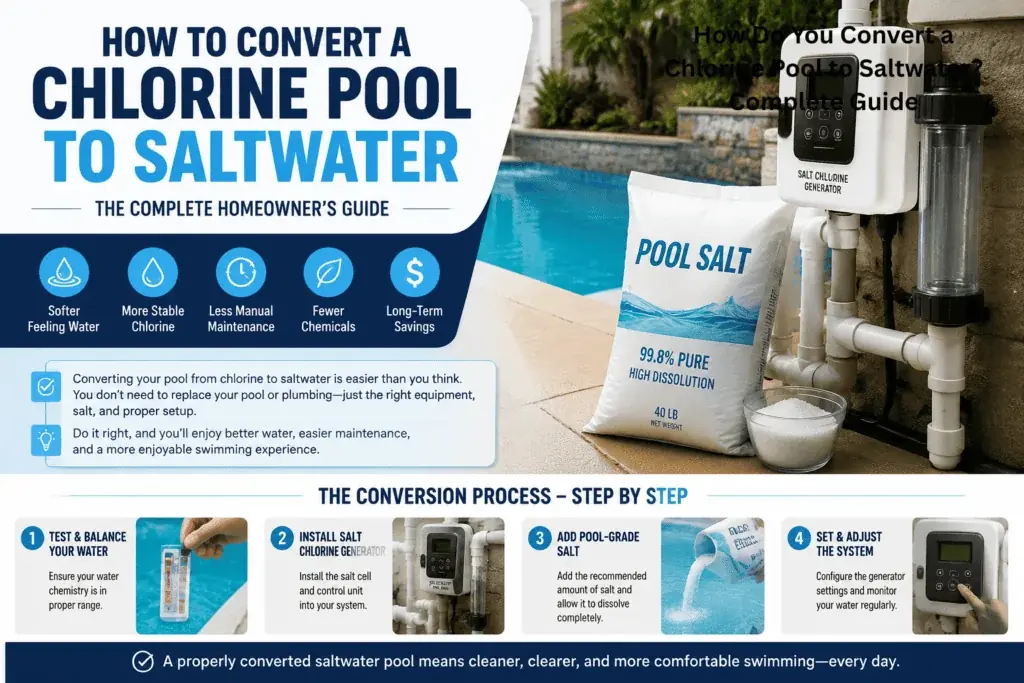
The upside to this is that a conversion from a chlorine pool to a saltwater pool is typically much easier than people think. Don’t have to replace the entire pool, dismantle the existing plumbing, or install a new system. Typically, it’s a matter of installing a saltwater chlorine generator, adding the proper amount of salt to the pool and adjusting your water chemistry.
But for it to work, it isn’t enough to just throw salt in the pool. People new to the pool building process often make common errors like selecting the wrong generator size, overlooking any current water issues, or thinking that saltwater pools are maintenance-free.
If you have a saltwater pool that is converted correctly, you’ll get softer-feeling water, a more stable chlorine and much more convenient swimming. However, it has been associated with the costs of equipment, maintenance and restrictions that all homeowners need to be aware of before converting to it.
This guide explains how to convert a chlorine pool to saltwater, including:
- Conversion costs
- Required equipment
- Step-by-step installation process
- Above-ground and inground pool considerations
- Saltwater chlorine generator selection
- Pros and cons
- Common mistakes
- Frequently asked questions
Whether you have a backyard pool in Texas, Florida, California, or anywhere else in the United States, this guide will help you decide whether a saltwater conversion is the right choice.
What You Will Learn
After reading this guide, you will understand:
- How a saltwater pool system actually works
- The equipment needed for chlorine-to-saltwater conversion
- The average cost of converting a pool
- How to install a saltwater chlorine generator
- Differences between above-ground and inground conversions
- Benefits and drawbacks of saltwater pools
- Mistakes that can damage your pool system
- Whether converting your pool is worth the investment
What Is a Saltwater Pool and How Does It Work?
A common misunderstanding is that saltwater pools do not contain chlorine. They actually do.The main difference is how the chlorine is produced.
A traditional chlorine pool requires you to manually add chlorine products such as:
- Liquid chlorine
- Chlorine tablets
- Granular chlorine
A saltwater pool uses a device called a saltwater chlorine generator (also called a salt cell or chlorine generator). This system converts dissolved salt into chlorine through a process called electrolysis.
How the Process Works
The basic process is:
- Pool-grade salt is added to the water.
- The salt dissolves completely.
- Water passes through the saltwater chlorine generator.
- Electrical current separates salt molecules.
- The system produces chlorine automatically.
- The chlorine sanitizes the pool water.
The salt itself is not what keeps the pool clean. The chlorine created by the generator does.
Many homeowners are surprised when they learn this because “saltwater” sounds like it means swimming in ocean-like water. In reality, most saltwater pools contain only a small amount of salt compared with seawater.
Ocean water contains around 35,000 parts per million (ppm) of salt, while many residential saltwater pools operate around 2,700–3,500 ppm.
Why Are Homeowners Switching From Chlorine Pools to Saltwater?
The popularity of saltwater conversions has increased because many pool owners want a simpler maintenance routine.
1. More Consistent Chlorine Levels
Traditional chlorine pools often experience chemical swings.
For example:
- A homeowner adds chlorine on Saturday.
- Chlorine levels become high.
- After several sunny days, levels drop.
- Algae starts forming.
A saltwater chlorine generator produces chlorine continuously, helping maintain a more stable sanitizer level.
2. Less Chlorine Handling
Handling chlorine chemicals requires care.
Pool owners often deal with:
- Strong chemical odors
- Storage concerns
- Measuring mistakes
- Frequent purchases
A saltwater system reduces the need to manually add chlorine every few days.
3. Softer Swimming Experience
Saltwater pools usually feel smoother because the water chemistry is different.
Many swimmers report:
- Less skin dryness
- Less eye irritation
- A more comfortable swimming experience
However, this does not mean every saltwater pool automatically feels perfect. Poor water balance can still cause irritation.
Can You Convert Any Chlorine Pool Into a Saltwater Pool?
In most cases, yes.
Both of these can usually be converted:
- Inground chlorine pools
- Above-ground chlorine pools
The existing pool structure, pump, filter, and plumbing can often remain.
The main requirement is adding a compatible saltwater chlorine generator.
However, before conversion, you should inspect your existing system.
Check Your Pool Equipment First
Before installing a salt system, examine:
Pool Surface
Salt can affect certain pool materials over time.
Pay attention to:
- Older plaster pools
- Damaged surfaces
- Metal components
Existing Plumbing
Check for:
- Leaks
- Corrosion
- Old pipes
Pool Equipment Compatibility
Your:
- Pump
- Filter
- Heater
- Automation system
should work with the new salt system.
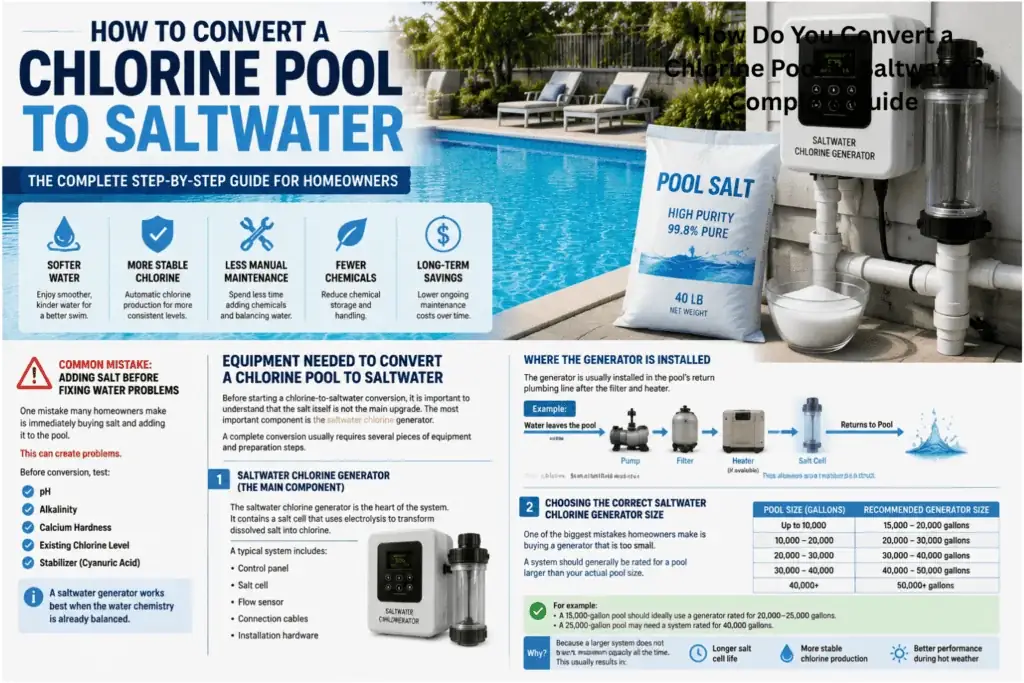
Common Mistake: Adding Salt Before Fixing Water Problems
One mistake many homeowners make is immediately buying salt and adding it to the pool.
This can create problems.
Before conversion, test:
- pH
- Alkalinity
- Calcium hardness
- Existing chlorine level
- Stabilizer (cyanuric acid)
A saltwater generator works best when the water chemistry is already balanced.
Equipment Needed to Convert a Chlorine Pool to Saltwater
Before starting a chlorine-to-saltwater conversion, it is important to understand that the salt itself is not the main upgrade. The most important component is the saltwater chlorine generator.
A complete conversion usually requires several pieces of equipment and preparation steps.
1. Saltwater Chlorine Generator (The Main Component)
The saltwater chlorine generator is the heart of the system.
It contains a salt cell that uses electrolysis to transform dissolved salt into chlorine.
A typical system includes:
- Control panel
- Salt cell
- Flow sensor
- Connection cables
- Installation hardware
The generator is usually installed in the pool’s return plumbing line after the filter and heater.
Example:
Water leaves the pool → pump → filter → heater (if available) → salt cell → returns to pool.
This allows sanitized water to circulate back into the pool.
Choosing the Correct Saltwater Chlorine Generator Size
One of the biggest mistakes homeowners make is buying a generator that is too small.
A system should generally be rated for a pool larger than your actual pool size.
For example:
- A 15,000-gallon pool should ideally use a generator rated for 20,000–25,000 gallons.
- A 25,000-gallon pool may need a system rated for 40,000 gallons.
Why?
Because a larger system does not have to work at maximum capacity all the time. This usually results in:
- Longer salt cell life
- More stable chlorine production
- Better performance during hot weather
2. Pool Salt
Not all salt is suitable for swimming pools.
You should use:
Pool-grade sodium chloride (NaCl)
Avoid using:
- Rock salt
- Table salt with additives
- Water softener salt containing impurities
Most residential systems require approximately:
2,700–3,500 ppm salt concentration
The exact amount depends on your generator model.
3. Salt Testing Equipment
A salt test kit or digital salt meter helps confirm the correct salt level.
Many homeowners assume the generator display is always accurate.
However:
- Old sensors can become inaccurate
- Temperature changes can affect readings
- Poor water chemistry can confuse measurements
Testing manually from time to time is a good practice.
4. Water Testing Supplies
Before and after conversion, you should monitor:
- pH
- Total alkalinity
- Calcium hardness
- Cyanuric acid
- Free chlorine
- Salt level
A saltwater pool still requires water testing.
A common misunderstanding is:
“Saltwater pools maintain themselves completely.”
They do reduce daily chemical work, but they are not maintenance-free.
5. Plumbing Connections and Installation Materials
Depending on your existing setup, installation may require:
- PVC fittings
- Unions
- Pipe sections
- PVC cement
- Electrical connections
Professional installation may also require:
- Electrical wiring
- Circuit protection
- Equipment mounting
Salt Water Pool Conversion Kit for Inground Pool
For inground pools, a typical conversion kit includes:
- Saltwater chlorine generator
- Salt cell
- Controller
- Installation accessories
Popular systems are available for different pool sizes.
When choosing a kit, consider:
- Pool volume
- Pump flow rate
- Existing automation system
- Warranty length
- Replacement salt cell cost
A cheaper system may appear attractive initially, but replacement cells can become expensive after several years.
Step-by-Step: How Do You Convert a Chlorine Pool to Saltwater?
The conversion process is straightforward when done correctly.
Step 1: Test Your Existing Pool Water
Before adding salt, test the current water chemistry.
Check:
| Chemical | Recommended Range |
| pH | 7.2–7.8 |
| Total Alkalinity | 80–120 ppm |
| Free Chlorine | 1–3 ppm |
| Cyanuric Acid | 30–50 ppm |
| Calcium Hardness | Depends on pool surface |
Correct any major problems first.
Step 2: Inspect Existing Pool Equipment
Check:
- Pump operation
- Filter condition
- Plumbing leaks
- Heater compatibility
- Pool surface condition
A salt system will not fix existing equipment problems.
For example:
If your filter is already failing, installing a salt generator will not improve filtration.
Step 3: Install the Saltwater Chlorine Generator
The salt cell is installed in the return line.
The installation location should allow:
- Proper water flow
- Easy access for maintenance
- Protection from extreme conditions
The control unit is mounted near existing pool equipment.
Electrical installation should follow local safety codes.
Step 4: Add Pool Salt
After installation, add the required amount of salt.
The process:
- Calculate pool gallons.
- Check current salt level.
- Add required pool salt.
- Allow salt to dissolve.
- Run the pump continuously for circulation.
Salt can take several hours to completely dissolve.
Do not immediately increase the generator output before confirming salt levels.
Step 5: Test Salt Levels
Once salt has dissolved:
- Test the salt concentration.
- Adjust if necessary.
- Confirm the generator reading.
Too little salt:
- Generator may not produce enough chlorine.
Too much salt:
- Reducing salt requires draining and replacing water.
Step 6: Balance Pool Chemistry
After conversion:
Adjust:
pH
Saltwater systems often cause pH to rise over time.
Regular monitoring is important.
Alkalinity
Incorrect alkalinity can make pH unstable.
Stabilizer
Cyanuric acid protects chlorine from sunlight.
This is especially important in sunny areas like Texas, Florida, and Arizona.
How Long Does a Chlorine-to-Saltwater Conversion Take?
For most residential pools:
DIY installation:
Approximately 4–8 hours depending on experience.
Professional installation:
Usually completed within one day.
The chemical adjustment period may take several days.
A common mistake is expecting perfect water balance immediately after adding salt.
The system needs time to stabilize.
Cost to Convert Chlorine Pool to Saltwater
The cost depends on:
- Pool size
- Generator quality
- Installation complexity
- Electrical requirements
- Existing equipment
Typical costs in the United States:
| Item | Estimated Cost |
| Saltwater chlorine generator | $500–$2,000 |
| Pool salt | $100–$300 |
| Installation labor | $300–$1,000 |
| Plumbing modifications | $100–$500 |
| Electrical work | $200–$800 |
Average Total Conversion Cost:
$1,000–$3,000
A simple DIY conversion may cost less, while professional installations can cost more.
Cost to Convert Chlorine Pool to Saltwater in Texas
Texas homeowners often choose saltwater systems because of:
- Strong sunlight
- Long swimming seasons
- High chlorine demand during summer
Typical Texas conversion costs are often around:
$1,500–$3,000
Factors increasing cost include:
- Large pools
- Older plumbing
- Electrical upgrades
- Premium automation systems
A larger generator is often recommended because hot Texas summers can increase chlorine demand.
How to Convert an Above-Ground Pool to Saltwater
Many above-ground pool owners assume saltwater systems are only designed for expensive inground pools. That is not true.
Most above-ground pools can be converted to saltwater as long as the pool equipment is compatible with a saltwater chlorine generator.The conversion process is similar, but there are a few extra considerations.
Above-Ground Pool Saltwater Conversion Process
Step 1: Determine Your Pool Size
Before buying a saltwater conversion kit, calculate your pool volume.
You need accurate gallons because the generator must match your pool size.
For example:
- Small above-ground pool: 5,000–10,000 gallons
- Medium pool: 10,000–20,000 gallons
- Large above-ground pool: 20,000+ gallons
Choosing a generator designed for a larger pool is usually better because it does not need to run at full power continuously.
Step 2: Check Your Existing Pump and Filter
The salt cell requires proper water flow.
Check:
- Pump horsepower
- Filter condition
- Pipe connections
- Flow rate
A weak pump may not activate the salt cell correctly.
A common beginner mistake is buying a saltwater generator first and checking compatibility later.
The better approach is:
Check your current equipment → choose the correct generator → install the system.
Step 3: Install the Saltwater Chlorine Generator
For above-ground pools, installation is usually easier because many systems are designed for simple plumbing connections.
The salt cell is installed after the filter and before water returns to the pool.
Typical setup:
Pool → Pump → Filter → Salt Cell → Pool Return
Some above-ground systems are designed with plug-and-play installation, making them suitable for homeowners who prefer DIY projects.
Step 4: Add Pool Salt
After installing the generator:
- Test current salt level.
- Add pool-grade salt.
- Run the pump.
- Allow salt to dissolve completely.
- Test again.
Never guess the salt amount.
Adding too much salt creates unnecessary problems because salt cannot simply be removed by adding chemicals.
Salt Water Pool Conversion Kit for Above Ground Pool
When choosing a saltwater conversion kit for an above-ground pool, consider:
Pool Size Rating
Do not buy only based on price.
A small generator working constantly may wear out faster.
Cell Replacement Cost
The salt cell is a consumable component.
Eventually, it loses efficiency and needs replacement.
Before buying a system, check:
- Replacement cell price
- Warranty
- Availability of parts
A cheaper system may cost more long-term if replacement parts are expensive.
Saltwater Pool Conversion Pros and Cons
Before converting, homeowners should understand both advantages and disadvantages.
A saltwater pool is not automatically better for everyone.
It depends on your priorities, budget, and maintenance preferences.
Advantages of Converting to Saltwater
1. Reduced Manual Chlorine Handling
One of the biggest benefits is convenience.
Instead of regularly measuring and adding chlorine, the generator produces chlorine automatically.
This is especially useful for:
- Busy families
- Vacation homes
- Large pools
Example:
A homeowner who travels frequently may prefer a saltwater system because chlorine levels are less likely to drop quickly while they are away.
2. More Stable Water Chemistry
Traditional chlorine pools can experience bigger chemical changes.
A saltwater system produces chlorine gradually.
This can help maintain:
- Consistent sanitation
- Fewer algae problems
- More predictable water quality
However, water testing is still necessary.
3. Comfortable Swimming Experience
Many swimmers prefer saltwater pools because they feel:
- Softer
- Less harsh
- More comfortable on skin
People who dislike the strong chlorine smell often notice a major improvement.
4. Lower Long-Term Chemical Costs
Although the initial installation costs more, some homeowners spend less on chlorine products over time.
You may reduce spending on:
- Chlorine tablets
- Liquid chlorine
- Shock treatments
However, savings depend on:
- Pool size
- Usage
- Local chemical prices
- Electricity costs
Disadvantages of Saltwater Conversion
1. Higher Upfront Cost
The biggest disadvantage is the initial investment.
A traditional chlorine pool may already have all required equipment.
A saltwater conversion requires:
- Generator
- Salt cell
- Installation
- Electrical work
2. Salt Cells Eventually Need Replacement
Salt cells do not last forever.
Typical lifespan:
3–7 years
depending on:
- Usage
- Water chemistry
- Cleaning frequency
- Operating time
Replacement cost varies by brand and model.
3. Salt Can Affect Certain Pool Components
Salt is generally safe at proper levels, but over time it can contribute to corrosion of certain materials.
Pay attention to:
- Metal fixtures
- Older heaters
- Poor-quality stainless steel components
Proper maintenance reduces these risks.
4. Saltwater Pools Still Need Maintenance
This is one of the biggest misconceptions.
A saltwater pool still requires:
- pH testing
- Filter cleaning
- Salt level checks
- Equipment inspection
- Pool cleaning
The system reduces work; it does not eliminate it.
Saltwater Pool vs Traditional Chlorine Pool
| Feature | Chlorine Pool | Saltwater Pool |
| Initial cost | Lower | Higher |
| Daily chlorine addition | More frequent | Less frequent |
| Maintenance | More manual | More automated |
| Water feel | Standard | Softer feel |
| Equipment cost | Lower | Higher |
| Chlorine production | Manual | Automatic |
| Salt cell replacement | No | Required |
Common Mistakes When Switching Chlorine Pool to Saltwater
Mistake 1: Buying an Undersized Generator
This is one of the most common mistakes.
A generator that is too small may struggle during:
- Hot weather
- Heavy swimming periods
- Pool parties
The system may run constantly but still fail to maintain chlorine levels.
Mistake 2: Ignoring Existing Water Problems
Installing a salt system does not repair:
- Poor filtration
- Algae problems
- Incorrect chemistry
Fix existing problems first.
Mistake 3: Adding the Wrong Type of Salt
Only use pool-grade salt.
Avoid:
- Road salt
- Industrial salt
- Salt with additives
Impurities can damage equipment.
Mistake 4: Assuming “Saltwater Means No Chlorine”
Saltwater pools still use chlorine.
The difference is:
Traditional pool:
You add chlorine manually.
Saltwater pool:
The system creates chlorine automatically.
Mistake 5: Forgetting About pH Control
Saltwater generators can gradually increase pH.
Many new owners are surprised when they need to adjust pH regularly.
Monitoring pH prevents:
- Cloudy water
- Scaling
- Equipment problems
Maintenance After Converting to Saltwater
A converted saltwater pool still requires a routine.
Weekly Checks
Monitor:
- pH
- Chlorine level
- Water clarity
- Salt level
Monthly Checks
Inspect:
- Salt cell condition
- Filter pressure
- Pool equipment
- Water balance
Seasonal Maintenance
Before heavy swimming season:
- Test chemistry
- Clean equipment
- Check generator output
- Inspect salt cell
Is Converting a Chlorine Pool to Saltwater Worth It?
For many homeowners, converting a chlorine pool to saltwater is worth the investment because it improves convenience and creates a more consistent swimming experience.
However, the decision depends on your priorities.
If you enjoy maintaining your pool manually and already have a good chlorine routine, staying with chlorine may make financial sense.
But if you are tired of:
- Buying chlorine regularly
- Managing chemical spikes
- Dealing with strong chlorine odors
- Constantly adjusting sanitizer levels
then a saltwater conversion can be a valuable upgrade.
The best candidates for saltwater conversion are homeowners who:
- Use their pool frequently
- Want lower daily maintenance
- Plan to own the pool for many years
- Prefer automated systems
Expert Recommendation: Choose the Right System, Not Just the Cheapest One
One of the biggest lessons in pool equipment is that the cheapest option is not always the most economical.
A quality saltwater chlorine generator can last many years, while a low-quality system may create frustration through:
- Frequent errors
- Poor chlorine production
- Expensive replacement parts
Before purchasing, compare:
1. Generator Capacity
Choose a system rated above your actual pool size.
A little extra capacity gives better performance during:
- Summer heat
- Heavy pool use
- Long swimming seasons
2. Replacement Cell Cost
Many buyers focus only on the initial purchase price.
However, the salt cell is the part that eventually needs replacement.
Always check:
- Replacement availability
- Replacement price
- Warranty coverage
3. Automation Compatibility
If your pool already uses automation controls, choose a generator that can communicate with your existing system.
This can make future maintenance easier.
How Do You Convert a Chlorine Pool to Saltwater in Texas?
Texas is one of the most suitable locations for saltwater pool systems because of:
- Long swimming seasons
- Strong sunlight
- High chlorine demand during summer
However, Texas homeowners should consider several factors.
Texas Heat and Chlorine Demand
Hot weather and intense sunlight can consume chlorine faster.
A properly sized saltwater generator helps maintain chlorine production during these conditions.
Many Texas pool owners benefit from:
- Oversized generators
- Good stabilizer levels
- Proper circulation
- Regular pH monitoring
Texas Water Considerations
Some areas have harder water, which means calcium buildup can become a concern.
Monitor:
- Calcium hardness
- pH levels
- Salt cell scaling
Cleaning the salt cell when needed helps maintain performance.
Professional Installation vs DIY Conversion
Many homeowners consider installing the system themselves.
Both options have advantages.
DIY Conversion
Advantages:
- Lower cost
- Learning experience
- Suitable for simple setups
Challenges:
- Electrical connections
- Plumbing modifications
- Correct sizing
- Troubleshooting
DIY may work well for experienced homeowners comfortable with pool equipment.
Professional Installation
Advantages:
- Correct installation
- Safety compliance
- Faster completion
- Professional troubleshooting
Professional installation is recommended when:
- Electrical work is required
- Pool equipment is complex
- Automation systems are involved
FAQs
Can you convert a regular chlorine pool to saltwater?
Yes. Most existing chlorine pools can be converted by installing a compatible saltwater chlorine generator and adding the correct amount of pool salt. You usually do not need to replace the pool itself, pump, or filter unless existing equipment is damaged or incompatible.
How much does it cost to convert a chlorine pool to saltwater?
The average cost is usually around $1,000–$3,000 in the United States. A basic DIY installation may cost less, while professional installation with premium equipment or electrical upgrades can cost more.
Do saltwater pools still use chlorine?
Yes. Saltwater pools still use chlorine, but the chlorine is generated automatically from salt through electrolysis instead of being manually added using tablets or liquid chlorine.
How much salt do I need for my pool conversion?
The required salt amount depends on your pool volume and the generator manufacturer’s recommendation. Most residential systems operate around 2,700–3,500 ppm salt concentration.
Always calculate before adding salt instead of guessing.
Can I convert an above-ground pool to saltwater?
Yes. Many above-ground pools can be converted using a suitable saltwater conversion kit. The main requirements are compatible plumbing, proper water flow, and a correctly sized chlorine generator.
Conclusion:
Learning how do you convert a chlorine pool to saltwater is the first step toward deciding whether the upgrade makes sense for your home.
The conversion process is relatively simple:
- Test and balance your existing pool water.
- Choose the correct saltwater chlorine generator.
- Install the system properly.
- Add pool-grade salt.
- Adjust water chemistry.
- Maintain the system regularly.
A saltwater conversion does not eliminate pool care, but it can make ownership easier and more enjoyable.
For most homeowners who swim frequently and want a more automated experience, a properly installed saltwater system is a worthwhile investment.
The key is choosing the right equipment, avoiding common mistakes, and understanding that good maintenance is still essential.
A saltwater pool is not a “no maintenance” pool it is a smarter maintenance system that can give you cleaner, more comfortable water with less daily effort.
