
About 70% of all new fish deaths within the first month of aquarium ownership can be attributed to a single cause untreated or poorly treated water. Not disease. Not bad luck. Preventable chlorine, chloramine, ammonia spikes, and pH crashes that could have been avoided with a $10 bottle of conditioner and a simple test kit.
You’ve probably done this before: typed “chemicals needed for fish tank” into Google at 11 p.m. when your new betta is gasping at the surface; you’re not alone you’re in the right place.
This guide is not just about “add dechlorinator.”You will know which chemicals are essential, which are optional upgrades, and which (believe it or not, some popular products) can actually damage your fish. We will discuss freshwater, tropical, betta, goldfish, planted, shrimp, and saltwater/reef tanks separately, since the chemical requirements of a 5-gallon betta bowl are not the same as those of a 75-gallon reef system.
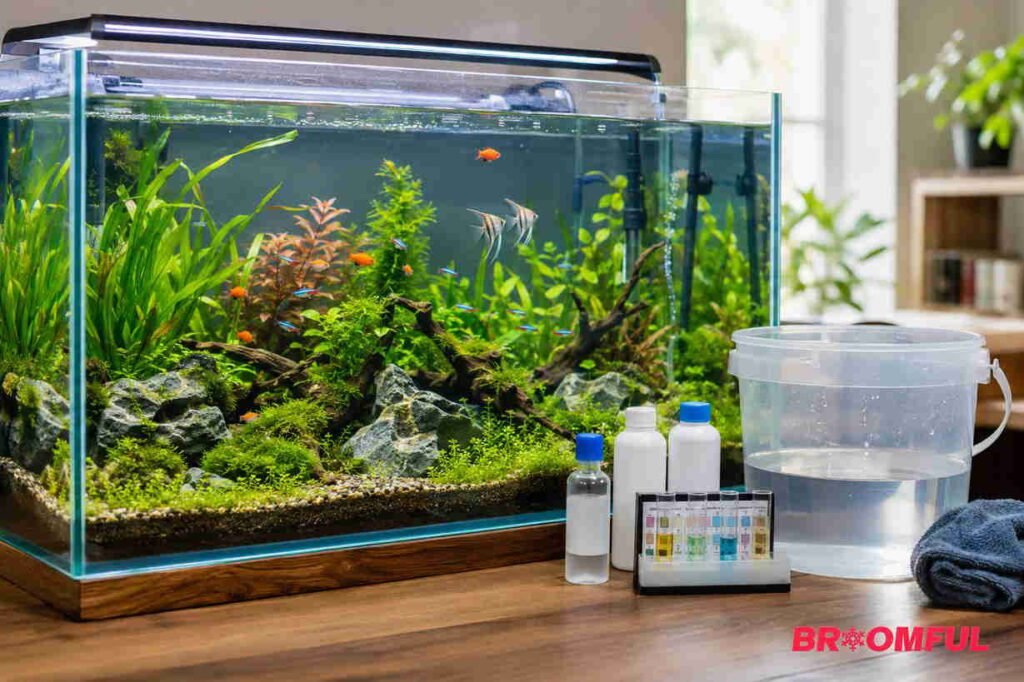
In this guide, you’ll learn:
- The essential “starter kit” of chemicals every tank should have, by priority
- How to prepare water for a fish tank step-by-step (for total beginners)
- Whether reverse osmosis (RO) water is good for aquariums and when to avoid it
- The chemicals required for fish tank cycling
- Chemical breakdown, one by one (tropical, betta, goldfish, saltwater, shrimp)
- A realistic aquarium water-change schedule and long-term aquarium water treatment
- Common mistakes that quietly kill fish, and how to avoid them
1. What Chemicals Do You Actually Need for a Fish Tank?
Most guides have 2,000 words of chemistry lecture in front of the answer. Let’s get the “why” behind each one first, then it’s up front!
No matter if the tank is a betta, goldfish, tropical community, or any other freshwater fish tank, there are three types of chemical support that are required: a dechlorinator, a way to establish beneficial bacteria, and a testing system to ensure the water is safe to use. All else is situational.
The Non-Negotiable Starter Kit
| Chemical / Product | Purpose | Priority | Typical Cost |
| Water conditioner (dechlorinator) | Neutralizes chlorine and chloramine, and binds heavy metals | Essential — every water change | $8–$15 |
| Liquid test kit (API Freshwater Master Kit or equivalent) | Measures ammonia, nitrite, nitrate, pH | Essential — weekly during cycling | $25–$35 |
| Beneficial bacteria supplement (e.g., Seachem Stability, Fritz Zyme 7) | Speeds up nitrogen cycle establishment | Highly recommended | $12–$20 |
| pH buffer/adjuster | Stabilizes pH for species-specific needs | Situational | $8–$12 |
| Aquarium salt (sodium chloride, not table salt) | Electrolyte support, stress/disease reduction | Situational | $5–$10 |
| Algaecide/phosphate remover | Controls algae blooms | Optional | $10–$18 |
| RO/DI remineralizer | Restores minerals to reverse osmosis water | Situational | $10–$15 |
Look at what isn’t included on the “essential” list: ammonia-locking products such as Amquel, “instant cycle” gimmicks, and most algae treatments. They do have a place, but they are not what a beginner needs on day one — and several competitor articles mix the two terms ‘nice to have’ and ‘must have’ up, which is what leads a new keeper to over-medicate a tank.
Why Chlorine and Chloramine Removal Comes First
The reason that municipal tap water is chlorinated or chloraminated is that it kills bacteria, and the same bacteria that your filter relies on to keep it alive are the bacteria that damage the gill tissue of fish. Unlike the older fishkeeping forums, chloramine does not simply evaporate after 24 hours; it’s more stable than chlorine. Chloramine is broken down by a proper conditioner like Seachem Prime, API Tap Water Conditioner, or Tetra AquaSafe, which neutralizes both parts of the chloramine in one dose. This is the most important product in this entire guide.
Why a Test Kit Outranks Every Other Purchase After Conditioner
What you can’t measure, you can’t manage. An ammonia spike can occur before your fish notice it; a liquid-reagent test kit will help you determine if your tank is cycling properly and will help you identify when your fish are stressed without any guesswork. Test strips are quick, but have been found over and over again to be far from accurate for ammonia and pH; independent hobbyist comparisons have shown that the strip results have drifted by as much as a full colour block from lab results, which is enough to miss the significant rise entirely.
2. How to Prepare Water for a Fish Tank (Step-by-Step for Beginners)
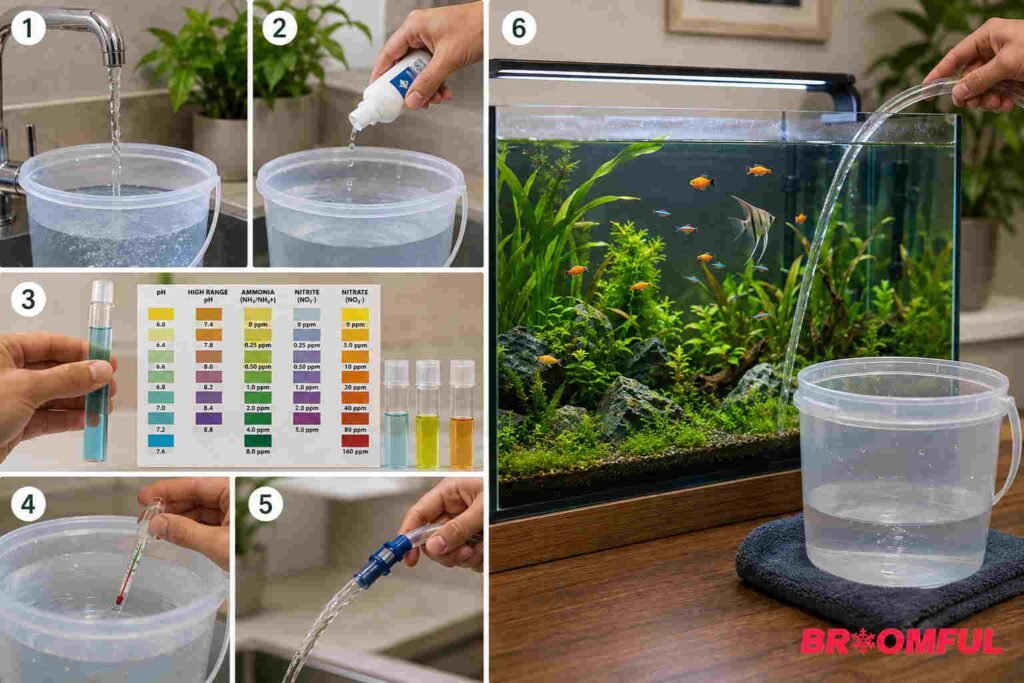
Whether you’re filling a new tank or adding water to an existing one, here’s the complete sequence.
Step 1: Match the Water Temperature
A temperature change of more than 5°F can cause temperature shock, particularly in sensitive fish and invertebrates such as shrimp and neon tetras, so try to keep the temperature within 2–3°F of your target temperature.
Step 2: Add the Water Conditioner First
Add the conditioner into the bucket before it comes into contact with the water in the tank (most conditioners use the ratio of 1 capful per 10 gallons, but verify the ratio on the bottle Prime is a more concentrated conditioner and should be used at half the standard dose. It is this step that is most often overlooked when people are filling up quickly and is the step that leads to the most beginner deaths.
Step 3: Test Before You Pour
Depending on your municipality, even tap water may have high pH, high hardness, or high nitrate levels. If you’re using a test strip, or you can do a quick liquid test on the water in the bucket you’re treating, you’ll know what you’re adding many water utilities switch between chlorine and chloramine seasonally, and it can come as a surprise to even the most experienced keepers the first time they have a new home or a seasonal change.
Step 4: Match pH and Hardness to Your Species (If Needed)
When the water from your tap has a significant difference from what your fish require, such as very soft, very acidic water for hard-water-loving African cichlids, this is where buffers or remineralizers can be used. Unless your species requires it, don’t obsess over ‘perfect’ numbers, as most community tropical fish are quite tolerant of a wide pH range (6.5-7.5).
Step 5: Introduce Water Slowly
Fill the tank with treated water slowly, preferably over a decoration or your hand, to avoid creating a current and noise, which could stress fish and disrupt substrate.
How to Prepare Water for a Fish Tank for Beginners: The Simplified Checklist
| Step | Action | Time Needed |
| 1 | Fill bucket, match temperature | 5–10 min |
| 2 | Add conditioner at correct dose | 1 min |
| 3 | Test treated water (pH, hardness) | 2–5 min |
| 4 | Adjust pH/hardness only if mismatched | 5–15 min |
| 5 | Pour slowly into tank | 5 min |
This process is necessary for a brand new tank before any fish are introduced, and then again before the tank goes through a full nitrogen cycle (which is detailed in Section 4) before stocking. This is the only way to change the water in an established tank, and it should be done every water change, without exception, until the tank is no longer in use. The most important “how to change water for fish” fact that most guides overlook is that the preparation procedure continues beyond the first month.
3. Is Reverse Osmosis (RO) Water Good for Aquariums?
This is one of the most searched and most misunderstood questions in the hobby and deserves its own section instead of a hastily thrown-together mention.
What Reverse Osmosis Water Actually Is
Fish tank reverse osmosis water is tap water that has been pushed through a semipermeable membrane to remove virtually all dissolved minerals, chlorine, chloramine, heavy metals, nitrates, and phosphates from the water. What comes out the other side is close to chemically pure H2O a blank slate rather than “clean tap water.”
Is RO Water Good for Aquariums? It Depends on the Species
RO water is a true improvement over tap water for soft-water species such as wild-caught discus, many tetras, wild bettas, and Amazonian biotope tanks, as you can create a water chemistry from scratch instead of working against the minerals found in your tap water. Tap water phosphates and silicates promote nuisance algae and may be detrimental to coral health, and, for reef and saltwater tanks, RO/DI (reverse osmosis + deionization) water is nearly a necessity.
In fact, straight RO water is a bad thing for the average freshwater community tank with hardy fish (guppies, platies, most tetras, goldfish, and bettas). It has almost no dissolved minerals, and therefore not much buffering capacity to maintain pH stability tanks operating on unremineralized RO water are susceptible to sudden pH changes which can be dangerous.
The Non-Negotiable Rule: Never Use Straight RO Water Without Remineralizing
When using reverse osmosis water for fish, you need to remineralize the water with a remineralizer product (such as Seachem Replenish, Salty Shrimp GH/KH+ or similar) before it comes in contact with your fish. Straight RO water has no osmotic buffer to protect the fish gills and no pH stability — it is not “safer” than tap water; it’s just unfinished water.
RO Water vs. Tap Water vs. Distilled Water
| Water Type | Chlorine/Chloramine | Minerals (GH/KH) | Nitrates/Phosphates | Best Use Case |
| Tap water (conditioned) | Removed by conditioner | Present (varies by region) | Present (varies) | Most community freshwater tanks |
| RO water | None to begin with | Stripped — must remineralize | Stripped | Soft-water species, reef tanks, shrimp |
| RO/DI water | None | Fully stripped | Fully stripped | Reef tanks, high-end planted tanks |
| Distilled water | None | Fully stripped | None | Emergency top-off only, not primary source |
Is RO Water Good for Shrimp Tanks?
Yes, but as with most things, remineralize it and remineralize it properly. Actually, the beginner-friendly Neocaridina shrimp prefer moderate GH/KH, whereas Caridina shrimp (crystal reds, bees) require very specific low, stable mineral levels which are hard to achieve with tap water. A case where it is worth the extra equipment expense for a beginner to get a specific source of RO water for the remineralizing process.
4. Chemicals Needed for Fish Tank Cycling
“Cycling” is a process that creates the nitrogen cycle, the biological process in which good bacteria convert the toxic ammonia (fish waste and uneaten food) into nitrite and then into less harmful nitrate. This is the one part of the hobby that is the most misunderstood and is what gets a lot of people to lose fish in week one they fill a brand new tank the same day as they buy it, and then stock it with fish, before any bacterial colony has had time to form to process the waste.
The Nitrogen Cycle, Simplified
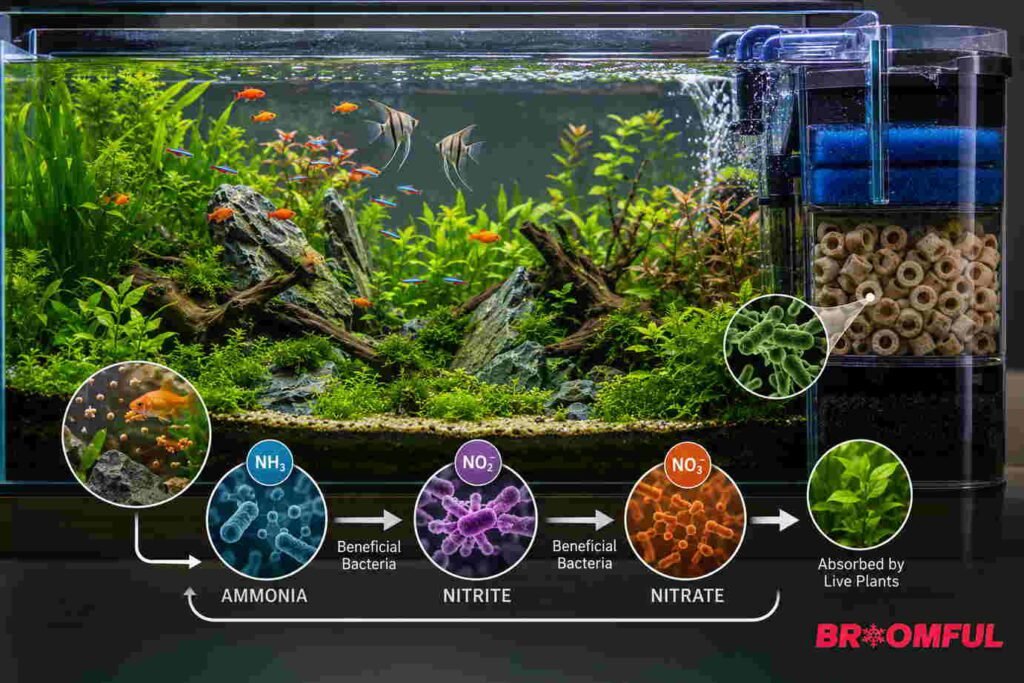
Fish waste is converted to ammonia (NH3/NH4) by Nitrosomonas bacteria, then to nitrite (NO2) by Nitrobacter bacteria, and finally removed by water changes or plant uptake, as nitrate (NO3).
Both ammonia and nitrite are toxic to fish even at small concentrations (0.25 ppm of ammonia will stress fish; 1.0+ ppm of nitrite will kill fish). Nitrate is relatively harmless and can be controlled by frequent water changes, not by bacteria.
Core Cycling Chemicals
Ammonia source (fishless cycling): Pure ammonia or a bottled product such as Dr. Tim’s Ammonium Chloride is added to the water to feed the bacterial colony you are attempting to grow, without the risk of live fish in toxic water.
Bacterial starter cultures: These products, such as Seachem Stability, Fritz Zyme 7, or Dr. Tim’s One and Only, contain live nitrifying bacteria, which can shorten the cycling time from the normal 4-6 weeks to as short as 7-14 days in many instances documented.
Ammonia detoxifier (fish-in cycling only): If you have to cycle with fish in the tank (not recommended, but often necessary when someone has already purchased fish before learning about cycling), products such as Seachem Prime temporarily bind the ammonia into a less harmful form for up to 24-48 hours, giving you time to change the water.
Test kit: Already covered it in section 1, but during the cycling, you will be testing every 1-2 days to monitor the ammonia to nitrite to nitrate transition, and will move from recommended to mandatory.
Fishless Cycling vs. Fish-In Cycling: Chemical Requirements
| Method | Chemicals Needed | Fish Welfare Risk | Timeline |
| Fishless cycling | Pure ammonia source, bacterial starter, test kit | None — no fish present | 2–6 weeks |
| Fish-in cycling | Conditioner, ammonia detoxifier, bacterial starter, test kit | Moderate to high | 4–8 weeks, with daily monitoring |
How to Know Your Tank Chemicals for Cycling Are Working
A completed cycle is indicated by ammonia and nitrite readings of 0 ppm and a nitrate reading (usually 5–40 ppm) after 24 hours following the introduction of ammonia and waiting. A tank with all three parameters at zero may not be cycled, but may be under-dosed, or the test kit may be misread.
What Chemicals Are Needed for Different Tank Types
The chemical requirements vary significantly according to the type of things you might be storing.
Chemicals Needed for Fish Tank (Freshwater General/Community)
For a standard freshwater community tank (guppies, tetras, corydoras, platies), the only additional items needed for the starter kit are the conditioner, test kit, and bacterial supplement during set-up, and nothing else special. Aquarium salt, a low general maintenance dose (1 tablespoon per 5 gallons), is not necessary and is only used during minor stress periods or as a mild antiparasitic treatment, not as a permanent aquarium addition.
What Chemicals Are Needed for a Tropical Fish Tank
For tropical freshwater fish (most community species: tetras, gouramis, angelfish, livebearers): The same basic kit is required, with two special items to mention: a filter with a water flow of at least 100% of the tank’s capacity, and a heater capable of maintaining the temperature within 3°F of the desired setting. A heater and thermometer are not chemicals, and a water conditioner designed for tropical systems (such as Seachem Prime) will also remove ammonia, but this is more important in warmer water as fish metabolism is greater and ammonia production is higher. Now, a pH buffer is more important if you are keeping species such as discus or angelfish that prefer slightly acidic soft water (pH 6.0–6.8) rather than the neutral tap water that most municipalities provide.
What Chemicals Are Needed for a Betta Fish Tank
Bettas are often housed in smaller tanks (5 – 10 gallons), causing chemistry swings to occur more rapidly and more severely than in larger tanks. The same conditioner and test kit are used, but the precision of the doses is more important if it is a 5-gallon tank, a dose error that might be insignificant in a 55-gallon tank can make a significant difference in ammonia or pH levels. Indian almond leaves or blackwater extract (which contains tannins) are popular additions for bettas, as they will slightly acidify water and have been proven to have antibacterial and antifungal properties which are beneficial for fin health, but not essential. Don’t use “betta water” pre-mixed jugs from some pet stores many cost more than a bottle of conditioner, and some hobbyists have said that the conditioner strength is not consistent.
Chemicals Needed for Fish Tank Goldfish
The nitrogen cycle chemicals of Section 4 are more important for the goldfish than they are for the smaller fish. The bacterial colonization is higher at the start-up and is faster in a goldfish tank than in a community tank (Seachem Stability dosed for a few days in a row), so it is important to get a better start. Goldfish also will tolerate, and in some areas may need, a slightly higher concentration of aquarium salt during treatment of illness (up to 0.1-0.3% for specific parasite treatments), but this should be a temporary medicated dose and not a permanent water chemistry.
What Chemicals Are Needed for a Saltwater/Reef Tank
The one area in which “chemicals needed” grows significantly larger than freshwater is saltwater and reef tanks. The additions include: marine salt mix (Instant Ocean, Red Sea Coral Pro) to make saltwater from RO/DI water, a refractometer or hydrometer to check salinity (not a chemical but necessary to use properly), and for reef tanks only, a calcium, alkalinity, and magnesium supplementation system (often called “the big three”) to help coral skeletal growth. Trace element supplements and phosphate/nitrate reducers complete an existing reef system.
Chemicals Needed for a Shrimp Tank
In contrast to fish, freshwater shrimp are sensitive to copper (Neocaridina, Caridina), and copper-based medicines in high concentrations are fatal to the shrimp. The copper-free conditioner and copper-free fertilizers (if applied) are essential, as well as GH/KH specific remineralizers, if RO water is used, as explained in Section 3.
Chemicals Needed for a Planted Tank
Planted tanks are a category that most beginner guides don’t even include: fertilization. In addition to using nitrate as food, live plants also remove potassium, iron, and trace minerals that are not adequately replenished by tap water and fish waste. For root and stem plants, a liquid all-in-one fertilizer (such as Seachem Flourish, Easy Green) can be used in low to medium light requirements, and CO2 (liquid or pressurized CO2) is applicable in medium to high light levels, where lighting without CO2 and nutrients will only support algae growth. As mentioned in the shrimp section above, copper-based fertilizers should not be used in any tank with shrimp or scaleless fish.
Chemical Needs by Tank Type at a Glance
| Tank Type | Core Chemicals | Situational Additions |
| Freshwater community | Conditioner, test kit, bacterial starter | Aquarium salt (occasional) |
| Tropical freshwater | Conditioner, test kit, bacterial starter | pH buffer for soft-water species |
| Betta | Conditioner, test kit | Indian almond leaf/blackwater extract |
| Goldfish | Conditioner, test kit, strong bacterial starter | Medicated salt dose (illness only) |
| Saltwater/reef | Marine salt mix, RO/DI water, test kit | Calcium/alkalinity/magnesium supplements |
| Shrimp | Copper-free conditioner, GH/KH remineralizer | RO water + remineralizer |
6. Aquarium Water Change Schedule and How to Treat Aquarium Water
Preparing water correctly once isn’t enough — how to treat aquarium water is an ongoing discipline, not a one-time task.
How Often to Change Water in a Fish Tank With Filter
A filtered freshwater community tank should have a water change of 25-30% every 1-2 weeks, depending on stocking density, filtration strength, and plant load. Heavy stocking and/or light filtering tanks may require weekly changes, while lightly stocked, heavily planted tanks with good filtration may be able to go as long as every 3 weeks. The filter will remove physical debris and beneficial bacteria, but will not remove dissolved nitrate, which can only be removed by water changes (or live plants).
Sample Water Change Schedule by Tank Type
| Tank Type | Change Frequency | Volume per Change |
| New tank (still cycling) | Every 2–3 days if ammonia/nitrite detected | 25–50% |
| Established community tank | Every 1–2 weeks | 20–30% |
| Heavily stocked/goldfish tank | Weekly | 25–40% |
| Lightly stocked planted tank | Every 2–3 weeks | 15–25% |
| Reef tank (established) | Every 2 weeks | 10–20% |
Remember, every 1-2 weeks is a starting point, not a rule a tank that is lightly stocked and has a canister filter may go three weeks without being cleaned, while a 10-gallon tank heavily stocked with a small hang-on-back filter may require a cleaning every 1-2 weeks until stocking rates are adjusted. Calibrating your schedule based on a generic schedule is not the best method; testing between changes is the best method.
How to Treat Aquarium Water on an Ongoing Basis
The water changing process is the same as described in Section 2 temperature match, condition, test, adjust if necessary, pour slowly and continues on and on. In addition to the water, “treating” an established aquarium also involves periodically testing, even in the absence of symptoms (full-panel tests every month are recommended to detect nitrate and hardness drift before it can become a problem), rinsing filter media in water removed from the tank, never using tap water (because it contains chlorine that can kill the beneficial bacteria), and monitoring for algae blooms as an early warning sign of excess nitrate or phosphate that can be corrected with a change in the water change schedule.
Signs Your Water Change Schedule Needs Adjusting
If nitrate levels remain above 40 ppm between changes, algae growth becomes visible and/or fish exhibit subtle signs of stress (clamped fins, decreased appetite, increased hiding) between changes, then it is time to reduce the time between changes or increase the amount per change, not to use a chemical first.
7. Common Chemical Mistakes That Kill Fish
Mistake 1: Skipping Conditioner During “Just a Top-Off”
Tap water top-offs require conditioning unless you’re adding water that has been lost to evaporation (water removed during change – evaporation replacement). This is not always the case in very low-stocked tanks and is not recommended for beginners.
Mistake 2: Stacking Multiple Ammonia-Removers Redundantly
A combination of two ammonia products (such as a conditioner that already detoxifies ammonia and a product that locks ammonia) does not double the safety margin – it may interfere with the test kit reading and cause false “bound” ammonia, which is not biologically active, to be detected on some test kits and result in unnecessary panic-dosing.
Mistake 3: Using Medications and Salt Simultaneously Without Research
Numerous fish drugs will not mix well with concurrent salt use, and some drugs containing copper are toxic to shrimp and some scaleless fish, such as some loaches. When using more than one treatment, consult the notes on the label for copper content and species-safety.
Mistake 4: Treating Straight RO or Distilled Water as “Extra Safe”
As mentioned in Section 3, mineral-free water with no remineralization is not necessarily safer as a default; it eliminates buffering capacity that fish rely on for stable pH.
Mistake 5: Over-Cleaning Filter Media
The beneficial bacteria colony that has developed during the cycle is destroyed if all the filter media is replaced, or if the tank is bleached, or hot water rinsed, and the nitrogen cycle is restarted with a dangerous ammonia spike in an “established” tank that appeared healthy the day before.
Mistake 6: Dosing by Eye Instead of by Measurement
Free-pouring conditioner/bacterial starter “until it looks like enough” is a bad scaling habit. Some products can be relatively safe in a 5-gallon betta tank if the dosage is doubled, but in medicated treatments (particularly copper), doubling a dose can be therapeutic to lethal in one treatment. Use a special measuring cap or syringe for aquarium chemicals, and always measure the chemicals to the actual water volume in the aquarium, not the labeled size of the aquarium (a “20-gallon” aquarium is not always 20 gallons when the substrate, decor, and equipment displacement are added up).
Mistake 7: Assuming Store-Bought Fish Came From Cycled Water
Fish from a pet store or online shipper typically have very little time in the water chemistry they will be dropped into. The chemical stress of not acclimating the bag (floating the bag, then adding a small amount of tank water over 15-30 minutes) also exacerbates the difference in temperature and pH between the store’s system and your system. It is not a “chemical” in the sense of the bottles, but it is part of the water-chemistry field that this entire guide is about.
Mistake 8: Chasing “Perfect” Numbers Instead of Stability
A pH of 7.4 is not uncommon for new keepers who are following a pH range of 6.5–7.5 and are trying to reach the middle of the range by adding a pH-down product. Sudden changes in chemistry are much more harmful to fish than a steady number slightly outside the textbook range. Most community fishes will do just fine if the window is more than what the care sheet recommends, and the window remains the same week to week — consistency is king, not precision.
FAQ:
What chemicals do I need to start a fish tank?
Minimum: A water conditioner/dechlorinator, liquid test kit, and bacterial starter culture. These three allow you to safely prepare water and set up the nitrogen cycle without adding fish. All the other buffers, salts, and remineralizers are dependent on the type of fish you have and the water chemistry of your tap water.
Do I really need a water conditioner every time?
Yes. Both chlorine and chloramine in tap water do not completely volatilize when left standing, particularly chloramine, and are harmful to fish gills and beneficial bacteria. No exception for “just a little bit” of water change or top-off water; conditioner must be used in every water change and top-off with tap water.
Is RO water good for aquariums or should I stick with tap water?
This will depend on the type of fish. RO water is useful for soft-water species and reef tanks as it allows you to adjust the mineral levels precisely. Most hardy community fishes are not adversely affected by conditioned tap water, and straight RO water without remineralization is riskier because it has lost its pH buffering capacity.
How long does it take to cycle a new tank?
Bacterial starter products are usually used to create a fishless cycle, which takes 2-4 weeks; using no starter culture may take 4-6 weeks or longer for natural cycling. Cycling with fish takes longer (6-8 weeks) and is riskier, as it requires careful daily monitoring and water changes.
Can I use tap water straight from the faucet for a water change?
No, not until it has been conditioned first. Tap water from the municipality can cause a sudden temperature and/or pH change that can shock fish, even if it is not chloraminated, and can expose fish to chlorine that can cause damage to gill tissue in hours.
How often should I change water in a tank with a filter?
The typical filtered water community tank requires a 20–30% change of water every week or two. Filters will remove debris and host bacteria, but will not remove dissolved nitrate, so regular water changes are still required regardless of the filter.
What’s the difference between a water conditioner and a dechlorinator?
They are frequently the same product, just sold under different names many of the new “conditioners” (Prime, AquaSafe) dechlorinate and also offer additional features such as binding heavy metals or temporarily detoxifying ammonia. Check the label to see if the “dechlorinator” will take out chlorine without the extras, and if it doesn’t, it’s a bare-bones “dechlorinator”.
Is aquarium salt necessary for every fish tank?
No. Aquarium salt is not a permanent aquarium additive. It is beneficial for some treatments of illnesses, and for some species can be used in brackish conditions. For some live plants, it can be harmful to live plants and scaleless fish if used at high concentrations, and is not a permanent aquarium additive for most freshwater communities.
Conclusion
Getting the chemicals needed for fish tank success right is not a matter of buying every product available in the pet store, but rather, understanding three simple facts: Conditioning every drop of tap water that comes in contact with your tank, allowing the nitrogen cycle to fully develop before you stock your tank, and matching any advanced chemistry (RO water, buffers, salt, reef supplements) to that of your fish species.
Three takeaways to remember: For all tanks, from a 5-gallon betta bowl to a 75-gallon reef system, a conditioner and a liquid test kit are essential. Second, reverse osmosis water is not a safety device, but a precision instrument it must be remineralized before use. Third, the timing of your water change is as important as the water conditioner itself even if you have perfectly conditioned water, it won’t help if you don’t change it.
Use the basics from Section 1, test first, assume last, and modify only what your fish need. Save this guide for future reference, and keep referring to the tank-type breakdown in Section 5 when introducing new species to your aquarium.
