
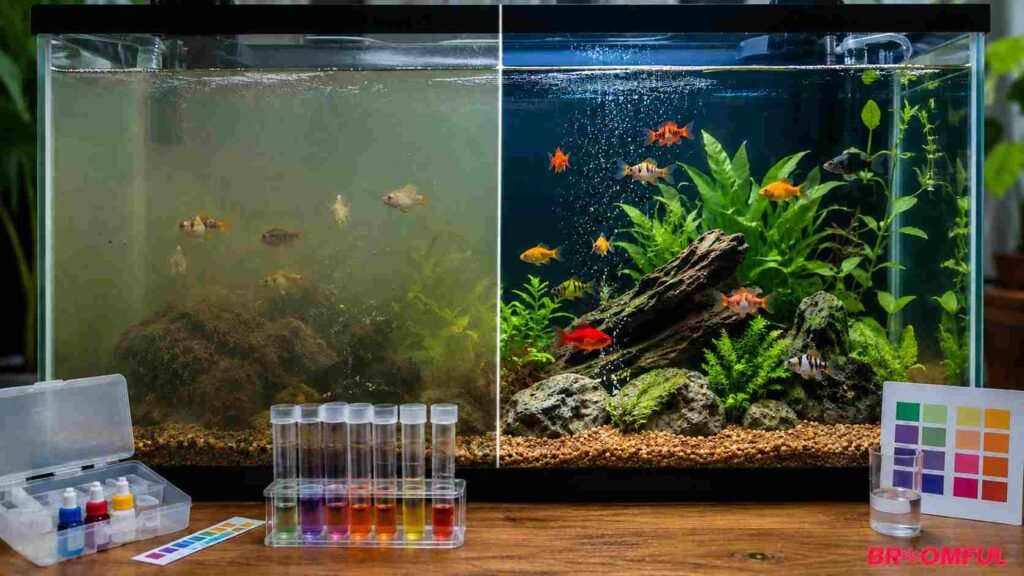
Poor aquarium water quality kills more fish than poor food or disease, and most beginners don’t test until something is amiss. If you’ve been wondering what’s going on under the water in your cloudy tank, the solution is easier than you think.
You’ll learn how to read an aquarium water quality chart, how to see early warning signs, how to test the water even if you don’t have a water quality test kit, and how to establish a routine that helps keep ammonia, pH, and hardness stable whether you’re using a freshwater aquarium, a planted aquarium, a shrimp aquarium, or a reef aquarium.
Aquarium Water Quality Parameters Explained
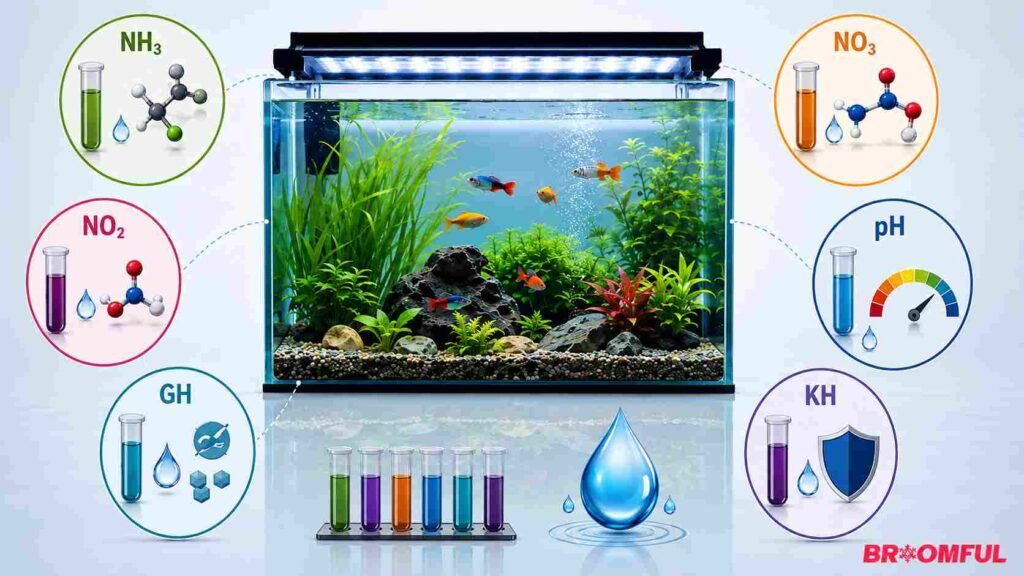
All aquariums have a nitrogen cycle, in which bacteria convert ammonia to nitrite and then nitrite to less toxic nitrate. Ammonia and nitrite rise erratically until that bacterial colony is established, typically 4-6 weeks, and that’s why many new tanks fail to get off the ground. Even if a pH of 7.4 isn’t perfect, it is safer than a tank that fluctuates between 6.8 and 7.8, because fish can tolerate consistency, not perfection.
Ammonia, Nitrite, and Nitrate
In cycled tanks, ammonia should be 0 ppm; if it is above 1 ppm, then there is an emergency and a water change is necessary immediately, and it becomes more toxic as pH and temperature increase. Nitrite should also remain at 0 ppm, as it causes fish gills to turn brown due to its in cycled tanks, ammonia should be 0 ppm; if it is above 1 ppm, then there is an emergency and a water change is necessary immediately, and it becomes more toxic as pH and temperature increase. Nitrite should also remain at 0 ppm, as it causes fish gills to turn brown due to its ability to inhibit the uptake of oxygen, and high levels (persistent > 1-2 ppm) are fatal for sensitive species. Nitrate is the least harmful but not harmless; most community fish can withstand up to 40 ppm, but under 20 ppm is preferred, and reef tanks should keep it below 5-10 ppm to prevent coral stress.
pH, GH, and KH
pH is a range of 0 to 14; most freshwater fish prefer a pH range of 6.5 to 7.5, whereas cichlids and reef systems like to see higher pH levels, which are more alkaline. GH (general hardness) is used to determine calcium and magnesium and has an impact on breeding and shrimp molting. Low KH is the silent culprit behind most mysterious overnight pH shifts and is the buffering capacity that prevents pH from dropping. KH (carbonate hardness) is the hidden factor in most pH swings, which most competitor guides don’t even mention.
Aquarium Water Quality Parameters Chart
| Parameter | Safe Range | Danger Zone |
| Ammonia (NH3) | 0 ppm | 1+ ppm |
| Nitrite (NO2-) | 0 ppm | 1+ ppm |
| Nitrate (NO3-) | Under 20 ppm | 40+ ppm |
| pH (freshwater) | 6.5–7.5 | Below 6.0 or above 8.0 |
| GH | 4–8 dGH | Extreme swings either direction |
| KH | 4–8 dKH | Under 1 dKH (pH crash risk) |
| Temperature (tropical) | 74–80°F | Below 70°F or above 86°F |
| Phosphate | Under 0.5 ppm | 1+ ppm |
Signs of Poor Water Quality in Aquarium Tanks
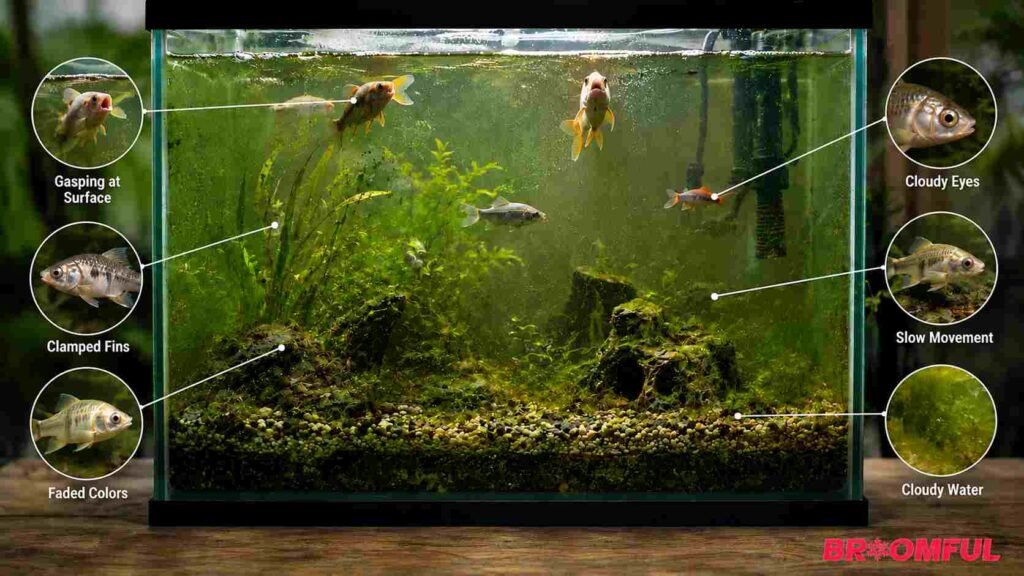
Classic signs of ammonia or nitrite stress or low oxygen are gasping at the surface, lethargy, hiding, appetite loss, and erratic darting. When multiple fish exhibit the same symptom simultaneously, consider water chemistry before disease.
Physical Warning Signs
Poor water quality may cause red/purple gills, clamped fins, faded color, cloudy eyes, and a thin white slime coat, and this is not a sign of infection. A permanent surface film and a potent odor of ammonia or sulphur are good indicators a healthy tank should not smell much at all.
Test immediately after a fish death, sudden cloudiness, addition of new fish, or if several fish have symptoms simultaneously. Waiting even 24 hours during an active ammonia spike can decide whether a tank recovers.
How to Test Fish Tank Water (With and Without a Kit)
Liquid master test kits are more accurate than paper strips, as they are based on color-matched chemical reactions, not on absorbent pads which lose their accuracy when wet. A liquid kit is worthwhile for anything you will do, such as an ammonia spike; strips are good for a fast sanity check.
Testing Without a Kit
Indirect chemistry trouble signs include strong ammonia or rotten-egg odor, sudden cloudiness, algae growth, or fish gasping at the surface. Local fish stores will typically test a sample of water for free; bring in 4-8 oz. in a clean container that is free of soap. It’s a very handy addition that most competitor guides don’t even mention.
Testing Frequency
Test once per week for established tanks, once every 1-2 days during cycling, and daily for 1 week after adding fish. Record all readings; one number indicates where you are; one log indicates where you are going, because CO2 produced by plant respiration can cause the pH to change by half a point from morning to evening.
Cloudy Aquarium Water: Causes and Fixes
Most hobby complaints are about cloudy water, and there are several different causes of cloudy water, which require different solutions. The majority of water guides make the mistake of lumping them together.
Why My Aquarium Is Cloudy: Bacterial Bloom
An ammonia-processing bacterial bloom is the most likely cause of a sudden white or gray haze in a tank under 6 weeks old. It usually clears up in 3-7 days, but the solution is to not overfeed and not over-clean the filter in the interim.
Fish Tank Cloudy After Cleaning or a Water Change
Cloudiness immediately after gravel vacuuming typically indicates that you’ve disturbed the filter bacteria or stirred up detritus; rinse the media with old tank water (not tap water) and allow the tank to settle for 24-48 hours. Cloudiness following a water change is typically caused by undechlorinated water, temperature mismatch, or disturbed sediment, so always dechlorinate and match temperature within 2°F.
Green Water and Algae
A green tint, unlike white or grey, is a free-floating algae bloom that is a result of excess light and nutrients. The solution is to reduce photoperiod to 6-8 hours and to reduce feeding, rather than a chemical “clearer,” which only treats the symptom.
How to Improve Water Quality in a Fish Tank
The best single method available is a weekly 10-25% water change, which dilutes the nitrate and eliminates dissolved organic waste from the water that can’t be filtered away. A frequent error is to skip the changes, since the numbers may appear good between tests. Mechanical filtration eliminates debris, biological filtration eliminates ammonia and nitrite, and chemical filtration (carbon and resins) eliminates dissolved toxins. Don’t rinse biological media under running water or change it completely; you could upset the balance you have created.
High Ammonia and High pH Fixes
If ammonia is high in a fish tank, change 25-50% of the water, add an ammonia-detoxifying dechlorinator, and reduce feeding for several days (overstocking is the most common cause of high ammonia). High pH in a fish tank can cause gills to move faster and higher ammonia toxicity, as ammonia becomes more toxic at pH 7.5-8.0. To lower the pH of aquarium water, use driftwood or Indian almond leaves, or mix in RO (reverse osmosis) water; do not use chemical “pH down” products as they can produce sharp drops in pH.
High Alkalinity, High KH, and Hard Water
High alkalinity buffers pH so strongly it resists adjustment, locking pH in place. If the KH of the water in the fish tank is too high, slowly add RO or distilled water to the tank, not all at once, to lower the KH. If your fish tank water has high GH and KH, it means that the water is hard, and you can soften it by gradually adding RO water, about a 25% increase per week, so as not to shock the fish by a sudden change.
Comparison: Common Water Quality Fixes
| Problem | Fast Fix | Avoid |
| High ammonia | 25–50% water change | Overdosing detoxifiers |
| High pH | Driftwood, RO blend | Chemical pH-down products |
| High KH | Gradual RO dilution | Crashing KH in one change |
| Hard water | Staged RO blending | Sudden full water replacement |
| Cloudy water | Identify the cause first | “Water clearer” chemicals alone |
FAQ:
What is considered good water quality for an aquarium?
0 ppm ammonia, 0 ppm nitrite, less than 20-40 ppm nitrate, and a stable pH range appropriate for your species. The importance of stability over time is equal to the importance of exact numbers.
How often should I check my aquarium water quality?
Established tanks: weekly; during cycling: every 1–2 days; and after new fish: daily for 1 week. Test for death, sudden cloudiness, or visible distress.
Why is my aquarium water cloudy after a water change?
Generally, a temperature difference, underchlorinated water, or disrupted sediment. Drain and rinse the tank after each use and allow it to sit 24–48 hours.
How can I lower ammonia in my fish tank fast?
Immediately change 25-50% of the water, add an ammonia detoxifier, and refrain from feeding for 2-3 days. Repeat testing every day until it is back to 0.
Can I test fish tank water without a kit?
Not exactly, but the presence of smell, cloudiness, algae growth, and fish behavior provide some clues. The majority of local fish markets will do a sample test for free.
What causes high pH in a fish tank?
Some substrates, hard tap water, and low CO2 in planted tanks cause pH to rise. If pH is high, it is often because KH is high, and reducing KH is truly the solution!
How do I lower GH and KH without harming fish?
Add RO or distilled water slowly (about 25% per week). Sudden hardness changes are more stressful to fish than the hardness.
Is cloudy water always dangerous for fish?
No, a new tank bacterial bloom is typically not a problem and will pass in one week. If cloudiness is accompanied by an ammonia or nitrite spike, a water change should be done right away.
Conclusion
Aquarium water quality is not a matter of getting the numbers right, but of being consistent, noticing the numbers early, and knowing what they mean. Three important points: ammonia and nitrite should always be 0 in a cycled tank, nitrate should be kept under control, and a weekly testing and logging program can detect drift well before it becomes an emergency.
Take a water test this week, record the baseline, and schedule a reminder for your next test. The water you can’t see is what affects your fish’s health; make sure you are watching it!
