
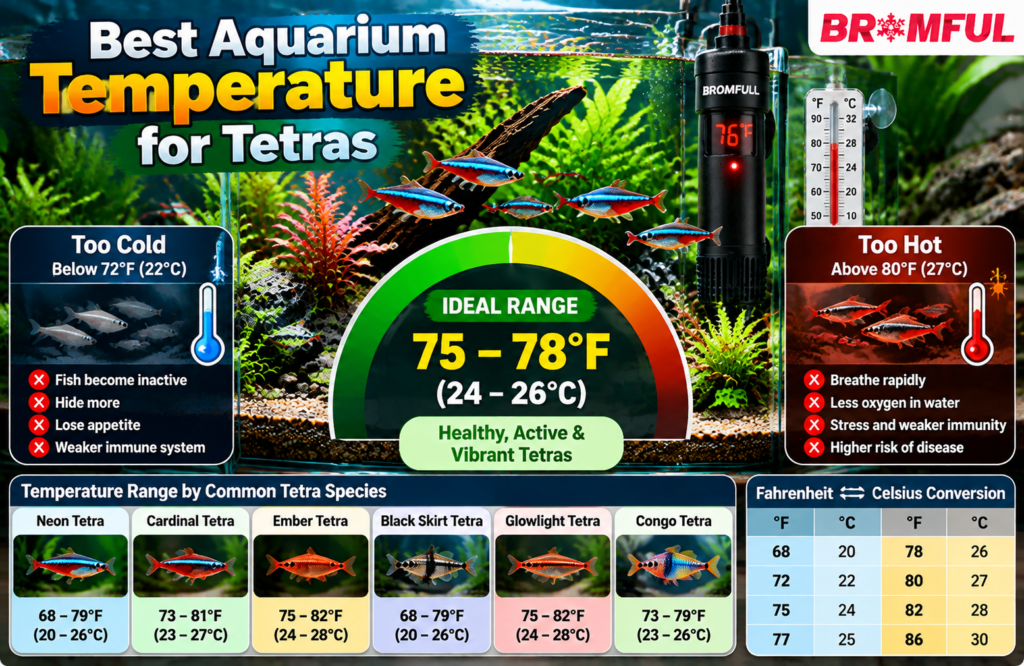
A few degrees can make the difference between a lively school of tetras and fish that hide, breathe rapidly, or lose appetite. For most commonly kept species, the right aquarium temperature for tetras falls somewhere between 72°F and 80°F (22°C and 27°C), but there is no single perfect number for every tetra. Neon tetras generally prefer the cooler side of the tropical range, while cardinal, ember, and glowlight tetras are comfortable somewhat warmer. The safest target is therefore the stable temperature that sits inside the proven range of every species sharing the tank.
In this guide you’ll learn the best temperature by tetra species, how to convert Fahrenheit and Celsius, why stability matters as much as the setpoint, how warm water affects oxygen, how to choose and place a heater, what to do during winter or a power outage, and how to match tetras with compatible community fish. You’ll also get a practical freshwater temperature chart and a printable reference you can save as a PDF.
Best Aquarium Temperature for Tetras: Quick Answer
For a mixed tetra aquarium, 75-78°F (24-26°C) is a practical starting range when all species in the tank overlap there. If you keep only one tetra species, use that species’ own range instead of assuming every tetra wants 78°F. This is the simplest answer to the search for the Best aquarium temperature for tetras: choose a stable point near the middle of the specific fish’s suitable range, then confirm that every tank mate can live there long term.
Broad industry guidance from the Ornamental Aquatic Trade Association places captive-bred tetras and pencilfish at 22-27°C (72-81°F), while species records are more specific. FishBase, for example, lists neon tetra at 20-26°C, cardinal tetra at 23-27°C, ember tetra at 24-28°C, black skirt tetra at 20-26°C, glowlight tetra at 24-28°C, and Congo tetra at 23-26°C. Those ranges are useful evidence, but they should not be read as a command to keep a fish at the extreme edge every day.
For a typical home aquarium in the United States, a thermostat-controlled heater set near 76°F or 77°F works well for many community combinations that include common tetras. A separate thermometer is still essential because the number printed on a heater dial is a target, not proof of the actual water temperature.
A practical setpoint for a community tetra tank
If your tank contains neon tetras, corydoras, rasboras, and other moderate-temperature community fish, 75-77°F (24-25°C) is often a useful compromise. If the school is made up of cardinal, ember, or glowlight tetras, 77-79°F (25-26°C) may fit better, provided the other fish share that warmer range.
The important word is overlap. Do not average two incompatible temperature ranges. A cool-water fish and a warm-water fish do not become compatible simply because the thermostat is set halfway between their preferences. Stocking decisions should be made around a shared band that works for every species.
Temperature stability matters more than chasing one exact degree
A tetra tank does not need to sit at exactly 77.0°F every minute. Small, gradual changes happen naturally. The bigger concern is rapid movement caused by an undersized heater, cold replacement water, direct afternoon sun, an air-conditioning vent, or a power outage. Fish are ectotherms, so the surrounding water directly affects metabolism, activity, digestion, and oxygen demand.
For day-to-day husbandry, aim for a narrow, predictable pattern. If the tank is 76°F in the morning and 77°F in the evening, that is very different from repeatedly swinging from the low 70s to the low 80s. Consistency also makes troubleshooting easier because behavior changes are less likely to be caused by a hidden temperature shift.
Do tetras need a heater?
Most tetras kept in U.S. homes are tropical or warm-water freshwater fish, so a heater is usually the safest way to keep temperature stable. A room that feels comfortable to a person can still fall below a tetra’s preferred water temperature overnight or during winter. OATA notes that tropical species generally require at least 22°C, and Aquarium Co-Op recommends a heater when room temperature is below the tropical range you need to maintain.
A heater is not only for making the tank warmer. Its main job is preventing the tank from cooling unpredictably. Even in a warm climate, air conditioning can create a large temperature gap between daytime and nighttime.
Tetra Fish Temperature Celsius: Species-by-Species Chart
The phrase Tetra fish temperature Celsius is often treated as if it has one universal answer. In practice, the correct Celsius target depends on the exact tetra. The chart below separates several popular species so you can see why a single ‘tropical fish’ number can be misleading.
These ranges are best used as husbandry boundaries and compatibility clues, not as invitations to keep a fish at the minimum or maximum forever. For routine care, choose a stable target comfortably inside the species’ range and consider the water chemistry, oxygen level, age, health, and tank mates at the same time.
| Tetra species | Reference temperature range | Approx. °F | Practical community target* | Notes |
| Neon tetra (Paracheirodon innesi) | 20-26°C | 68-79°F | 23-25°C / 73-77°F | Often suits the cooler side of a tropical community. |
| Cardinal tetra (Paracheirodon axelrodi) | 23-27°C | 73-81°F | 25-26°C / 77-79°F | Typically kept warmer than neon tetras. |
| Ember tetra (Hyphessobrycon amandae) | 24-28°C | 75-82°F | 25-26°C / 77-79°F | Small warm-water tetra; stable nano tanks matter. |
| Black skirt tetra (Gymnocorymbus ternetzi) | 20-26°C | 68-79°F | 23-25°C / 73-77°F | Broad range; avoid unnecessary high heat. |
| Glowlight tetra (Hemigrammus erythrozonus) | 24-28°C | 75-82°F | 25-26°C / 77-79°F | Pairs naturally with other warm, peaceful species. |
| Congo tetra (Phenacogrammus interruptus) | 23-26°C | 73-79°F | 24-25°C / 75-77°F | Larger African tetra; needs more swimming space. |
Aquarium temperature for tetras Celsius vs. Fahrenheit
For U.S. aquarists, heaters and thermometers are often labeled in Fahrenheit, while many fish references use Celsius. The conversion is °F = (°C × 9/5) + 32. A fish tank temperature Celsius reading of 24°C is about 75°F; 25°C is 77°F; 26°C is about 79°F; and 27°C is about 81°F.
That makes 24-26°C roughly equivalent to 75-79°F, a useful overlap for many popular tetras. When reading care sheets, avoid rounding a borderline value too aggressively. A heater set to 80°F is not the same as one set to 26°C exactly; 26°C is 78.8°F.
Neon tetra vs. cardinal tetra temperature
Neon and cardinal tetras look similar, but their temperature profiles are not identical. FishBase lists neon tetras at 20-26°C and cardinals at 23-27°C. That overlap means they can share a tank in some setups, but a temperature chosen for neon longevity may feel cool for cardinals, while the warmest cardinal conditions can push neons toward the top of their range.
If you keep both species together, roughly 24-26°C (75-79°F) is the overlap to evaluate, with other water parameters and tank-mate requirements considered too. This species comparison is one reason the Best aquarium temperature for tetras cannot be reduced to a universal 78°F rule.
Why a reference range is not the same as an ideal setpoint
Species databases may describe environmental or recorded temperature ranges. Care guides may instead recommend a narrower captive range. Those are related but different kinds of information. A fish surviving or occurring at an edge temperature does not prove that the edge is the best long-term aquarium setpoint.
For everyday care, a middle value usually offers more margin for brief room-temperature changes, heater cycling, and measurement error. Sensitive or newly imported fish may need even more caution during acclimation.
Why Aquarium Temperature Matters for Tetras
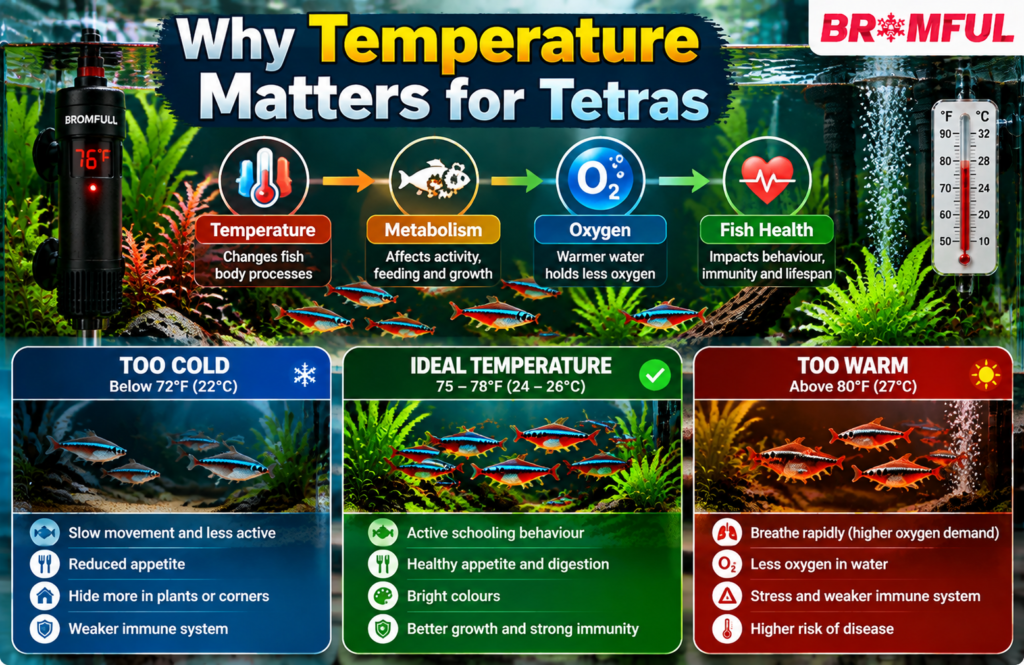
Temperature is not an isolated number. It changes how fast a fish’s body works and how much oxygen the water can hold. That is why temperature mistakes often appear as behavior problems before an aquarist notices the thermometer.
The most useful way to think about aquarium temperature for tetras is as a system: temperature influences metabolism; metabolism influences oxygen demand and feeding; temperature also influences dissolved oxygen availability; and all of those interact with stocking level, filtration, surface agitation, and water quality.
Metabolism, feeding, growth, and behavior
Tetras are ectothermic, which means they do not internally regulate body temperature the way mammals do. As water warms within a suitable range, biological processes generally run faster. Fish may become more active and digest food faster. When water is too cool, activity and appetite can decline. When it is too warm, metabolism and oxygen demand can rise beyond what the environment comfortably supports.
This is why a temperature that is technically survivable can still be poor husbandry if it chronically pushes a species toward an extreme. Watch the whole fish, not just the number: schooling behavior, appetite, color, respiration, fin position, and hiding can all provide clues when something is off.
Warm water holds less dissolved oxygen
The U.S. Environmental Protection Agency notes that higher temperatures reduce oxygen solubility in water. In practical aquarium terms, warm water can hold less dissolved oxygen while a warm fish may simultaneously demand more oxygen because its metabolism is faster. That combination makes aeration especially important during summer heat, medication periods, heavy stocking, or any time the tank is warmer than usual.
Surface movement from a filter return, air stone, spray bar, or other circulation increases gas exchange. If tetras gather near the surface and breathe rapidly during a heatwave, check temperature and water quality immediately and increase aeration while correcting the underlying problem gradually.
Temperature swings and chronic stress
A sudden change can be more disruptive than a stable value a little away from the center of the range. Common causes include large water changes with mismatched replacement water, moving a fish directly from a store bag into a tank, heater failure, leaving a heater unplugged after maintenance, direct sun, or placing the aquarium beside an HVAC vent.
During water changes, match replacement water reasonably closely to the tank. You do not need laboratory precision, but a large abrupt shift is avoidable. After a power outage, restore heat gradually rather than trying to force the tank upward as fast as possible.
Temperature is only one part of tetra compatibility
Two fish can share the same temperature range and still be poor tank mates because of pH, hardness, adult size, activity, aggression, feeding style, or schooling needs. Conversely, two species may overlap only narrowly in temperature; in that case, the shared band must also work with their other requirements.
For a well-planned community tank, treat temperature as the first filter, not the final compatibility test.
How to Set and Measure Aquarium Temperature for Tetras
A reliable setup uses two separate pieces of equipment: a thermostat-controlled heater to add heat and an independent thermometer to verify the actual water temperature. Depending on room conditions and tank size, a controller or second heater may add redundancy, but the basic principle stays the same: heat the water evenly and measure it somewhere that can reveal problems.
Do not assume the heater’s dial is perfectly calibrated. Set it, give the aquarium time to stabilize, then read the independent thermometer at different times of day.
Choose the heater size for your room, not just your tank volume
A common aquarium rule of thumb is about 5 watts per gallon when the heater must raise the aquarium roughly 10°F above room temperature and the tank has a lid. Aquarium Co-Op uses that as a practical starting point. A 20-gallon tank in a reasonably heated room therefore often lands around 100 watts, while a colder room may require more capacity.
The temperature difference matters. A 20-gallon tank held at 77°F in a 72°F living room has an easier job than the same tank in a 60°F basement. If your home becomes much colder in winter, size the heating plan around the coldest realistic room temperature rather than the average afternoon temperature.
Heater placement and temperature circulation
Place a submersible heater where moving water can carry warmth across the aquarium, commonly near a filter output or another area of reliable flow. On a long tank, one heater at the far end from all circulation can create warm and cool zones even when the average reading looks acceptable.
Put the independent thermometer away from the heater so it measures whether heat is reaching the rest of the tank. For larger aquariums, two smaller heaters placed apart can improve distribution and provide partial backup if one stops working.
Digital, glass, and stick-on thermometers
A simple aquarium thermometer is inexpensive insurance. Digital probe thermometers are easy to read and can be checked quickly. Traditional glass aquarium thermometers are also useful when placed where fish cannot damage them. External stick-on strips are convenient for trends but measure through the aquarium wall, so many keepers prefer an in-water thermometer as the primary reference.
Whichever type you use, compare it occasionally with a second thermometer. If two devices disagree by several degrees, investigate before changing the heater based on one reading.
A simple 24-hour temperature audit
When setting up a new tank, changing heaters, or entering a new season, record the water temperature three times: early morning, late afternoon, and before bed. Repeat for two or three days. This reveals a pattern that a single reading cannot show.
If the tank stays within about a degree or two across the day, the system is usually stable. If it moves several degrees, look for room-temperature changes, sunlight, undersized equipment, missing lids, strong air conditioning, or a heater placed in stagnant water.
How to Choose the Right Temperature for Your Exact Tetra Tank
A chart can narrow the answer, but the final setpoint should come from the animals actually living in your aquarium. Two tanks with tetras may need different temperatures because one contains neon tetras and Corydoras while another contains cardinals, embers, and warm-water dwarf cichlids. The correct method is to work from the species list outward, not from a favorite heater setting inward.
This approach also protects you from one of the most common aquarium mistakes: choosing 78°F because it is often described as a generic tropical temperature and then forcing every fish to live around that number. A better setpoint is evidence-based, shared by all inhabitants, and easy for your equipment to hold consistently.
Step 1: Identify every fish to species level
Write down the scientific or accepted common name of each fish before comparing temperatures. ‘Tetra’ covers many species from different habitats, and even visually similar fish can have different thermal preferences. Neon tetras and cardinal tetras are the classic example: both are small blue-and-red schooling fish, but their reference ranges are not identical.
If a fish was sold under a vague store label such as ‘assorted tetra,’ identify it before setting the tank around a narrow range. Photos, retailer records, and reputable species databases can help. This small step prevents a broad family-level guideline from replacing species-level husbandry.
Step 2: Find the true overlap, not the average
List each species’ comfortable temperature range and highlight the values shared by all of them. Suppose one fish is best kept at 72-78°F and another at 75-81°F. The useful overlap is 75-78°F. A target around 76-77°F gives margin on both sides. That is very different from averaging the two midpoints without checking whether the result is actually inside every range.
If the overlap is only one degree wide, reconsider the stocking combination. A narrow overlap leaves little room for measurement error, seasonal changes, or a slightly different recommendation from another reliable source. Community fishkeeping is easier when species share a broad comfortable band.
Step 3: Account for tank size, flow, and room conditions
Water volume affects how quickly temperature changes. A small aquarium can cool or heat faster than a large one when room temperature shifts, sunlight reaches the glass, or the heater cycles poorly. In a nano tetra tank, stable room conditions and a correctly sized thermostat-controlled heater are therefore especially important.
Flow also matters because the thermometer may show a good reading while another corner is cooler. Observe where fish spend time and test more than one location during setup. If the tank is long, heavily planted, or divided by hardscape, make sure warm water can circulate rather than collecting around the heater.
Step 4: Acclimate new tetras to the stable tank, not the bag
New fish may arrive from water that is warmer or cooler than your aquarium. The goal is not to redesign the established tank around the transport bag; it is to move the fish safely into a stable, species-appropriate system. Equalize temperature and follow a sensible acclimation process while minimizing the time fish remain in stressed transport water.
After introduction, avoid changing the heater repeatedly in response to normal shyness. Newly added tetras may hide, school tightly, or eat lightly for reasons unrelated to temperature. Verify the thermometer and water quality first, then give the fish time to settle unless there is a clear welfare problem.
Best Temperature for Fish Tank in Winter: Tetra-Safe Heating
The Best temperature for fish tank in winter is not a special seasonal number; it is the same species-appropriate temperature you would maintain the rest of the year. Winter changes the challenge, not the target. The heater has to work harder because the room is colder and heat leaves the aquarium faster.
For many tetra communities, keeping a stable 75-78°F (24-26°C) is a sensible winter goal when those values fit every species. The biggest winter risks are undersized heaters, cold drafts, overnight thermostat setbacks, and power outages.
Winter heater sizing and redundancy
If the room may drop into the low 60s Fahrenheit while the aquarium needs the upper 70s, the heater is maintaining a 15°F or larger difference. A unit sized for a mild 5-10°F lift may run almost continuously or fail to hold the setpoint. Recheck heater capacity before cold weather arrives.
For larger tanks, splitting the total wattage between two smaller heaters can reduce the severity of a single failure. If one heater stops, the second may slow the cooling; if one thermostat sticks on, a half-size heater generally heats the system less aggressively than one oversized unit. An external temperature controller adds another layer of protection where appropriate.
Protect the tank from drafts and heat loss
Keep aquariums away from exterior doors, frequently opened windows, and direct HVAC airflow. A lid helps reduce evaporative heat loss. In very cold rooms, insulating the back or sides of the tank with removable foam panels can reduce heat loss, provided ventilation, equipment clearance, and electrical safety are maintained.
Do not wrap heaters or electrical components. The goal is to reduce heat escaping through exposed glass, not to trap heat around equipment.
What to do during a winter power outage
First, preserve heat and oxygen. Keep the aquarium covered, minimize unnecessary lid opening, and insulate the outside with blankets while keeping air pathways and electrical equipment safe. If the outage is prolonged, battery-powered air pumps can help maintain oxygenation. In a cool room, the aquarium will lose heat gradually, with smaller tanks changing faster than larger ones.
When power returns, check the actual water temperature before making adjustments. Restore normal conditions gradually. Avoid pouring hot water directly into the aquarium, placing household heating devices against the glass, or making a large hot-water change; uneven heating can injure fish and create sudden swings.
Water changes in cold weather
Winter tap water can be dramatically colder than aquarium water. Mix or temper replacement water so it is reasonably close to the tank before adding it. Large cold-water changes can produce a temperature shock even when the new water is otherwise dechlorinated and chemically suitable.
The Best temperature for fish tank in winter therefore comes down to consistency: keep the same safe setpoint, prepare replacement water carefully, and make sure the heater can handle the seasonal temperature gap.
Freshwater Aquarium Fish Temperature Chart: Tetras and Tank Mates
A Freshwater aquarium fish temperature Chart is most useful when it shows overlap rather than isolated species numbers. Community aquariums succeed when every fish can live comfortably at the chosen setpoint for years, not merely tolerate it for a short period.
The table below is a planning reference for common freshwater groups. Exact species can differ, so use it as a screening tool and verify each species before buying.
| Fish/group | Common practical range | Good overlap with many tetras? | Planning note |
| Neon tetra | 72-78°F / 22-26°C | Yes | Best with moderate-temperature community fish. |
| Cardinal tetra | 75-81°F / 24-27°C | Yes, warmer setups | Prefer warmer water than neons. |
| Ember tetra | 75-82°F / 24-28°C | Yes, warmer setups | Good for planted nano communities with matching species. |
| Corydoras (many common species) | 72-78°F / 22-26°C | Often | Species-specific differences matter. |
| Harlequin rasbora | 74-80°F / 23-27°C | Often | Common peaceful community match. |
| Guppy | 74-80°F / 23-27°C | Often | Water hardness needs may differ from soft-water tetras. |
| Betta | 76-82°F / 24-28°C | Sometimes | Behavior and tank layout matter as much as temperature. |
| Discus | 82-86°F / 28-30°C | Limited | Usually warmer than ideal for many common tetras. |
| Goldfish | Cool-water conditions | No | Do not use a tropical compromise temperature. |
This Aquarium fish temperature Chart is a starting point, not a stocking guarantee. Water hardness, pH, adult size, swimming space, diet, temperament, and group size still need to match.
How to use an aquarium fish temperature chart correctly
Start with the species that has the narrowest or most demanding range. Then check whether every other fish has a comfortable overlap. If all species share 76-77°F, that can become your candidate setpoint. If one species requires 68-72°F and another requires 80-84°F, there is no responsible middle number that fixes the mismatch.
Next, check water chemistry. Guppies and many livebearers can share temperature with tetras but often prefer harder, more mineral-rich water than Amazonian tetras. Temperature overlap is necessary, not sufficient.
A general community-tank example
Imagine a 20-gallon aquarium with neon tetras, a suitable Corydoras species, and harlequin rasboras. A target around 75-77°F can fall within the practical range of all three groups. That makes the temperature easy to maintain and leaves room for small normal variation.
Now replace the rasboras with discus. The temperature requirement shifts upward substantially, and the tank size requirement changes too. This is why a stocking plan should be designed as a system rather than assembled species by species after purchase.
Fish tank temperature Celsius for mixed communities
For readers using metric equipment, a fish tank temperature Celsius target of 24-26°C is a common planning band for many peaceful tropical community fish. It fits numerous tetra combinations, but it is not universal. Warm-water specialists may need more, and subtropical fish may need less.
If you are using a heater marked only in Celsius, remember that 24°C is about 75°F, 25°C is 77°F, and 26°C is about 79°F.
Troubleshooting Tetra Temperature: Too Hot, Too Cold, or Unstable
Temperature problems are easiest to fix when you identify the pattern before taking action. A tank that is consistently two degrees too warm is different from one that changes six degrees between morning and evening. Start by measuring, then correct the cause gradually.
Behavior can provide warning signs, but it is not diagnostic by itself. Rapid breathing, lethargy, hiding, clamped fins, loss of appetite, or unusual surface behavior can also result from ammonia, nitrite, disease, aggression, or low dissolved oxygen. Test water quality whenever fish behavior changes.
| Problem | Possible signs | Common causes | Safer response |
| Water too cold | Sluggish swimming, reduced feeding, hiding | Cold room, failed/undersized heater, heater unplugged | Verify with a second thermometer; restore heat gradually; inspect heater. |
| Water too hot | Rapid breathing, surface gathering, agitation | Heatwave, direct sun, heater stuck on | Increase aeration; remove heat source; cool gradually; verify water quality. |
| Large daily swings | Behavior changes at certain times | Sunlight, HVAC, small tank, poor heater placement | Track morning/evening temperature; stabilize room and equipment. |
| Uneven tank temperature | Fish cluster in one area | Low flow, heater at one end | Improve circulation; reposition heater; measure opposite sides. |
| Wrong reading | Heater and thermometer disagree | Calibration error, poor placement, faulty device | Compare with a second thermometer before changing settings. |
If the tetra tank is too cold
Confirm the reading with a second thermometer. If the water is genuinely below the species’ normal range, inspect the heater, plug, controller, and power source. Do not compensate with boiling water or a sudden hot water change. Restore the aquarium toward its normal range gradually while watching the fish.
If the heater is running constantly but cannot reach the setpoint, it may be undersized for the room-temperature difference. A lid, better placement, or more appropriate heater capacity may solve the root problem.
If the tetra tank is too hot
Increase surface agitation immediately because warm water holds less oxygen. Turn off or isolate the heat source if a heater is stuck on, close blinds if direct sunlight is heating the tank, and cool the room when possible. Fans blowing across the water surface can increase evaporative cooling, but they also increase evaporation, so monitor water level and top off appropriately.
Avoid dropping ice directly into the aquarium. Rapid cooling and localized cold spots can create a second stressor. The goal is a controlled return to the species’ normal range, not the fastest possible temperature drop.
If temperature keeps fluctuating
Log temperature for at least a full day. Note when room heating or air conditioning turns on, when aquarium lights operate, and when direct sunlight reaches the glass. If the temperature follows the room, heater capacity may be marginal. If only one side of the tank changes, circulation may be the issue.
Small tanks deserve extra attention because they have less water volume to buffer environmental changes. A stable room, correctly sized heater, lid, and reliable flow are especially useful for nano tetra setups.
When temperature is normal but fish still look stressed
Do not keep turning the heater dial simply because fish are behaving strangely. Check ammonia, nitrite, nitrate, pH, oxygenation, recent additions, disease signs, aggression, and feeding. A normal temperature reading eliminates one variable; it does not diagnose the aquarium.
If fish show severe or persistent symptoms, consult an aquatic veterinarian or experienced fish-health professional rather than treating blindly.
Aquarium Fish Temperature Chart PDF: Printable Tetra Reference
If you searched for an Aquarium fish temperature chart pdf, the safest version is one that reminds you to verify the exact species instead of presenting one universal tropical number. The compact chart below is designed to be printed, saved, or copied into your aquarium maintenance notes.
You can save this guide from Google Docs or your browser as a PDF and keep the chart near your tank. The important habit is to record your actual target, not just the broad range. A range tells you what may work; a written setpoint tells everyone in the household what the aquarium should normally read.
| Quick reference | Temperature |
| Common mixed-tetra planning band | 75-78°F / 24-26°C |
| Neon tetra reference range | 68-79°F / 20-26°C |
| Cardinal tetra reference range | 73-81°F / 23-27°C |
| Ember tetra reference range | 75-82°F / 24-28°C |
| Black skirt tetra reference range | 68-79°F / 20-26°C |
| Glowlight tetra reference range | 75-82°F / 24-28°C |
| Congo tetra reference range | 73-79°F / 23-26°C |
| General captive-bred tetra guidance (OATA) | 72-81°F / 22-27°C |
What to write on your own tank label
A useful aquarium label can be as simple as: ‘Target 76°F; normal range 75-77°F; check morning and evening after maintenance.’ Add the species list underneath. That gives a pet sitter, family member, or maintenance technician a clear reference without asking them to interpret a large chart.
If your heater uses Celsius, write both units: ‘Target 25°C / 77°F.’ This prevents conversion mistakes and keeps the Aquarium temperature for tetras celsius value visible.
How often should you check temperature?
Check daily when a tank is new, after installing a new heater, during heatwaves or cold snaps, and after power interruptions. Once the system is proven stable, a quick daily glance is still a good habit. Temperature should also be checked before and after major water changes.
A connected temperature alarm can be useful for valuable or sensitive setups, but it should supplement rather than replace regular observation.
Why the PDF chart should include a warning
Any Aquarium fish temperature chart pdf that covers many fish should state that ranges differ by species and source. A broad chart is excellent for screening tank mates, but it cannot capture local strains, acclimation history, breeding conditions, juvenile care, disease treatment, or every water-chemistry interaction.
Use the chart to ask better questions: Does every species overlap at my target? Is my heater capable of holding that target in winter? Does the warmer setting reduce oxygen margin? Those questions make the chart actionable instead of decorative.
FAQs
What is the best aquarium temperature for tetras?
For many common tetra community tanks, 75-78°F (24-26°C) is a practical target, but the exact answer depends on species. Neon tetras generally suit cooler conditions than cardinal, ember, or glowlight tetras. Choose a stable temperature inside every tank mate’s overlapping range rather than using one universal number.
Is 78°F too hot for neon tetras?
Usually not, but it is near the upper side of common neon-tetra guidance. FishBase lists neon tetras at 20-26°C (68-79°F). If you keep them at 78°F, prioritize stability, good oxygenation, and compatible tank mates instead of pushing the aquarium warmer without a species-specific reason.
What is the ideal tetra fish temperature Celsius?
A common community target is about 24-26°C, but tetra fish temperature Celsius requirements differ by species. Neon tetras are recorded around 20-26°C, cardinals 23-27°C, and embers 24-28°C. Use the exact species range and pick a stable middle value that also suits every tank mate.
Can tetras live without a heater?
Some tetras can tolerate cooler conditions, but most commonly kept tetras are safest with a heater in U.S. homes because room temperature changes through the day and season. The heater’s key role is stability. If the room is consistently within the species’ range, heating demand is lower, but monitoring is still essential.
What temperature should a tetra tank be in winter?
Keep the same species-appropriate target you use year-round; winter does not require a special lower setpoint. For many tetra communities that means roughly 75-78°F (24-26°C). Make sure the heater is sized for the colder room, protect the tank from drafts, and match replacement-water temperature during water changes.
How quickly can I change aquarium temperature for tetras?
Avoid rapid, unnecessary changes. Correct a temperature problem gradually while monitoring fish behavior and oxygenation. The safest rate depends on the situation, species, and severity, so focus on removing the cause rather than chasing a fixed speed. During routine water changes, use replacement water close to the tank temperature.
Why are my tetras at the surface when the tank is warm?
Warm water holds less dissolved oxygen, and fish may need more oxygen as metabolism rises. Surface gathering or rapid breathing can therefore signal heat or low oxygen, but it can also indicate poor water quality. Check temperature, ammonia and nitrite immediately, increase aeration, and correct the underlying problem gradually.
Can different tetra species share the same temperature?
Yes, when their comfortable ranges overlap. Neon and cardinal tetras, for example, can overlap around the mid-70s Fahrenheit, while some warmer tetras prefer the upper 70s. Temperature overlap alone does not guarantee compatibility, so also compare pH, hardness, adult size, temperament, tank size, and schooling requirements.
Conclusion
The right aquarium temperature for tetras is species-specific, but three rules make the decision much easier. First, use the exact tetra’s documented range instead of assuming every tropical fish wants 78°F. Second, choose a stable setpoint inside the overlap shared by all tank mates; for many community tetra tanks, about 75-78°F (24-26°C) is a practical planning range. Third, treat temperature as part of a complete system: heater capacity, circulation, dissolved oxygen, water-change temperature, and seasonal room conditions all matter.
Check your thermometer today, write down your tank’s normal target in both °F and °C, and compare every fish in the aquarium against that same setpoint. If the ranges do not comfortably overlap, change the stocking plan rather than forcing the temperature into an unsafe compromise.
