
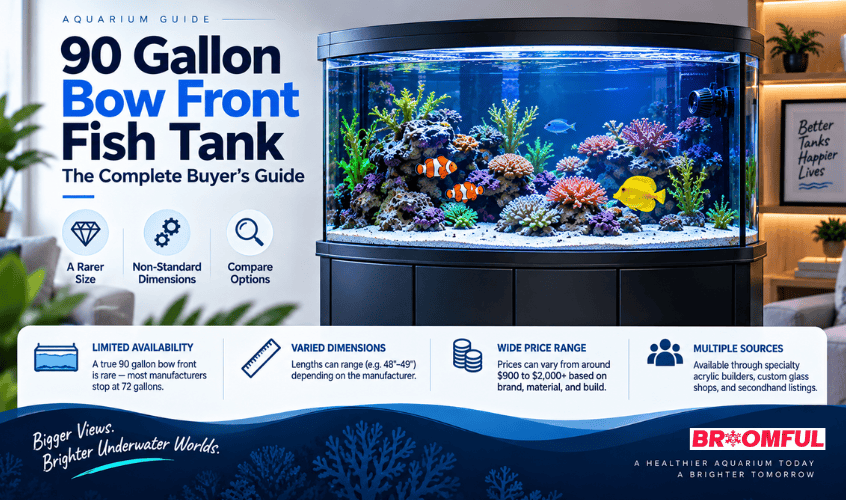
Here’s something most buying guides won’t tell you: a true 90 gallon bow front fish tank is one of the rarest sizes in the entire aquarium industry. Almost every major glass manufacturer caps its bow front line at 72 gallons, so the moment you start searching for a 90 gallon bow front aquarium, you leave the world of standardized, off-the-shelf products and enter a smaller market of specialty acrylic builders, custom glass shops, and secondhand listings each with its own dimensions and pricing.
That’s exactly why so many people researching a 90 gallon bow front fish tank end up confused. One source quotes 48 inches long, another says 49. One lists the tank at 900 dollars, another at 2,000. Neither is necessarily wrong they’re just describing different manufacturers’ interpretations of the same nominal size.
In this guide, you’ll learn the real 90 gallon bow front fish tank dimensions pulled from actual manufacturer listings (not generic charts), how they compare to standard 90 gallon fish tank dimensions, what to check before buying a 90 gallon bow front fish tank with stand, current 90 gallon aquarium price ranges, a full 90 gallon bow front fish tank setup walkthrough, and where a genuine 90 gallon bow front aquarium for sale is most likely to turn up. Let’s get into it.
What Is a 90 Gallon Bow Front Fish Tank?
A bow front aquarium replaces the flat front pane of a standard tank with a curved one, so the glass (or acrylic) bulges gently outward at the center and tapers back in toward each end. The result is a panoramic, almost theater-like viewing angle, plus a sense of depth that a flat-front tank of identical volume can’t replicate.
The Bow Front Design Explained
The curve isn’t decorative flourish it’s a structural and optical choice. Because the front panel bows outward, the tank holds more water at the mid-point without adding front-to-back depth at the ends, which is why bow front tanks are often praised for looking “fuller” than a rectangular tank of the same gallonage. The tradeoff is that the curved glass introduces mild magnification and some distortion when viewed from an angle rather than straight-on.
Glass vs. Acrylic: The First Decision You’ll Make
Because true 90 gallon bow fronts are rarely mass-produced in glass, most buyers end up choosing acrylic, or a semi-custom thermally-bent glass build from a specialty manufacturer. Here’s how the two materials actually compare at this size:
| Feature | Glass Bow Front | Acrylic Bow Front |
|---|---|---|
| Availability at 90 gal | Rare — usually semi-custom or discontinued lines | More common among specialty builders |
| Weight (empty) | Heavier | 30–40% lighter |
| Optical clarity | Slight green tint (unless low-iron glass) | Crystal clear, no tint |
| Scratch resistance | High | Lower — scratches more easily |
| Impact resistance | Lower — can crack under point impact | Higher — flexes rather than shattering |
| Yellowing over time | None | Possible with lower-grade acrylic |
| Typical tank-only price at ~90 gal | $900–$1,700 | $1,000–$2,200 |
| Best for | Buyers prioritizing scratch resistance and long-term optical clarity | Buyers prioritizing lighter weight, safety, and seamless curves |
Why This Size Is Harder to Find Than You’d Expect
Search any major pet retailer’s aquarium catalog and you’ll notice their bow front lineup usually stops at 72 gallons. That’s not a coincidence a 72-gallon bow front (roughly 48 inches long, 22 inches tall) sits at the upper limit of what most glass manufacturers can mass-produce economically with standard silicone-seamed construction. Past that point, the curved front panel needs to be thermally bent as a single piece or reinforced with heavier acrylic, which pushes production into specialty and semi-custom territory. Brands like Aquavim and a handful of acrylic fabricators do build seamless 90-plus-gallon bow fronts, but you won’t typically find them on a shelf at a big-box pet store you’ll be ordering direct or buying secondhand.
90 Gallon Bow Front Fish Tank Dimensions: The Complete, Corrected Size Breakdown
This is the section where most competing guides get it wrong either by quoting generic 90 gallon fish tank dimensions for a rectangular tank and calling it a bow front, or by assuming the bow makes the tank wider at the ends when the opposite is usually true.
Standard 90 Gallon Fish Tank Dimensions (Rectangular, for Comparison)
Before comparing bow front sizing, anchor to the number most hobbyists already know. A standard rectangular 90 gallon tank measures approximately:
- Length: 48 inches
- Width (front to back): 18 inches
- Height: 24 inches
This is the baseline that most stands, canopies, and lighting fixtures on the market are designed around.
The Real Shape of a Bow Front: Correcting a Common Misconception
Here’s the detail most articles get backward: on a bow front tank, the ends of the tank are narrower than the standard width, and the center bulges out past it. Using the well-documented 72 gallon bow front as a reference point, the tank runs about 48 inches long and 22 inches tall, with the front panel measuring roughly 12–13 inches deep at each end and bowing out to about 18–20 inches at the center. The same tapering pattern carries over to the 90 gallon size it’s the depth of the curve, not a uniform width increase, that adds the extra volume compared to a same-length rectangular tank.
Actual 90 Gallon Bow Front Aquarium Dimensions from Real Listings
Because there’s no single industry-standard mold at this size, the most reliable way to understand real 90 gallon bow front fish tank dimensions is to look at actual production models rather than averaged charts:
- Aquavim 93-gallon seamless low-iron glass bow front: 49″ L x 19″ W (at the bow) x 25″ H for the tank alone, with a Euro-braced top and internal overflow. With a matched wood stand and canopy, total assembled height runs closer to 64 inches.
- Legacy Oceanic/AGA-style 90 gallon bow fronts (occasionally found on the secondhand market): approximately 48″ L x 18″ W at the bow x 24″–29″ H, depending on the specific mold generation.
- General acrylic 90-class bow fronts: typically 48″–49″ long, 18″–20″ deep at the bow’s widest point, and 24″–25″ tall, with the ends narrowing to roughly 12–14 inches.
Because these numbers come from different manufacturers’ molds rather than one shared standard, treat them as a realistic range to sanity-check a listing against not a spec to expect down to the fraction of an inch.
Why Dimensions Vary So Much Between Manufacturers
Unlike rectangular tanks, which follow near-universal industry norms, bow front tanks are shaped around each manufacturer’s proprietary curve mold. A 90 gallon bow front built by one acrylic specialist might use a shallower, wider bow, while another uses a deeper, narrower one both hold roughly 90 gallons, but their footprints aren’t interchangeable. This is the single biggest reason people get frustrated trying to buy a replacement stand or canopy for a used bow front tank: always get the exact dimensions from the specific tank you’re buying, not a generic chart, including yours.
Footprint & Room Planning Checklist
Before committing to a 90 gallon bow front fish tank, measure your space against these real-world clearance needs:
- Wall space: Allow at least 52 inches of wall length for a 48–49 inch tank, leaving a few inches of buffer on each side.
- Front clearance: Plan for 22–26 inches of depth from the wall to clear the widest point of the bow, even though the tank’s ends may only need 12–14 inches.
- Ceiling height: With a stand (typically 30–32 inches) plus the tank (24–25 inches) plus a canopy or open-top lighting, budget for roughly 58–64 inches of total vertical space.
- Doorway width: A 90 gallon bow front, especially in acrylic or seamless glass, usually ships or moves as one piece — measure your narrowest doorway and hallway turn before delivery day.
Comparison Table: 90 Gallon Bow Front vs. Nearby Bow Front Sizes
| Tank Size | Typical Length | Depth at Ends → at Bow | Height | Approx. Filled Weight |
|---|---|---|---|---|
| 46 Gallon Bow Front | 36.5″ | ~13″ → 16.5″–18″ | 20.9″–21″ | ~525 lbs |
| 72 Gallon Bow Front | 48″–48.4″ | ~12″–13″ → 18″–20″ | 22″–23″ | ~815 lbs |
| 90 Gallon Bow Front | 48″–49″ | ~12″–14″ → 18″–20″ | 24″–25″ | ~1,015 lbs |
| 125 Gallon Bow Front | 60″ | ~14″–16″ → 18″–21″ | 30″ | ~1,410 lbs |
| 195 Gallon Bow Front | 72″ | ~26″–28″ → 30″–32″ | 24″ | ~2,200 lbs |
Weight estimates assume roughly 8.3 lbs per gallon of water plus substrate, decor, and the tank’s own weight always confirm your floor can support this before setup, especially on upper floors or over unsupported spans.
90 Gallon Bow Front vs. Standard Rectangular 90 Gallon: Which Should You Buy?
Before you commit to the extra cost and sourcing effort a bow front requires, it’s worth weighing it honestly against a standard rectangular 90 gallon tank, which remains far easier to buy, stand, and accessorize.
Reasons to Choose the Bow Front
- Visual impact: The curved panel creates a panoramic, gallery-style view that a flat front simply can’t match, especially when the tank is a room’s focal point.
- Perceived depth: Aquascapes look fuller and more three-dimensional through the bow’s mild magnification effect.
- Space efficiency at the ends: The narrower ends can tuck slightly closer to adjacent furniture than a full-depth rectangular tank.
Reasons to Choose the Standard Rectangular Tank
- Availability: Standard 90 gallon rectangular tanks are mass-produced by nearly every major brand and sit on shelves at big-box pet retailers.
- Stand and canopy compatibility: Because dimensions are standardized, off-the-shelf stands, canopies, and backgrounds fit reliably.
- Lower cost: A standard 90 gallon glass tank typically costs a third to half of what a comparable bow front runs.
- Easier maintenance access: A flat front lets algae scrapers and cleaning magnets glide evenly, with no curve to navigate.
Side-by-Side Comparison
| Factor | Standard 90 Gallon Rectangular | 90 Gallon Bow Front |
|---|---|---|
| Off-the-shelf availability | Widely available | Rare — usually special order |
| Tank-only price | $350–$700 | $900–$2,200 |
| Stand/canopy sourcing | Simple, standardized | Requires exact-fit or matched stand |
| Visual “wow factor” | Moderate | High |
| Cleaning difficulty | Lower | Slightly higher (curved surface) |
| Best for | Budget-conscious, straightforward setups | Statement displays, living rooms, showcase builds |
If your priority is stocking fish for the lowest possible cost and fastest possible setup, the standard rectangular 90 wins. If the tank itself is meant to be a design centerpiece and you’re comfortable special-ordering or hunting the secondhand market, the bow front is worth the extra effort and expense.
90 Gallon Bow Front Fish Tank with Stand: What You Need to Know
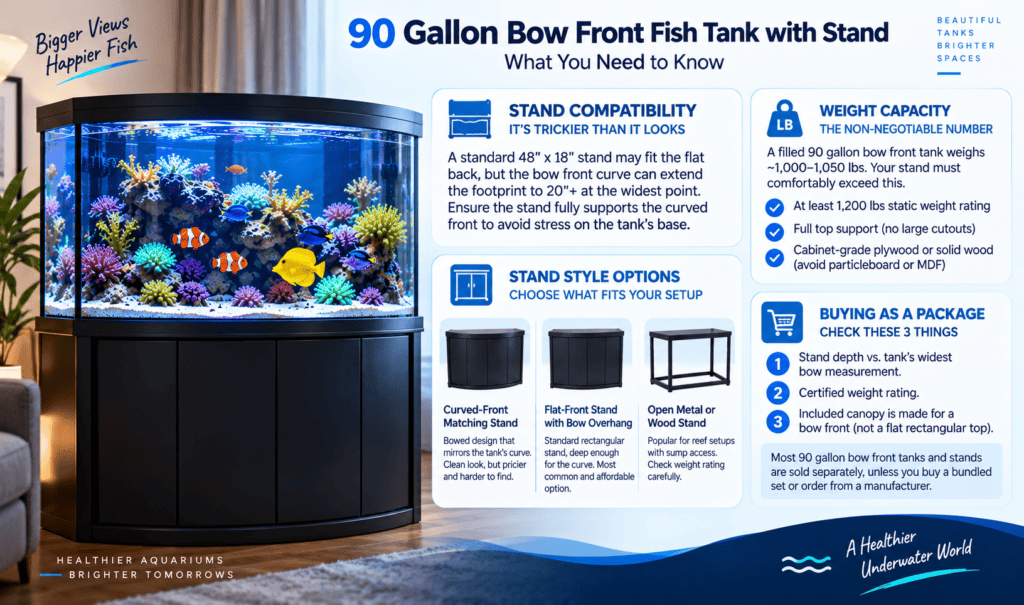
A 90 gallon bow front fish tank with stand is almost always sold as two separate purchases unless you buy directly from a manufacturer that bundles them, or you order a matched acrylic tank-and-stand combo. Getting the stand wrong is one of the most common and most dangerous mistakes new bow front owners make.
Why Stand Compatibility Is Trickier Than It Looks
A standard 48″ x 18″ stand built for a rectangular 90 gallon tank will often fit the flat back edge of a bow front tank’s footprint, but it won’t automatically account for the curved front overhang, which can extend the tank’s true footprint to 20 inches or more at its widest point. If the bow extends past the front edge of the stand without support, you’re putting uneven stress on the tank’s base seam over time. Reputable bow front sellers either include a matched stand or clearly list the required stand depth don’t assume a generic 18-inch-deep stand is safe without checking the bow’s widest measurement against it.
Weight Capacity: The Non-Negotiable Number
A filled 90 gallon bow front tank weighs approximately 1,000–1,050 pounds once you add substrate, rock, and decor. Any stand you use must comfortably exceed this, not just meet it. Look for:
- A stated static weight rating of at least 1,200 lbs from the manufacturer
- Full corner-to-corner top support (avoid stands with large open cutouts on the top panel)
- Cabinet-grade plywood or solid wood construction rather than particleboard or MDF, which can sag under sustained weight
Stand Style Options for Bow Front Tanks
- Curved-front matching stands: Built with a bowed cabinet face that mirrors the tank’s curve the cleanest look, but pricier and harder to find secondhand.
- Flat-front stands with bow overhang: A standard rectangular stand deep enough that the bow’s widest point still sits within the top panel’s support area. This is the most common and most affordable solution.
- Open metal or wood stands: Popular for reef setups needing sump access underneath; require careful weight-rating verification since they distribute load differently than a solid cabinet.
Buying a 90 Gallon Bow Front Fish Tank with Stand as a Package
If you find a 90 gallon bow front fish tank with stand sold together, verify three things before buying: the stand’s actual depth versus the tank’s bow measurement, the stand’s certified weight rating, and whether any included canopy is cut for a bow front’s curved top rather than a flat rectangular one. Mismatched canopies are one of the most common complaints in used-tank marketplace listings.
90 Gallon Aquarium Price: What You’ll Actually Pay
Pricing is where most buyers get blindsided, because a generic “90 gallon aquarium price” search returns numbers for basic rectangular tanks, not the specialty bow front you actually want. Here’s a realistic, itemized breakdown drawn from current tank-only listings, matched stand packages, and complete new-build kits.
Tank-Only Pricing
| Configuration | Estimated Price Range |
|---|---|
| Standard rectangular 90 gallon (glass, no stand) | $350–$700 |
| 90 gallon bow front (acrylic, tank only) | $1,000–$2,200 |
| 90-93 gallon bow front (seamless low-iron glass, tank only) | $900–$1,700 |
| 90 gallon bow front with matched stand and canopy | $1,600–$3,200 |
| 90 gallon bow front, full reef-ready kit (tank, stand, lighting, filtration) | $2,500–$4,500+ |
For reference, a well-documented example — a 93-gallon seamless low-iron glass bow front with a wood stand, canopy, and internal overflow originally listed at roughly $1,700 for the full three-piece package new, which lines up closely with the ranges above.
What Drives the Price Up or Down
- Material: Acrylic and seamless thermally-bent glass bow fronts both command a premium over standard rectangular glass due to the specialized molding or bending process involved.
- Overflow drilling: A reef-ready 90 gallon bow front with a pre-drilled or built-in overflow for a sump costs noticeably more than an undrilled freshwater version.
- Included stand and canopy: A matched stand can add $500–$1,200, and a fitted canopy another $100–$400.
- Brand and build quality: Established builders using thicker panel walls (1/2 inch or more), low-iron glass, or warrantied seams command a premium over unbranded imports.
- New vs. used: Buying a used 90 gallon bow front aquarium for sale through local marketplaces can cut the price by 50–75%, but always inspect for micro-scratches, seam integrity, and any signs of previous leaks before transporting it.
Full Setup Budget: Realistic Total Cost of Ownership
Many buyers only budget for the tank itself and are surprised by the full setup cost. Here’s what a complete 90 gallon bow front fish tank setup realistically runs:
| Item | Estimated Cost |
|---|---|
| Tank (acrylic or seamless glass bow front) | $900–$2,200 |
| Matched stand | $500–$1,200 |
| Canopy or lighting | $150–$500 |
| Filtration (canister or sump system) | $200–$600 |
| Heater(s) | $40–$100 |
| Substrate | $60–$150 |
| Decor and hardscape | $100–$400 |
| Water conditioner, test kit, initial supplies | $50–$100 |
| Total realistic budget | $2,000–$5,250 |
Where to Find a 90 Gallon Bow Front Aquarium for Sale
- Specialty aquarium manufacturers: The most reliable source for a true 90 gallon bow front built to published, verifiable dimensions, typically with a warranty.
- Local fish stores with custom-order programs: Many independent aquarium shops can special-order a bow front at this size even when it isn’t on the sales floor.
- Marketplace listings (local pickup only): Frequently the best value, but budget time to inspect the tank in person both acrylic and seamless glass bow fronts are expensive and risky to ship long-distance without professional freight.
- Aquarium forums and hobbyist classifieds: Often have moving hobbyists selling complete, cycled setups (tank, stand, and sometimes established filtration) at a steep discount compared to buying new.
Complete 90 Gallon Bow Front Fish Tank Setup Guide
Once you’ve secured the tank and stand, the setup process for a bow front follows the same core principles as any large aquarium, with a few bow-specific adjustments.
Step 1: Site Preparation and Stand Leveling
Place the stand in its final location and use a level across both the front-to-back and side-to-side axes. Because a bow front’s curved base seam is more sensitive to uneven pressure than a flat rectangular tank, even a slight lean can create long-term stress on the front panel. Shim the stand’s feet if your flooring isn’t perfectly level, and never set the tank on carpet without a rigid board underneath.
Step 2: Foam Backing and Tank Placement
Lay a sheet of 1/4-inch polystyrene foam (not the crumbly packing kind) across the full stand top before placing the tank. This compensates for any microscopic imperfections in either the stand top or the tank’s bottom panel critical on a bow front, since the curved shape makes visually inspecting the base seam harder than on a flat tank.
Step 3: Plumbing and Equipment Placement (Reef or Sump Setups)
If your 90 gallon bow front is drilled for an overflow, this is the stage to dry-fit your plumbing before adding a drop of water. Test bulkhead seals, dry-run your return pump, and confirm your sump fits the stand’s internal footprint bow front stands sometimes have slightly reduced internal cabinet width compared to rectangular stands of the same external size, since the front curve eats into usable space.
Step 4: Substrate, Hardscape, and Filling
Add substrate in a shallow, even layer, then build your hardscape before adding water. Fill slowly, using a plate or bowl to break the water stream so you don’t disturb your substrate layout. On a bow front, work from the flat back section outward it’s easier to keep hardscape stable near the straight rear glass before extending pieces into the wider, curved front zone.
Step 5: Filtration, Heating, and Cycling
Install your filter and heater, then begin the nitrogen cycle. For a 90 gallon tank, expect fishless cycling to take roughly 4–6 weeks using an ammonia source and regular test-kit monitoring, tracking ammonia, nitrite, and nitrate until ammonia and nitrite consistently hit zero within 24 hours of dosing.
Step 6: Lighting and Final Aquascape Adjustments
Because a bow front’s curved glass slightly distorts light angles compared to a flat panel, center your main light fixture over the tank rather than pushing it toward the back, so light disperses evenly through the bowed front section instead of creating a bright center and dim edges.
Setup Timeline at a Glance
- Day 1: Stand leveling, foam backing, tank placement
- Day 1–2: Plumbing dry-fit and equipment installation
- Day 2: Substrate, hardscape, and filling
- Day 2 onward: Begin fishless cycling
- Week 4–6: Test water parameters; add fish gradually once the cycle completes
- Ongoing: Fine-tune lighting, flow, and aquascape as the tank matures
Best Fish & Stocking Plans for a 90 Gallon Bow Front Aquarium
The extra visual depth of a bow front makes it especially well suited to species that use the full water column and benefit from a wide viewing angle.
Freshwater Community Stocking
A 90 gallon bow front comfortably supports a mixed community such as:
- 8–10 medium tetras or barbs as a mid-water shoal
- 2–3 angelfish, which show off beautifully against the curved front glass
- A small pleco or other algae-eating catfish
- 6–8 corydoras as a bottom-dwelling cleanup crew
- A centerpiece fish like a pearl gourami or a dwarf cichlid pair
Cichlid and Semi-Aggressive Setups
The extra depth at the center of the bow gives territorial fish more usable floor space than a standard rectangular tank of the same gallonage. This makes a 90 gallon bow front a strong choice for:
- A small group of mid-size African cichlids (mbuna or peacocks) with heavy rockwork
- A single large South American cichlid, such as an oscar or a Jack Dempsey, paired with a few hardy dither fish
- A biotope-style setup replicating a rocky lake shoreline, using the bow’s curve to create a natural amphitheater effect
Saltwater and Reef Options
If your tank is drilled for an overflow, a 90 gallon bow front makes an excellent moderate-sized reef display:
- A mixed reef with LPS and soft corals along the wider bow section, where light spread is most even
- A fish-only-with-live-rock (FOWLR) setup featuring 4–6 medium reef fish and a curated rockscape
- A predator tank for a single showcase fish like a lionfish or moray eel, using the bow’s extra width for swimming room
Stocking Table: Bioload Guidelines by Approach
| Stocking Style | Approx. Fish Count | Key Consideration |
|---|---|---|
| Freshwater community | 20–30 small/medium fish | Prioritize mid-water and bottom-dweller balance |
| Single large cichlid display | 1 centerpiece + 4–6 dithers | Heavy filtration and frequent water changes |
| African cichlid colony | 12–18 mbuna/peacocks | Overstocking intentionally to reduce aggression |
| Reef (mixed) | 6–10 fish + coral | Requires sump, protein skimmer, and strong lighting |
| Predator/showcase | 1–2 large fish | Prioritize swimming space over fish count |
Maintenance, Longevity & Common Mistakes
Cleaning the Curved Front Without Scratching It
Bow front glass and especially acrylic scratch more easily along the curve than on a flat panel, because algae scrapers designed for straight lines don’t always sit flush against a curved surface. Use a magnetic or handheld cleaner rated for your tank’s exact material, and always rinse sand or grit off the pad before each pass a single trapped grain is the most common cause of visible arc-shaped scratches on bow front tanks.
Structural Checks Specific to Bow Front Tanks
Because a bow front tank has a curved seam that flat tanks don’t, periodically inspect the silicone along the base and side seams for any bowing, discoloration, or separation, especially in the first six months after setup while the stand and floor settle under the tank’s full weight.
Common Mistakes First-Time Bow Front Owners Make
- Buying a generic rectangular stand without confirming it supports the bow’s widest point, leading to unsupported overhang.
- Underestimating floor clearance, then discovering the tank’s curve makes it stick out further into the room than expected.
- Assuming all 90 gallon bow front fish tank dimensions are identical across brands, then buying a canopy or background that doesn’t fit.
- Skipping the foam backing layer, which matters more on a bow front due to the added stress points along the curved seam.
- Sizing filtration for a flat 90 gallon rather than accounting for the slightly larger surface area a bow front’s curve can add.
Long-Term Care Checklist
- Weekly: 10–15% water change, glass or acrylic cleaning, equipment check
- Monthly: Test kit calibration check, deep-clean filter media, inspect stand for shifting
- Quarterly: Full seam and silicone inspection, deep substrate vacuum, trim or replace worn tubing
- Annually: Replace bulbs or check LED output, service pumps, reassess bioload versus tank capacity
FAQ:
What are the standard 90 gallon bow front fish tank dimensions?
Most 90 gallon bow front tanks measure roughly 48–49 inches long, 12–14 inches deep at the flat ends, 18–20 inches deep at the widest point of the bow, and 24–25 inches tall. Because bow fronts aren’t standardized like rectangular tanks, always confirm exact dimensions with the specific manufacturer before buying a stand or canopy.
How much does a 90 gallon bow front fish tank cost?
Expect to pay $900–$2,200 for the tank alone, or $1,600–$3,200 for a matched tank-and-stand package. A full setup with filtration, lighting, and substrate typically totals $2,000–$5,250 depending on whether you choose freshwater or reef equipment.
Is a 90 gallon bow front tank heavier than a standard 90 gallon tank?
Yes, slightly. A filled 90 gallon bow front weighs approximately 1,000–1,050 pounds due to its added water volume at the curved front, compared to roughly 1,000 pounds for a standard rectangular 90 gallon the difference is minor, but any stand must still be rated well above this weight regardless of shape.
Can I use a regular 90 gallon stand for a bow front tank?
Sometimes, but only if the stand’s depth exceeds the bow’s widest measurement so the curve doesn’t overhang unsupported. A flat rectangular stand built for an 18-inch-deep tank can work if the bow’s widest point stays within that 18 inches, but many bow fronts bulge past it and need a deeper stand.
What fish are best for a 90 gallon bow front aquarium?
A 90 gallon bow front works well for freshwater communities of tetras, angelfish, and corydoras, semi-aggressive setups like a single oscar with dither fish, African cichlid colonies, or if drilled for an overflow a moderate mixed reef display.
Where can I find a 90 gallon bow front fish tank for sale?
Specialty aquarium manufacturers and local fish stores with custom-order programs are the most reliable sources for a true 90 gallon bow front. Marketplace listings for local pickup often offer the best value on used tanks, but always inspect seams and panels in person before purchasing.
How long does it take to cycle a 90 gallon bow front fish tank?
Fishless cycling typically takes 4–6 weeks. You’ll know the cycle is complete when ammonia and nitrite both test at zero within 24 hours of dosing ammonia, while nitrates are present and rising.
Why are 90 gallon bow front tanks harder to find than 72 gallon ones?
Most major glass aquarium manufacturers cap their mass-produced bow front lines at 72 gallons because a curved panel that large is at the practical limit of standard silicone-seamed construction. A true 90 gallon bow front is typically built in acrylic or seamless thermally-bent glass by specialty manufacturers instead of being sold off-the-shelf at big-box pet retailers.
Conclusion:
A 90 gallon bow front fish tank is one of the most striking centerpiece aquariums you can add to a home, but it’s also one of the least standardized which is exactly why doing your homework on dimensions, stand compatibility, and true setup cost matters before you buy.
Three takeaways to remember: first, real 90 gallon bow front fish tank dimensions vary by manufacturer and the bow actually narrows at the ends before bulging out at the center, so always confirm exact measurements rather than assuming a generic chart applies to your specific tank. Second, budget for the full setup, not just the tank a complete 90 gallon bow front fish tank setup with a matched stand and proper filtration realistically runs $2,000 to $5,250. Third, because true 90 gallon bow fronts are mostly acrylic or semi-custom seamless glass, take extra time sourcing from a reputable manufacturer, local fish store, or verified used listing rather than assuming this size is as easy to find as a standard rectangular 90 gallon.
Ready to move forward? Start by measuring your space against the footprint guidelines above, then request exact 90 gallon bow front aquarium dimensions from your chosen seller before you buy a stand, canopy, or any accessories it’s the single step that prevents almost every headache first-time bow front owners run into.
Note on sourcing: Dimensions and prices in this guide are compiled from publicly available manufacturer listings, retailer specifications, and verified marketplace sale postings current as of 2026. Because bow front tanks are not built to a single industry standard, always confirm exact measurements and pricing directly with your chosen seller before purchasing a stand, canopy, or accessories.
